Pragmatic politics focused on the public interest for those uncomfortable with America's two-party system and its way of doing politics. Considering the interface of politics with psychology, cognitive biology, social behavior, morality and history.
Etiquette
DP Etiquette
First rule: Don't be a jackass. Most people are good.
Other rules: Do not attack or insult people you disagree with. Engage with facts, logic and beliefs. Out of respect for others, please provide some sources for the facts and truths you rely on if you are asked for that. If emotion is getting out of hand, get it back in hand. To limit dehumanizing people, don't call people or whole groups of people disrespectful names, e.g., stupid, dumb or liar. Insulting people is counterproductive to rational discussion. Insult makes people angry and defensive. All points of view are welcome, right, center, left and elsewhere. Just disagree, but don't be belligerent or reject inconvenient facts, truths or defensible reasoning.
Evidence the House Committee on the 1/6 coup attempt makes clear, once again, is (i) the iron grip that Christian nationalism has on elite Republicans, and (ii) how deeply opposed to democracy and secularism CN dogma actually is. Former counsel Greg Jacob to Vice President Mike Pence said this without one shred of recognition of what he was actually saying about democracy or the US Constitution:
Q (paraphrasing): We heard that you and VP Pence started 1/6 with a prayer because you thought you were facing danger. How did your faith guide you on 1/6? (a grossly incompetent and stupid way for Mr. Aguilar to ask about this -- he is clueless about what he is doing and how to do it)
Jacob (paraphrasing): I pulled out my Bible, read through it and just took great comfort. In Daniel 6, Daniel had become the 2nd in command and looked to God for guidance.
Jacob didn't think to look to the US Constitution or the rule of law for guidance. He looked to God. And the incompetent idiot Aguilar let Jacob off the hook.
The only thing worse than incompetent Democrats is incompetent, neo-fascist Republicans. It's long past time for regime change. Current evidence suggests that maybe it's already too late.
Point 11 of Rick Scott's 11 point pro-pollution plan to
"save America" by giving it to ruthless capitalists to freely exploit
The weather is always changing. We take climate change seriously, but not hysterically. We will not adopt nutty policies that harm our economy or our jobs. -- Republican Senator Rick Scott making his only statement about climate change in his 11 point plan; Scott means this literally in defense of pollution and polluters; taking climate change seriously means stopping the federal government from trying to deal with pollution and climate change; to pro-pollution Republicans it is nutty and hysterical for government to even try to deal with climate change and pollution
The Republican Party has been staunchly pro-pollution, climate denier and anti-environment for years. It isn't just blind opposition. Included in the Republican pro-pollution political-commercial movement is an intelligent, focused legal strategy that could mostly neuter the capacity of American law to nudge us toward a pro-environment legal and regulatory climate. The New York Times writes:
Republican Drive to Tilt Courts Against Climate Action Reaches a Crucial Moment
A Supreme Court environmental case being decided this month is the product of a coordinated, multiyear strategy by Republican attorneys general and conservative allies.
WASHINGTON — Within days, the conservative majority on the Supreme Court is expected to hand down a decision that could severely limit the federal government’s authority to reduce carbon dioxide from power plants — pollution that is dangerously heating the planet.
But it’s only a start.
The case, West Virginia v. Environmental Protection Agency, is the product of a coordinated, multiyear strategy by Republican attorneys general, conservative legal activists and their funders, several with ties to the oil and coal industries, to use the judicial system to rewrite environmental law, weakening the executive branch’s ability to tackle global warming.
Coming up through the federal courts are more climate cases, some featuring novel legal arguments, each carefully selected for its potential to block the government’s ability to regulate industries and businesses that produce greenhouse gases.
“The West Virginia vs. E.P.A. case is unusual, but it’s emblematic of the bigger picture. A.G.s are willing to use these unusual strategies more,” said Paul Nolette, a professor of political science at Marquette University who has studied state attorneys general. “And the strategies are becoming more and more sophisticated.”
The plaintiffs want to hem in what they call the administrative state, the E.P.A. and other federal agencies that set rules and regulations that affect the American economy. That should be the role of Congress, which is more accountable to voters, said Jeff Landry, the Louisiana attorney general and one of the leaders of the Republican group bringing the lawsuits.
But Congress has barely addressed the issue of climate change. Instead, for decades it has delegated authority to the agencies because it lacks the expertise possessed by the specialists who write complicated rules and regulations and who can respond quickly to changing science, particularly when Capitol Hill is gridlocked.
West Virginia v. E.P.A., No. 20–1530 on the court docket, is also notable for the tangle of connections between the plaintiffs and the Supreme Court justices who will decide their case. The Republican plaintiffs share many of the same donors behind efforts to nominate and confirm five of the Republicans on the bench — John G. Roberts, Samuel A. Alito Jr., Neil M. Gorsuch, Brett M. Kavanaugh and Amy Coney Barrett.
“It’s a pincer move,” said Lisa Graves, executive director of the progressive watchdog group True North Research and a former senior Justice Department official. “They are teeing up the attorneys to bring the litigation before the same judges that they handpicked.” The pattern is repeated in other climate cases filed by the Republican attorneys general and now advancing through the lower courts: The plaintiffs are supported by the same network of conservative donors who helped former President Donald J. Trump place more than 200 federal judges, many now in position to rule on the climate cases in the coming year.
At least two of the cases feature an unusual approach that demonstrates the aggressive nature of the legal campaign. In those suits, the plaintiffs are challenging regulations or policies that don’t yet exist. They want to pre-empt efforts by President Biden to deliver on his promise to pivot the country away from fossil fuels, while at the same time aiming to prevent a future president from trying anything similar.
That is truly an aggressive pro-pollution, anti-climate legal strategy the Republican laissez-faire capitalists have dreamed up. The propaganda is, as usual, based on fomenting fear based on both lies of commission and lies of omission.
It's not just abortion that neo-fascist Republican elites are going after. Their goals are huge. They want to change society, government, religion and commerce. Neo-fascist Republicans intend to force major social engineering changes on all of those targets.
What about pro-pollution Democrats?
As we all know, Joe Manchin is a staunchly pro-pollution Senator who defends coal and oil industry interests, which heavily fund him. His shameless conflicts of interest are off the charts. Democratic leadership made Manchin the Chairman of the Senate Energy and Natural Resources Committee. That gives him enormous power to defend polluters and pollution. Manchin's government propaganda page says this about him:
Senator Joe Manchin (D-W.Va.) is proud to represent West Virginia on four critical Senate committees that will tackle the important work of addressing our nation’s energy needs, standing up for members of the military, honoring our veterans and finding commonsense solutions to boost economic prosperity.
Senator Manchin is proud to serve as Chairman of the Senate Energy and Natural Resources Committee, where he will fight for a commonsense, balanced energy approach that recognizes West Virginia’s critical role in our nation’s energy future and helps us achieve energy independence within a generation. Senator Manchin believes it is imperative that this country develops an energy policy that focuses on security by reducing our dependence on foreign oil. Every state must do its part to use its resources – whether it’s clean coal and natural gas or wind and solar – to make energy independence a reality. Senator Manchin will always stand up for energy policies that are good for West Virginia jobs, America’s security and our way of life.
Well, there you have it. How could anyone stand in the way of dirty energy? Our precious security and very way of life are threatened by even trying to deal with climate change.
With pro-pollution Democrats like Manchin in charge of the federal non-response to climate change and pollution, who needs pro-pollution Republicans like Rick Scott? They use the same kind of language to downplay climate change, deflect from its seriousness and protect big polluters, while taking campaign contributions from big polluters in return for politician loyalty.
The environment is to be exploited, damaged as much needed and convenient, and the wealth flowing from capitalist environmental rape trickled up to the elites at the top and right into their big, fat bank accounts.
What about us common folks? People can either just go pound sand if they don't like it, or continue to vote for corrupt Republicans and Democrats if they do.
Q: Does anyone see a pattern in the propaganda here?
Hint: The tactics are the same for polluters, corrupt politicians (Democrats and Republicans), authoritarian demagogues, Christian zealots, ruthless capitalists with no social conscience, QAnon conspiracy crackpots, haters, liars, traitors, etc.
A: Yes, there is a pattern. Because it works so well, it is repeated over and over and over.
Primary vote-share matters for the general election.
Observers look at primary elections as a separate species from general elections. Primaries are viewed both as a signal of which direction a party is headed as well as a determining factor in the outcome of the general election. But we should also pay attention to the partisan composition of primaries, because data shows that the partisan makeup of primaries has been strongly predictive of the final popular vote for the last 15 years.
This implies two tentative conclusions. First, that votes in a primary are not just about how contested the primary is. That is, parties don’t get more votes solely because their primary has a competitive race. Instead, there is a deeper mechanism going on which speaks to voter enthusiasm. When the general election is still months away, primary voters may be expressing their underlying inclinations by voting in the relevant partisan primary, particularly in open primary states where they have freedom to choose which primary they vote in.
Second, this data is interesting because of when primaries happen. Most occur between May and July. The conventional wisdom says that independent voters only tune in and make choices around Labor Day. But the link between primary turnout and general election vote-share suggests that in fact, many voters have made up their minds by mid-summer.
In trying to analyze the correlation between the primary and the general election, we have considered the cycles from 2006 onwards. This is because prior to the turn of the century, Democrats dominated the southern primary vote to such a degree that it skewed the entire country’s numbers and Republicans had no equivalent counterbalance. However, as voters began to shed historical party attachments, the correlation became stronger and stronger. By 2006, it began to have real predictive value.
Below, we plot the Democratic vote share in primaries against the vote share that they earned in the general election, for elections from 2006 to 2018. We see a clear pattern—the better a party’s relative primary turnout, the better their general election performance.
A plot comparing Democratic primary vote share to Democratic general election vote share, from 2006-2018 (2012 was omitted due to several states canceling their Democratic primaries and giving the delegates to President Obama).
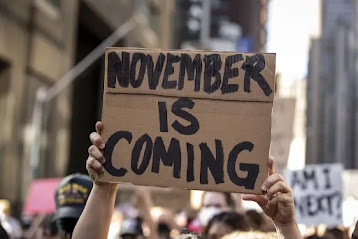
In 2006, 2008, and 2018, Democrats dominated primary turnout. They won all three of these general elections by 7 points or more in November. In 2010 and 2014, Democrats saw abysmal primary turnout. Both of those years were Republican waves. With the caveat that the sample size here is small, the correlation does suggest that primary turnout foreshadows voter attitudes for November.
With this tentative link in mind, let’s look at what this thesis would suggest for the 2022 midterms. The current primary season is not over, but the initial data is suggestive. So far, we can track primary turnout in 15 states and make reasonable comparisons to their 2018 primary turnout. In 2018 Republicans outvoted Democrats in those states by 12 points. So far in 2022, Republicans are outvoting Democrats in those same states by 26 points. That 14 point increase for Republicans suggests a good, though perhaps not dominant, environment for them.
However, those numbers don’t tell the whole story. Instead of looking at the overall margin in these states, we can also look at the average margin, which avoids giving extra weight to states that cast more votes. In these fifteen states, in 2018, Republicans outvoted Democrats in the primary by an average of 11 points. In 2022, that average has grown to 31, an increase of 20 points. This would suggest a November 2022 environment more in line with the Republican waves of 2010 or 2014.
Both sets of numbers have merit. The first number gives a more accurate view of what is going on in the aggregate—Republicans are increasing their primary vote share, if not as dramatically as one might expect. But the second number is useful as well. Republicans lag on the first metric because Democrats have seen their primary numbers hold up very well in both Pennsylvania and Texas, and both states cast large numbers of votes. But it is not necessarily clear that Democrats will continue to do well in large states that cast a lot of votes. With about 30 primaries left, it is possible that the variation buoying Democrats here will start to fade.
So what does that tell us about 2022? If Republicans finish the primary season only doing 14 points better than they did in 2018, it would mean they outvote Democrats by 3 points overall in primary vote share. This is enough of a swing to give Republicans an edge, but not a major one in line with a wave election. Using historical data, we would project that Republicans would win the popular vote by around 3 points, depending on the model. However, if Republicans instead end up doing roughly 20 points better in primary vote share, we would project a popular vote win of up to 7 points, which is closer to their 2010 landslide.
In either case, however, the environment does appear to be significantly more Republican in 2022 than in any election cycle since 2014. This means that Democratic candidates seeking to hang on in marginal or GOP-leaning districts would probably need to win by flipping many voters who would otherwise be predisposed to vote Republican. Thus, a Democratic candidate’s crossover strength will be at a premium, because the environment will likely create an electorate that is much more Republican than either 2018 or 2020.
And in an era where crossover voting is plummeting rapidly, such candidates are becoming rarer and rarer.
The AP writes in an article entitled, Jan. 6 witnesses push Trump stalwarts back to rabbit hole:
One by one, several of Donald Trump’s former top advisers have told a special House committee investigating his role in the Jan. 6 insurrection that they didn’t believe his lies about the 2020 election, and that the former president knew he lost to Joe Biden.
But instead of convincing Trump’s most stalwart supporters, testimony from former attorney general Bill Barr and Trump’s daughter Ivanka about the election and the attack on the U.S. Capitol is prompting many of them to simply reassert their views that the former president was correct in his false claim of victory.
Barr’s testimony that Trump was repeatedly told there was no election fraud? He was paid off by a voting machine company, according to one false claim that went viral this week. Ivanka Trump saying she didn’t believe Trump either? It’s all part of Trump’s grand plan to confuse his enemies and save America.
The claims again demonstrate how deeply rooted Trump’s false narrative about the election has become.
Continuing dark free speech from the radical right leads to false beliefs and hate that will lead to more violence. The Washington Post writes:
One of two Republican members of the House committee investigating the attack on the U.S. Capitol on Jan. 6, 2021, starkly warned Sunday that his own party’s lies could feed additional violence.
“There is violence in the future, I’m going to tell you,” said Rep. Adam Kinzinger (R-Ill.), on ABC’s “This Week.” “And until we get a grip on telling people the truth, we can’t expect any differently.”
Kinzinger, who defied party leadership by serving on the Democratic-led committee, described an alarming message he received at home in the mail several days ago threatening to execute him, his wife and their 5-month-old baby.
Public officials have been inundated with threats in recent months, many spurred by former president Donald Trump’s continued obsession with the baseless claim that his 2020 loss was the result of a vast conspiracy of fraud. The Washington Post last year tracked how election administrators in at least 17 states received threats of violence in the months after the Jan. 6 attack, often sparked directly by comments from Trump.
Sooner or later, the ex-president's vitriol and lies will lead to more violence than he has already incited. The Republican Party is not backing down one iota. It is digging in and planning for continuing and intensifying its all-out war against democracy, civil liberties, secularism, pluralism, truth and the separation of church and state.
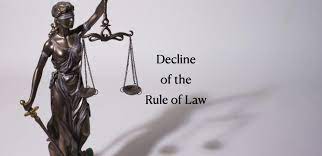
Worse, some professional news sources are starting to report that it will be hard or impossible to convict the ex-president of any his crimes associated with his 1/6 coup attempt. The rule of law is in full blown failure in the face of professional white collar criminals and traitors. Plausible deniability and subverted judges protect them.
If nothing from 1/6 is prosecutable, that leaves the felony obstruction of justice crimes the ex-president committed during the Mueller investigation. There is no hint that Merrick Garland and his DoJ has any interest in prosecuting those crimes. That leaves probably all of the ex-president's crimes as big, fat nothingburgers in the blind eyes of American law.