Etiquette


DP Etiquette

First rule: Don't be a jackass. Most people are good.

Other rules: Do not attack or insult people you disagree with. Engage with facts, logic and beliefs. Out of respect for others, please provide some sources for the facts and truths you rely on if you are asked for that. If emotion is getting out of hand, get it back in hand. To limit dehumanizing people, don't call people or whole groups of people disrespectful names, e.g., stupid, dumb or liar. Insulting people is counterproductive to rational discussion. Insult makes people angry and defensive. All points of view are welcome, right, center, left and elsewhere. Just disagree, but don't be belligerent or reject inconvenient facts, truths or defensible reasoning.

Tuesday, October 31, 2023

What's TOO SMALL?


Trademark law and First Amendment clash in Supreme Court review of ‘Trump too small’ T-shirts

A trademark fight at the Supreme Court will dredge up a viral moment during the 2016 Republican presidential primary.

WASHINGTON (CN) — A lawyer wants the Supreme Court to allow him to profit from making fun of former President Donald Trump. 

This coming week, Steve Elster’s fight to trademark “Trump too small” on T-shirts will be argued in front of the nine justices — three of which were nominated to the high court by the very man Elster seeks to gibe. 

The joke traces its origins to the 2016 U.S. presidential primaries, when the size of Trump’s hands turned into a national joke. Senator Marco Rubio was seemingly unimpressed with Trump’s characterization of him as “Little Marco,” throwing out his own insult. 

“You know what they say about men with small hands,” Rubio quipped during a campaign stop. 

Trump took the liberty of clearing the issue up at the next presidential debate. 

“I guarantee you there’s no problem,” Trump said while showing his hands to the audience. 

The viral moment inspired Elster to create shirts and hats emblazoned with “Trump too small.” Alongside the double entendre, Elster planned to include an illustration of a derogatory hand gesture as political commentary about “the smallness of Donald Trump’s overall approach to governing as president of the United States.”

Although those involved in the matter might appreciate the Supreme Court’s seal of approval over who bested the other, the justices are unlikely to comment on the debacle. 

“Despite outward appearances, this case is really not about Trump or the size of his policies or (body parts),” Fara Sunderji, a trademark attorney with Dorsey & Whitney, said. 

Instead, the justices’ arguments on Wednesday will cover the intersection between trademark law, the First Amendment, and rights to privacy. 

Elster wanted to trademark his idea and although it was unique, the U.S. Patent and Trademark Office denied his request. The government cited a section of trademark law that prohibits marks on public officials' names without their consent. According to the government, this is a way to avoid confusing customers who might think the shirt was connected to Trump himself. 

Although Elster argued the message on the shirt should be enough to tell customers Trump had no hand in making the product, the appeals board still denied Elster’s mark because it needed to protect Trump’s rights to privacy and publicity. 

The federal circuit did not see eye to eye with that reasoning, reversing and finding that Elster’s free speech rights had been violated. 

The government appealed to the Supreme Court, asking if the First Amendment is violated when the patent office refuses to offer trademarks that contain criticism of a government official. According to the government, the patent office uses a viewpoint-neutral condition when offering trademarks. 

“As a viewpoint-neutral bar on federal trademark registration, Section 1052(c) is a condition on a government benefit, not a restriction on speech,” U.S. Solicitor General Elizabeth Prelogar wrote. “Refusal of registration under Section 1052(c) does not limit the rights of trademark owners to use their marks in commerce or to engage in whatever speech they wish. The only effect of the refusal is to deny an owner the benefits — i.e.,  additional mechanisms to prevent use of the same mark by competitors — that federal registration provides.” 

Elster says Congress’ desire to protect important people’s names has allowed them to avoid criticism. 

“So, under the clause, JOE 2020 has been registered, but not ‘No Joe in 2024,’” Jonathan Taylor, an attorney with Gupta Wessler representing Elster, wrote. “HILLARY FOR AMERICA has also been registered. But not ‘Hillary for Prison 2016.’ And BIDEN PRESIDENT is registered, while ‘Impeach 46’ was denied.” 

Both sides of the aisle argue siding with the other stifles speech. The government says allowing these kinds of trademarks will chill speech by giving one person a monopoly over the criticism

“​​The anomalous effect of the court of appeals’ decision is to vest respondent with a First Amendment right to prevent others from speaking and to obtain the government’s assistance in that endeavor, notwithstanding Congress’s decision to exclude respondent’s own mark from eligibility for the benefits that federal registration confers,” Prelogar wrote. “And it is particularly strange to treat the political character of respondent’s message as a factor supporting that result.” 

Elster argues that not receiving a trademark because of the content of his speech is itself an effort to chill speech. 

“Because no one would ever consent to the registration of speech that insults them, the clause effectively precludes the registration of all marks that disparage or criticize living people,” Wessler wrote. “That viewpoint-based effect only further reinforces the need for scrutiny.” 

The Motion Picture Association of America weighed in on the debate, urging the justices to avoid a broad ruling that could stifle its ability to create expressive works. 

“If people could wield the right of publicity as a veto against their depiction in expressive works, then filmmakers would be required to obtain the consent of every living person they portray on film, likely by paying them for the privilege,” Susan Kohlmann, an attorney with Jenner & Block representing the group, wrote. “Some individuals wouldn’t grant permission at any price, rendering certain works about real people impossible to make.” 

The justices will hear oral arguments in the case on Nov. 1. 

https://www.courthousenews.com/trademark-law-and-first-amendment-clash-in-supreme-courts-review-of-trump-too-small-t-shirts/


1. How will the Supremes rule?
2. How should the Supremes rule - in your humble opinion? 


Monday, October 30, 2023

"We Are Overpaying the Price for a Sin We Didn't Commit"-- a Moral perspective on the Israel-Gaza war

This article by Nicholas Kristof was published in the NYT on 10/28.  Whether one agrees with everything he says or not, Kristof encourages readers to look at the moral dimensions of unfolding events. He spent a week in Israel conducting interviews with victims of Hamas, politicians on all sides including former PM Ehud Barak,  Israeli Palestinians,  and he also cites a survey of Israeli public opinions from 10/18-19 which reveals some disturbing findings. On X (formerly Twitter), he posted videos of several of the very affecting interviews he conducted. The link to the public opinion survey of Israelis fr 10/18-19 is in the article below.


‘We Are Overpaying the Price for a Sin We Didn’t Commit’

A photograph of a person holding an orange jug and carrying an orange mattress on their back as they walk through rubble, twisted metal wires and damaged buildings.
Gaza City.Credit...Ahmad Hasaballah/Getty Images


The most consequential decision Israel will face in the coming days is how hard to continue hitting Gaza. Should it undertake a monthslong ground invasion? Continue with large-scale aerial bombardment? Allow fuel into Gaza to keep hospitals running?

Over the last week that I’ve spent reporting in Israel and the West Bank, I’ve tried to listen and learn. So let me share why I believe we’ll someday look back at this moment and see a profound moral and policy failure.

But let me start with someone smart who has a different take.

Ehud Barak, the former Israeli general, defense minister and prime minister, knows more about the military challenges of taking on Gaza than almost anybody. In 2009 he oversaw a major ground offensive against Hamas. I dropped by his home in Tel Aviv, and we sat in his office, surrounded by his collection of framed cartoons mocking him — he has a thick skin — as he argued in favor of a ground invasion as the only way to crush Hamas.

“There is no way but to send many tens of thousands of boots on the ground,” he said, but he acknowledged that this will be a prolonged and bloody task. He estimated that there is a 50 percent chance that it will lead to a war with Hezbollah in the north, plus some risk of attacks from militias on the Syrian side of the Golan Heights and of serious unrest on the West Bank.

Barak also warned that after a number of months when Israel might be ready to withdraw from Gaza, it could have trouble handing the territory over to someone else. But it’s conceivable, he said, that Israel could find a multilateral Arab force to take over Gaza and that this force could eventually transfer control of the territory to the Palestinian Authority. On balance, he thinks that it is possible for Israel to destroy most of Hamas’s capabilities, establish a no-go zone along the border and extricate itself.

For my part, I’m skeptical that either the invasion or the handover would go well, partly because I’ve observed so many military operations that started optimistically and ended as bloody quagmires. But Barak also made another important point: Israel will now finally end Prime Minister Benjamin Netanyahu’s policy of bolstering Hamas.

What? Israel supported Hamas?

Yes, under Netanyahu, Israel approved the transfer of over $1 billion to Gaza from Qatar — intended to cover expenses such as salaries and energy costs — but some funds reached Hamas’ military wing, Ha’aretz reported. (Qatar has denied that the money was misused.) Netanyahu’s aim, according to Barak and others, was to buttress Hamas so as to weaken the rival Palestinian Authority and undermine any possibility of a two-state solution. “Those who want to thwart the possibility of a Palestinian state should support the strengthening of Hamas and the transfer of money to Hamas,” Netanyahu reportedly said in 2019.

That monetary lifeline to Hamas will now surely be cut, and that may hurt the organization as much as any number of bombs.

Israel has the right to defend itself and strike military targets in Gaza, and there should be strong international pressure on Hamas to release its hostages. My reporting in Gaza over the years convinces me that Gazans themselves would be much better off if Hamas could be removed: Some American liberals don’t appreciate how repressive, misogynistic, homophobic and economically incompetent Hamas is in Gaza, to say nothing of its long history of terror attacks on Israel. All this explains why many Gazans are fed up with Hamas.

“Hamas spends money building tunnels, not investing in people,” a Gaza woman told me. She was stuck in Jerusalem, where her young son was receiving cancer treatment at a Palestinian hospital.

The despair in Gaza, she said, is such that for years some young men have simply dreamed of becoming “martyrs” and winning honor by killing Israelis.

“In Gaza, there is no hope,” she said. “There is no life, there is nothing we have from living in Gaza. The only thing people can do is become a martyr.”

The woman, whom I’m not identifying for fear of retaliation by Hamas, says that she is against the killing of civilians on either side and that now she weeps each day as she follows the bombing of Gaza and wonders if her husband and other children there will survive. Her son with cancer was sitting a few feet away, watching videos on his mom’s phone, and I looked over to see what he was watching.

It was TikToks of his neighborhood being bombed.

He was glued to the screen as videos showed areas the size of multiple football fields near his home turned into rubble; satellite imagery shows other large areas pulverized as well. No one knows how many people are caught in the wreckage, but some Gazans told me they had heard cries from inside collapsed buildings. They lack proper equipment to rescue people, so eventually, the cries stop, and a stench rises.

Despite her own opposition to Hamas, the woman said that anger at the Israeli attacks will probably boost support for Hamas in the territory.

One well-educated young woman inside Gaza, Amal, told me over WhatsApp that the victims she knew of were mostly civilians, and she sounded full of despair.

“Constant bombardment has me feeling as if I am not human anymore, as if our souls mean nothing at all,” she told me. “We are being massacred.”


A 16-year-old girl in Gaza offered this message, conveyed through Save the Children: “It’s like we are overpaying the price for a sin we didn’t commit. We were always with peace and will always be.”

As Israel stands poised to escalate the war, there are two arguments to think through. The first is pragmatic: Can a siege and large-scale ground invasion succeed in erasing Hamas?

I’m skeptical, and when I hear backers of an invasion speak of removing Hamas, I have the same sinking feeling as when I heard hawks in 2002 and 2003 cheerily promising to liberate Iraq. Just because it would be good to eliminate a brutal regime doesn’t mean it is readily achievable; the Taliban can confirm that.

The answers to the question of who will take over a battered Gaza after months of warfare also seem too iffy to me. It won’t be Egypt, said the former Egyptian foreign minister Nabil Fahmy.

“I can’t imagine any international force being ready to take on what’s left there,” Fahmy told me. He thinks an Israeli invasion is unlikely to destroy Hamas and is more likely to inflame radicalism in Gaza, and he warns that President Biden has damaged American standing in the region because of his perceived indifference to Palestinian lives.

The second prism through which to consider the Gaza war is a moral one, for we have values as well as interests. Decades from now when we look back at this moment, I suspect it’s the moral failures that we may most regret — the inability of some on the left (and many in the Arab world) to condemn the barbaric Oct. 7 attacks on Israelis, and the acceptance by so many Americans and Israelis that countless children and civilians must pay with their lives in what Netanyahu described as Israel’s “mighty vengeance.”

When Israeli Jews were asked in a poll whether the suffering of Palestinian civilians should be taken into account in planning the war on Gaza, 83 percent said “not at all” or “not so much.” I can’t help feeling that while we say that all lives have equal value, President Biden has likewise greatly prioritized Israeli children over Gazan children.

I give Biden great credit for promptly moving two aircraft carrier groups to the region, to help deter Hezbollah or others from joining the war. The White House was right to condemn the “grotesque” and “antisemitic” messages on some college campuses. And Biden’s compassion for victims of the Hamas attacks was so heartfelt that he built up political capital in Israel — but so far he hasn’t leveraged it to get significant aid into Gaza.

The United Nations Secretary General, António Guterres, has condemned what he called “clear violations of international humanitarian law that we are witnessing in Gaza.” The Biden administration, which in the context of Ukraine constantly speaks of international law, vetoed a Security Council resolution calling for humanitarian pauses to deliver aid.

Every account I’ve heard from Gaza this past week, including directly from people there who despise Hamas, suggests that the civilian toll there has been horrendous. One gauge is that at least 53 United Nations staff members have been killed so far, including teachers, an engineer, a psychologist and a gynecologist. More than 20 journalists have been killed, too, and an Al Jazeera correspondent lost his wife, son, daughter and grandson to an airstrike.

And now the suffering in Gaza is set to get much worse.

That’s partly because hospitals are running out of diesel fuel, and Israel is not allowing fuel into the territory. I understand the reason: Hamas could use diesel fuel for its attacks on Israelis, and an Israeli military spokesman also told me that United Nations alarmists may be exaggerating the shortage. Yet if hospitals lack fuel and cannot operate generators, babies in incubators may die along with people needing dialysis or surgeries. Some 50,000 pregnant women in Gaza would face greater risks if hospitals can’t take them.

“We are on the brink of collapse,” Philippe Lazzarini, who runs the United Nations agency for Palestinian refugees, the largest aid agency in Gaza, told me.

Dr. Hussam Abu Safiya, the lead physician in Gaza for the aid group MedGlobal, put it this way, “When the fuel runs out tomorrow, this hospital will rapidly become a mass grave.”

Because of the siege, Gaza is also running out of insulin and anesthetic, according to Dr. Tedros Adhanom Ghebreyesus, director general of the World Health Organization.

Fadi Abu Shammalah, who works in Gaza with a civil society organization called Just Vision, visited the United States this year at the invitation of the State Department, presumably because he was seen as a potential bridge across cultures. “I love you,” he told me over the phone, speaking of Americans. “You are so kind to me.”

I thanked him but noted that we were also providing some of the bombs being dropped near him. He said he doubted that the Americans he so admired understood how the war was actually playing out against civilians.

“Is it a war against Hamas, really?” he asked. “Or it’s against my kids?” He said that as bombs dropped, he tried to calm his terrified children by saying that if they could hear the explosions, they were safe; it’s the bombs you never hear that kill you. That backfired; when there was silence, the children feared they were about to be obliterated.

“One of the reasons the Oct. 7 attacks were so horrible was because adult men slaughtered children,” said Sari Bashi of Human Rights Watch. “But adult men are slaughtering children every day in Gaza by dropping bombs on their homes.”

Israel faces an agonizing challenge: A neighboring territory is ruled by well-armed terrorists who have committed unimaginable atrocities, aim to commit more and now shelter in tunnels beneath a population of more than two million people. It’s a nightmare. But the sober question must be: What policies will reduce the risk, not inflame it, while honoring the intrinsic value of Palestinian life as well as Israeli life?

People will answer that question in different ways, and I don’t claim to have all the answers. But I think someday we will look back in horror at both the Hamas butchery in Israel and at the worsening tableau of suffering in Gaza in which we are complicit.


News bits: TDS is real; Regarding the 2020 census

The radical right refers to Trump Derangement Syndrome as people who criticize DJT. I use it to refer to Trump’s actual mental derangement. For example, Trump recently said Biden threatened to lead the US into “world war two”, and Trump said he thought he had beaten Barack Obama for the presidency back in 2016. That’s nuts.

Trump also remarked that “U.S.” and “us” are spelled the same and noted that he’d “just picked that up.” “Has anyone ever thought of that before?” he asked the crowd. “Couple of days, I’m reading, and it said ‘us.’ and I said, you know, when you think about it, us equals U.S. Now if we say something genius, they will never say it.”  
He says he was never indicted: “We did nothing wrong,” Trump said. “This is all Biden’s stuff … I was never indicted. You practically never heard the word.”
Trump spokesperson Liz Harrington said the former president just doesn’t understand why attorneys Jenna Ellis, Sidney Powell and Ken Chesboro would plead guilty.

Trump’s Spokesperson says he is “confused” about why Sidney Powell, Jenna Ellis, and Ken Chesebro would plead guilty because they are lawyers and should’ve known there was no case. pic.twitter.com/57SF8uUai8 — Ron Filipkowski (@RonFilipkowski)  October 29, 2023

“I think [Trump is] a little confused because if you’re a lawyer, you know there’s no crimes here,” said Harrington, who is a journalist, not a lawyer. “According to the law, there’s literally nothing to plead guilty to because there’s nothing that was — no laws that were broken.
_______________________________________________
_______________________________________________

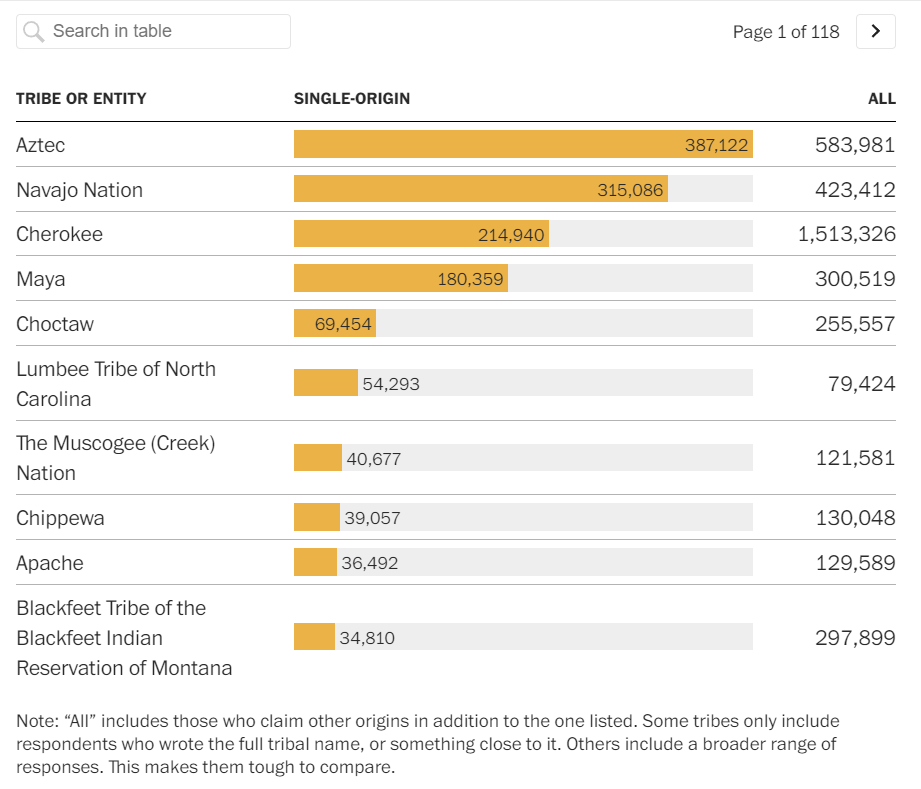
At Detailed Demographic and Housing Characteristics File A, the US census bureau  released detailed 2020 census data for Native American groups or tribes. The result was surprising, but hard to explain. The NYT comments about the data:
The report provides the most detailed data we’ve ever had on America’s racial and ethnic origins, including stunningly exhaustive data on nearly 1,200 tribes, native villages and other entities. We hoped it would shed light on one of the biggest mysteries in the 2020 Census: Why did the Native American population skyrocket by 85 percent over the past decade?  
From the 1870s until the 1960s, the federal government ran brutal boarding schools designed to assimilate Indigenous children. Then came the tribal-termination era of the 1950s and ’60s when the government encouraged Indigenous people to pack up and move to the city. Under the so-called Voluntary Relocation Program, Maxim told us, the U.S. Bureau of Indian Affairs would terminate a tribe’s federal recognition, “divide up the reservation, sell it off to the settlers and give the tribal members a one-time cash payment and a one-way ticket to the city.” It broke Native social ties and led to more marriages to outsiders.

That heartbreaking history helps explain why Native Americans are more likely to have a mixed heritage. But it doesn’t explain the giant increase in numbers in recent years. 
Slightly muddled counts of Native American origins

Sunday, October 29, 2023

Random thoughts

I started commenting at Faux News a couple of weeks ago. Today, I was unable to comment. I've been canceled again by America's authoritarian radical right propaganda Leviathan (even bigger than a Kraken!). That makes 10 different sites that have canceled me. And the radical tyranny supporters complain about their free speech being canceled. 


Vox comments about the disaster called the Middle East:
Palestinians fear they’re being displaced permanently. 
Here’s why that’s logical.

In Israel, calls to expel Palestinians have become increasingly mainstream. Many believe an expulsion like the 1948 Nakba is possible

Since Hamas’s deadly attack on Israel on October 7, 1.4 million people have been displaced in Gaza following Israeli orders to flee south, according to the United Nations. That’s over 60 percent of the Gaza Strip’s population. In wartime, civilians sometimes have to flee an area until it’s safe to return. .... But many Palestinians worldwide fear that those who are trying to escape the fighting in Gaza will never be able to return to their homes. The displacement, they worry, will become a permanent exile.  
Most of the 2.1 million Palestinians in Gaza aren’t originally from Gaza. They’re the children or grandchildren of the more than 700,000 refugees who were expelled or forced to flee their homes in what is now Israel during the 1948 war that led to the country’s creation. This 75-year-old expulsion — which Palestinians call the Nakba, Arabic for “catastrophe” — is not a long-faded memory. It’s a deeply felt, visceral, and ongoing pain.


Christian nationalism just got significantly more powerful: Mike Johnson Conducted Seminars Promoting the US as a “Christian Nation” -- The new House speaker called for “Biblically-sanctioned government.”

Christian opacity and deceit:
Kelly's website was taken down shortly after 
Mike became speaker- they tried to hide this, but 
'twas too late


The New Republic writes about the latest mass shooting tragedy: The senseless violence has also tapped into another fruitless round of Republican leaders issuing “thoughts and prayers” to the families of victims while continuing to pocket large donations from gun lobbyists. In the last decade, the National Rifle Association has spent more than $37 million on its political lobbying, with GOP legislators reaping the bulk of it, including Senators Mitt Romney and Mitch McConnell, according to data from OpenSecrets.

TNR's feisty headline for that bit is Screw You, Republicans, and Your Stupid, Useless Prayers.

Hm. The news hasn't been very good lately. ☹️