Etiquette


DP Etiquette

First rule: Don't be a jackass. Most people are good.

Other rules: Do not attack or insult people you disagree with. Engage with facts, logic and beliefs. Out of respect for others, please provide some sources for the facts and truths you rely on if you are asked for that. If emotion is getting out of hand, get it back in hand. To limit dehumanizing people, don't call people or whole groups of people disrespectful names, e.g., stupid, dumb or liar. Insulting people is counterproductive to rational discussion. Insult makes people angry and defensive. All points of view are welcome, right, center, left and elsewhere. Just disagree, but don't be belligerent or reject inconvenient facts, truths or defensible reasoning.

Tuesday, November 5, 2019

Saudi Arabia: arrests of dissidents and torture allegations continue


Relaxation of social laws has belied repression since murder of Jamal Khashoggi, says report
https://www.theguardian.com/world/2019/nov/04/saudi-arabia-mass-arrests-of-dissidents-and-torture-allegations-continue

Activists, clerics and other perceived critics of the Saudi crown prince, Mohammed bin Salman, continue to be arbitrarily detained more than a year after the killing of Jamal Khashoggi, a report has said.
Bin Salman has overseen the relaxing of a number of the kingdom’s restrictive social laws since assuming a leadership position in the Saudi government four years ago, most recently allowing women over 21 to obtain passports and travel abroad without the permission of a male guardian.
But these reforms have belied a “darker reality”, according to a report released on Monday by Human Rights Watch, including the mass arrests of women’s rights activists, a number of whom have allegedly been sexually assaulted and suffered torture including whipping and electric shocks.
Saudi government agencies have denied mistreatment of female activists.
About 20 people have been arbitrarily detained this year and there have been 30 detentions since the murder in October last year of Khashoggi, a journalist, in the Saudi consulate in Istanbul, HRW said.
Khashoggi’s murder attracted a wave of scrutiny of the crown prince’s efforts to transform the kingdom and make it less reliant on oil revenues.
A UN report released in June said there was “credible evidence” Bin Salman and other senior Saudi officials were liable for Khashoggi’s killing, which the kingdom has characterised as a rogue operation by its agents.
But the international criticism has failed to halt a campaign against perceived dissidents inside the kingdom, according to the HRW report, with waves of arrests carried out against women’s rights activists and their allies this year, including the writer Khadijah al-Harbi, who was pregnant at the time of her detention.
Anas al-Mazrou, a lecturer at King Saud University, was arrested in March after raising the issue of the detained women’s rights activists during a panel discussion at Riyadh book fair.
Michael Page, a deputy Middle East division director at HRW, said: “Mohammed bin Salman has created an entertainment sector and allowed women to travel and drive, but Saudi authorities have also locked away many of the country’s leading reformist thinkers and activists on his watch, some of whom called for these very changes.
“It’s not real reform in Saudi Arabia if it takes place in a dystopia where rights activists are imprisoned and freedom of expression exists just for those who malign the dissidents.”
The crackdown under Bin Salman began in September 2017 with the arrests of dozens of critics, including intellectuals and influential clerics, in what was widely interpreted as an attempt to crush dissent.
The report noted the arrest of human rights activists and dissidents was not a new phenomenon, but the wave of repression since late 2017 had been distinguished by “the sheer number and range of individuals targeted over a short period of time, as well as the introduction of new repressive practices not seen under previous Saudi leadership”.
These practices included extorting financial assets in exchange for a detainee’s freedom, a tool used against dozens of businesspeople and royal family members arbitrarily held at the Ritz-Carlton hotel in Riyadh in November 2017.
The kingdom has also allegedly scaled up its use of commercially available surveillance technologies to penetrate the online accounts of critics and dissidents. Guardian journalists are among those to be warned they have been targeted by a hacking unit inside the Saudi government.
On Sunday, the engine of Saudi Arabia’s economy, the state-owned energy company Aramco, announced plans to list on the domestic stock exchange.
The sale of shares in the world’s most profitable company, including eventually on a foreign stock exchange, would raise at least hundreds of millions of dollars the Saudi government hopes to use to fund the country’s transformation and ensure its long-term future in a world where fossil fuel use is projected to dwindle.
The social reforms shepherded through by Bin Salman, often against significant opposition from conservative elements, are part of this wider economic transformation, but Saudis have complained the new “red lines” are difficult to discern and inconsistently enforced.

Monday, November 4, 2019

Does Identity Politics Rightly Pertain to the Proper Functioning of Democracy?

An essay the New York Review of Books published on the origin of identity politics argues that it is old. The author, Sarah Churchwell, posits that white identity politics was inflamed by sources such as Breitbart News and Fox News, and that enabled the rise of Donald Trump. That narrative holds that “the 2016 election was a populist backlash of ordinary voters against an increasingly aberrant left that has allowed itself to be distracted by narrow questions about groups whose niche concerns do not rightly pertain to the proper functioning of democracy. ..... Identity politics—according to this telling—fosters a series of peripheral grievances that, in travestying political norms, pose a dangerous threat to these values.”

Some critics on both the left and right argue that by its immersion in identity politics, the left is marginalizing and distancing itself from many Americans, leading to a whitelash reaction among many rural Americans. The author refers to an argument for a return to pre-identity liberalism from current identity politics liberalism by a prominent liberal, Mark Lilla:
“Finally, the whitelash thesis is convenient because it absolves liberals of not recognizing how their own obsession with diversity has encouraged white, rural, religious Americans to think of themselves as a disadvantaged group whose identity is being threatened or ignored… they are reacting against the omnipresent rhetoric of identity, which is what they mean by ‘political correctness.’ Liberals should bear in mind that the first identity movement in American politics was the Ku Klux Klan, which still exists.”
Churchwell points out that the KKK was not America's first identity movement. America was founded on identity politics. Grants of political, economic, and legal rights applied to only some identity groups, but not all. She further argues that nearly all major events in American history was directly caused by identity politics. The identities that drove political events included slavery, gender and national origin (immigration). In arguing against identity politics, Lilla asserts that “national politics in healthy periods is not about ‘difference,’ it is about commonality.”

Churchwell argues that the phrase identity politics itself  is a distraction and a slippery slope into Fascism:
“As a phrase, identity politics is always a red herring, leading the debate away from the real question—namely, which groups have access to political, legal, and economic power. The history of America is a history of violent battles over who gets to be counted, in every sense, as a ‘real American.’ ..... Concern with bloodlines and ‘racial stock’ is pure identity politics, and it was praised by Trump’s former attorney general, Jeff Sessions, during a 2015 radio interview with Steve Bannon. ‘In seven years, we’ll have the highest percentage of Americans, non-native born, since the founding of the Republic,’ noted Sessions. ‘… [I]t’s a radical change.’ ..... This logic is not only nativist, it is outright eugenicist, which is the slippery slope down which identity politics always risks heading. Fascist movements, too, are political projects that valorize ‘the people,’ a group bound by ancestry and region into an ur-identity that is seen as a more authentic form of national identity than that granted to other citizens. The form of nationalism that fascism takes can be political, militaristic, cultural, ethnic or some combination thereof, but it is always framed as an appeal to the ‘real’ people of the nation.”

Churchwell acknowledges that although American populist movements share similarities with European Fascism, they are not the same:
“they do share a strong family resemblance, including a nominal populism that bolsters the power of a corporate or oligarchic state, an emotional wave of personal identification with an individual leader, a faith in authoritarianism as an expression of “authentic” national identity, the demonization of “alien” groups who are said to undermine national virtue, a willingness to sacrifice the rule of law to defeat those whom it views as enemies, and a reliance upon an economy of fear.”
Churchwell concludes with this:

“..... identity politics from the left may well prove an insufficient weapon against identity politics from the right. But it is not true that identity politics are necessarily divisive. Difference is a fact of life, to which divisiveness is only one response. Inclusiveness is another: not just tolerating but celebrating difference, fighting for the rights of all, not just the few. To be a truly representative democracy, America will need to stop thinking in terms of the representative common man. Thinking in terms of common decency might be a start.”

Questions
If Churchwell is right that identity politics distracts from the real question of which groups have access to political, legal, and economic power, how should such concerns be addressed? Are Churchwell and Lilla right that the left is marginalizing itself? In view of current free speech and endless dark political rhetoric, is appeal to common decency more persuasive than appeals to groups who see and feel injustice, real or imagined? What is more responsible for perceptions of rural white Americans that they are persecuted, e.g., rhetoric and behavior by the left, the right or both roughly equally?

Finally, does identity politics rightly pertain to the proper functioning of democracy, or do all legal tactics rightly pertain?

Sunday, November 3, 2019

The Economics of Toil

As a baseline, everyone has a certain amount of toil which must be allocated to or from them in order for them to survive.
To support a leisure class (not just the rich, but people like CEOs, professors, and marketers) some people must toil much harder than they need to support only themselves in order to allow for this class to exist. This is why the human race has historically relied on slavery, and we still use economic conscription (sometimes brutal) when we're not using outright labor camps to produce goods and services. Without this de facto slavery, humanity could not really advance.
This will always be true short of us automating everything and/or achieving a post-scarcity economy (freeing us from toil altogether)
Under most forms of socialism (excepting models like mutualism and collectivism that allow for wealth accumulation) everyone must toil to support both themselves and the overhead of the community, meaning everyone is working beyond what they need in order to have baseline survival. Everyone is indentured, even in its ideal and theoretical form, never mind in practice. It cannot support a leisure class in its pure form. Maybe that's why the Khmer Rouge set about murdering academics.
Under capitalism, the toil is not evenly distributed, so some people toil so others do not. This creates class disparity and "unfairness" (life isn't fair) but allows for a thriving leisure class and the human advancement that comes with it.
Post-scarcity would make all of this obsolete, but we're not nearly there yet, if we ever will be. I think that would probably be a type 1 society on the Kardashev scale, and if so we're probably a century or two away from that, assuming we survive.

5 facts about crime in the U.S.

BY JOHN GRAMLICH
https://www.pewresearch.org/fact-tank/2019/10/17/facts-about-crime-in-the-u-s/

Donald Trump made fighting crime a central focus of his campaign for president, and he cited it again during his January 2017 inaugural address. His administration has since taken steps intended to address crime in American communities, such as instructing federal prosecutors to pursue the strongest possible charges against criminal suspects. Here are five facts about crime in the United States.
1Violent crime in the U.S. has fallen sharply over the past quarter century. The two most commonly cited sources of crime statistics in the U.S. both show a substantial decline in the violent crime rate since it peaked in the early 1990s. One is an annual report by the FBI of serious crimes reported to police in more than 18,500 jurisdictions around the country. The other is a nationally representative annual survey by the Bureau of Justice Statistics, which asks approximately 160,000 Americans ages 12 and older whether they were victims of crime, regardless of whether they reported those crimes to the police.
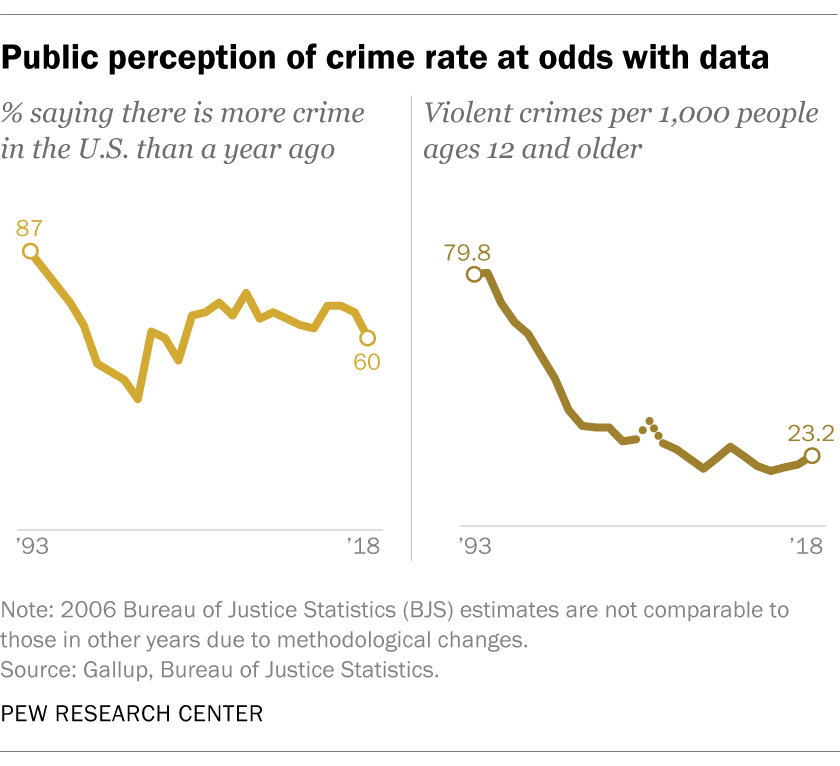
Using the FBI numbers, the violent crime rate fell 51% between 1993 and 2018. Using the BJS data, the rate fell 71% during that span. The long-term decline in violent crime hasn’t been uninterrupted, though. The FBI, for instance, reported increases in the violent crime rate between 2004 and 2006 and again between 2014 and 2016. Violent crime includes offenses such as rape, robbery and assault.

2Property crime has declined significantly over the long term. Like the violent crime rate, the U.S. property crime rate today is far below its peak level. FBI data shows that the rate fell by 54% between 1993 and 2018, while BJS reports a decline of 69% during that span. Property crime includes offenses such as burglary, theft and motor vehicle theft, and it is generally far more common than violent crime.
3Public perceptions about crime in the U.S. often don’t align with the data. Opinion surveys regularly find that Americans believe crime is up nationally, even when the data shows it is down. In 18 of 22 Gallup surveys conducted between 1993 and 2018, at least six-in-ten Americans said there was more crime in the U.S. compared with the year before, despite the generally downward trend in national violent and property crime rates during most of that period.
Pew Research Center surveys have found a similar pattern. In a survey in late 2016, for instance, 57% of registered voters said crime in the U.S. had gotten worse since 2008, even though FBI and BJS data shows that violent and property crime rates declined by double-digit percentages during that span.
While perceptions of rising crime at the national level are common, fewer Americans tend to say crime is up when asked about the local level. In all 21 Gallup surveys that have included the question since 1996, no more than about half of Americans have said crime is up in their area compared with the year before.
4There are large geographic variations in crime rates. The BJS statistics don’t allow for specific geographic comparisons, but the FBI data shows big differences from state to state and city to city. In 2018, there were more than 800 violent crimes per 100,000 residents in Alaska and New Mexico. By contrast, Maine, New Hampshire and Vermont had rates below 200 violent crimes per 100,000 residents. And while Chicago has drawn widespread attention for its soaring murder total in recent years, its murder rate in 2018 – about 21 murders and non-negligent manslaughters per 100,000 residents – was less than half of the rates in St. Louis (about 61 per 100,000) and Baltimore (about 51 per 100,000). The FBI notes that various factors might influence a particular area’s crime rate, including its population density and economic conditions.
5Most crimes are not reported to police, and most reported crimes are not solved. In its annual survey, BJS asks victims of crime whether they reported that crime to police. In 2018, only 43% of violent crimes tracked by BJS were reported to police. And in the much more common category of property crime, only about a third (34%) were reported. There are a variety of reasons crime might not be reported, including a feeling that police “would not or could not do anything to help” or that the crime is “a personal issue or too trivial to report,” according to BJS.
Most of the crimes that are reported to police, meanwhile, are not solved, at least based on an FBI measure known as the “clearance rate.” That’s the share of cases each year that are closed, or “cleared,” through the arrest, charging and referral of a suspect for prosecution (or through “exceptional means,” such as the death of a suspect or a victim’s refusal to cooperate with a prosecution). In 2018, police nationwide cleared 46% of violent crimes that were reported to them. For property crimes, the national clearance rate was 18%.