Etiquette


DP Etiquette

First rule: Don't be a jackass. Most people are good.

Other rules: Do not attack or insult people you disagree with. Engage with facts, logic and beliefs. Out of respect for others, please provide some sources for the facts and truths you rely on if you are asked for that. If emotion is getting out of hand, get it back in hand. To limit dehumanizing people, don't call people or whole groups of people disrespectful names, e.g., stupid, dumb or liar. Insulting people is counterproductive to rational discussion. Insult makes people angry and defensive. All points of view are welcome, right, center, left and elsewhere. Just disagree, but don't be belligerent or reject inconvenient facts, truths or defensible reasoning.

Wednesday, January 29, 2020

Thoughts on the President’s Impeachment

The acquittal of the president in the Senate was obvious at least from the time that Senate majority leader Mitch McConnell said he had no interest in being neutral. All that was left was for the GOP to figure a way to acquit the president while still holding up a fig leaf to cover their obviously political decision.


The broken law argument
Even without paying attention to the proceedings in the Senate, a couple of interesting points filtered through. One is that GOP senators raised the bar on the political process of impeachment to require broken law(s). That is not required by the constitution, which is silent on the point. Of course, that requires them to ignore or downplay the fact that the GAO found the president did break a law in the course of attempting to extort Ukraine.

But on the point of lawbreaking, the president’s attorney argued that a broken law is nonetheless required to impeach. The broken law defense first surfaced in 1868, when a lawyer defending president Andrew Johnson argued the president could not be removed from office because he was not guilty of a crime. The current situation again proves that impeachment can be fundamentally political if the people in congress choose to make it political. In this case, the GOP is making it partisan political, nothing more. It’s leader and/or party before country for the modern GOP. That mindset is a key trait of authoritarian regimes throughout history.


Idle speculation
Although this is obvious, it bears mention: If the facts were all the same except that president was Hillary Clinton and the House was also controlled by the GOP, the GOP would be calling and voting for impeachment. Again, impeachment is political. An interesting question asks how many, if any, congressional democrats would vote to impeach a president Clinton under the otherwise same circumstances. I bet it would not be zero as it has been and probably will be with the GOP. But that is just idle speculation.


The heads on pikes comment
House impeachment manager Adam Schiff commented that GOP senators had to vote to acquit the president or their heads would be on a pike. That rings true of the modern authoritarian GOP. Discussions here have pointed out that the modern GOP leadership is rigidly intolerant of internal dissent. For GOP congress people, they either tow the line or they will be primaried by a well-funded opponent in the next election cycle. As we all know, re-election comes before country and that is a bipartisan moral value.

It may be the case that no one explicitly made the head on a pike threat. Schiff acknowledged that. Nonetheless, it is obvious the threat is there and real. Schiff just stated what everyone knows: tow the line or we’ll have your head on a pike. Schiff’s comment arguably was a tactical error because it enraged GOP senators. They want to maintain a facade of plausible independence. Regardless, it makes no difference what Schiff says or what the evidence against the president is. The GOP is authoritarian and it politicians will acquit the president mostly or due to authoritarian tribe loyalty, pure terror or some combination of the two.

Tuesday, January 28, 2020

Why migrating to another planet is a stupid and implausible idea


Swiss astrophysicist Michel Mayor, whose work detecting exoplanets recently earned him a share in the Nobel prize for physics, says humans will never migrate beyond our own solar system. Maybe it’s time we started taking this whole “climate change” thing seriously.
The first exoplanet with the potential to host life as we know it, meaning it was orbiting a star similar to the one we call ‘the sun,’ was discovered by Mayor and fellow Nobel winner Didier Queloz in 1995. In the time since, researchers have confirmed the existence of more than 4,000 exoplanets. But we won’t be making the trip to any of them, says Mayor.
If we are talking about exoplanets, things should be clear: we will not migrate there. These planets are much, much too far away. Even in the very optimistic case of a livable planet that is not too far, say a few dozen light years, which is not a lot, it’s in the neighborhood, the time to go there is considerable. We are talking about hundreds of millions of days using the means we have available today.
Rather than concern ourselves with dreams of colonizing planets throughout our galaxy and beyond, Mayor says “We must take care of our planet.” He told AFP that he wanted to dissuade people from thinking of migration as a viable solution to existential threats, telling reporters he felt the need to “kill all the statements that say ‘OK, we will go to a livable planet if one day life is not possible on earth.” He went on to call such sentiments “completely crazy.”
And he’s right. The current space race may not be a direct response to climate crisis science, but it’s turning out to be a fantastic distraction from the actual, scientifically proven catastrophe unfolding here on Earth.
We shouldn’t be online picking out curtains for some future mansion we hope to live in one day while our studio apartment is burning down around us.
Because, if exoplanets are off the table (barring some far-future tech like quantum warping), then we don’t really have any other options. The Moon? It’s not big enough. Mars? Let’s examine that one briefly.
The red planet is uninhabitable. Despite Elon Musk’s assertion that ‘nuking’ it would kick-start the atmosphere, there’s no current technology capable of “terraforming” it to make it livable. There’s a reason why people haven’t fled the crowded streets of New York, Paris, and Bangladesh to stretch their legs in the wide-open expanses of Antarctica. Because uninhabitable means you can’t survive without accommodations that don’t occur naturally. The challenge of surviving on Mars is almost infinitely more difficult than living on Earth‘s south pole.
When we imagine these ventures, the ones where we send brave explorers off to carve out a new home for humanity (Battlestar Galactica anyone?), we’re not thinking about the billions of ‘regular people‘ who don’t have ‘the right stuff,’ to survive in the harsher-than-anything-on-our-planet reality of space.
There’s no doubt we’ll eventually set up small colonies on the Moon and Mars, but feeding and housing billions of people?
If we’re trying to preserve the species, we need to fight the climate crisis head-on. Building cosmic arks won’t save us. 

Monday, January 27, 2020

Getting older does NOT make you wiser, claim scientists

  • Old performed no better than the young in a wisdom test, Yale University found 
  • But introverts prone to melancholy are more astute at understanding behaviour
  • The researchers have now created their own interactive test that allows you to find out how much wisdom you have
It's long been thought that wisdom comes with age. 
But scientists now claim that having more life experience doesn't necessarily make you more knowledgeable about life.
In particular, old age doesn't seem to help people get an intuitive knack for grasping how others think and behave, researchers claim.
In a new study, the elderly performed no better than the young in a test of how well they understood human characteristics.
The researchers at Yale University have now created their own interactive test that allows you to find out how much wisdom you have.
Take the test below or click here:
Yale psychologists used more than 1,000 volunteers to look at how different factors affected how the average person thinks, feels, and acts in various social contexts.
As part of the study, the team of scientists found that older people did no better than younger people at understanding the nuances of human behaviour.
Anton Gollwitzer, a graduate student at Yale University said: 'The lack of a relationship does suggest that the number of experiences one has had in the world does not seem to heighten one's ability to infer how most people think and behave in social contexts.' 
If the oldest people are not the wisest, the researchers set out to determine which group of people are the best natural psychologists. 
The researchers developed a forty question test to assess a persons skill at reading between the lines and understanding the dynamics of a social situation.
It can be taken here or online via the Yale website for people to see how intuitive and wise they are. 
The authors then analysed the highest scoring participants in more detail to see what they had in common. 
By doing this, the researchers unearthed the characteristics of the type of people who are best at understanding others.
They found that people of the ilk of famed author Harper Lee are the most adept at understanding social clues. 
This means introverts prone to melancholy seem to be more astute at understanding how we behave in groups than their gregarious peers, the researchers found.
They also found intelligence and wanting to engage with complex problems was a key predictor of wisdom. 
'It seems to be a case of sadder but wiser,' said Gollwitzer.
'They don't view the world through rose-colored glasses as jovial and extroverted people do.'
'It could be that the melancholic, introverted people are spending more time observing human nature than those who are busy interacting with others.'
Mr Gollwitzer added: 'Take, for instance, the novelist Ernest Hemingway, or the founder of modern psychology, William James.
'Without empirical backing, these individuals were able to accurately capture and communicate deep social human truths.' 
The research was published in the journal Social Psychology
 (NOTE: If you are indeed a smart person, don't bother reading the report, it is long and boring) 

ARE MIDDLE CLASS PEOPLE WISER THAN WORKING CLASS PEOPLE? 

Research has found that middle class values of self-reliance and individual attainment have left the bourgeois less prepared to handle their interpersonal relationships.
As a result, the working-class folk are more wise than their middle-class equivalents.  
The University of Waterloo in Canada defined wisdom as the ability to be open-minded, intellectually humble and integrate different perspectives on important issues.
A higher social class provides greater opportunities to pursue knowledge and education.
Despite this, working class people show more wisdom when dealing with others.
Experts say economic hardship means less wealthy people spend more time considering the impact of their decisions on those around them.
They found that more affluent people are linked with diminished ability to reason wisely when it comes to other people. 


Sunday, January 26, 2020

Science Closes in on a Possible Biological Explanation for Sentience

Consciousness: the awareness or perception of something by a person; the fact of awareness by the mind of itself and the world;

Sentience: the capacity to feel, perceive or experience subjectively; the ability to experience sensations, known in philosophy of mind as qualia; (this may not be true: “sentience appears at a certain stage in humans, as in other species, and brain damage can result in those abilities being lost so not all humans are sentient”)

Mind: the element or aspect of a person that enables them to be aware of the world and their experiences, to think, and to feel; the faculty of consciousness and thought, including abstract thought about things not directly sensed by human senses such as sight, touch, smell or hearing


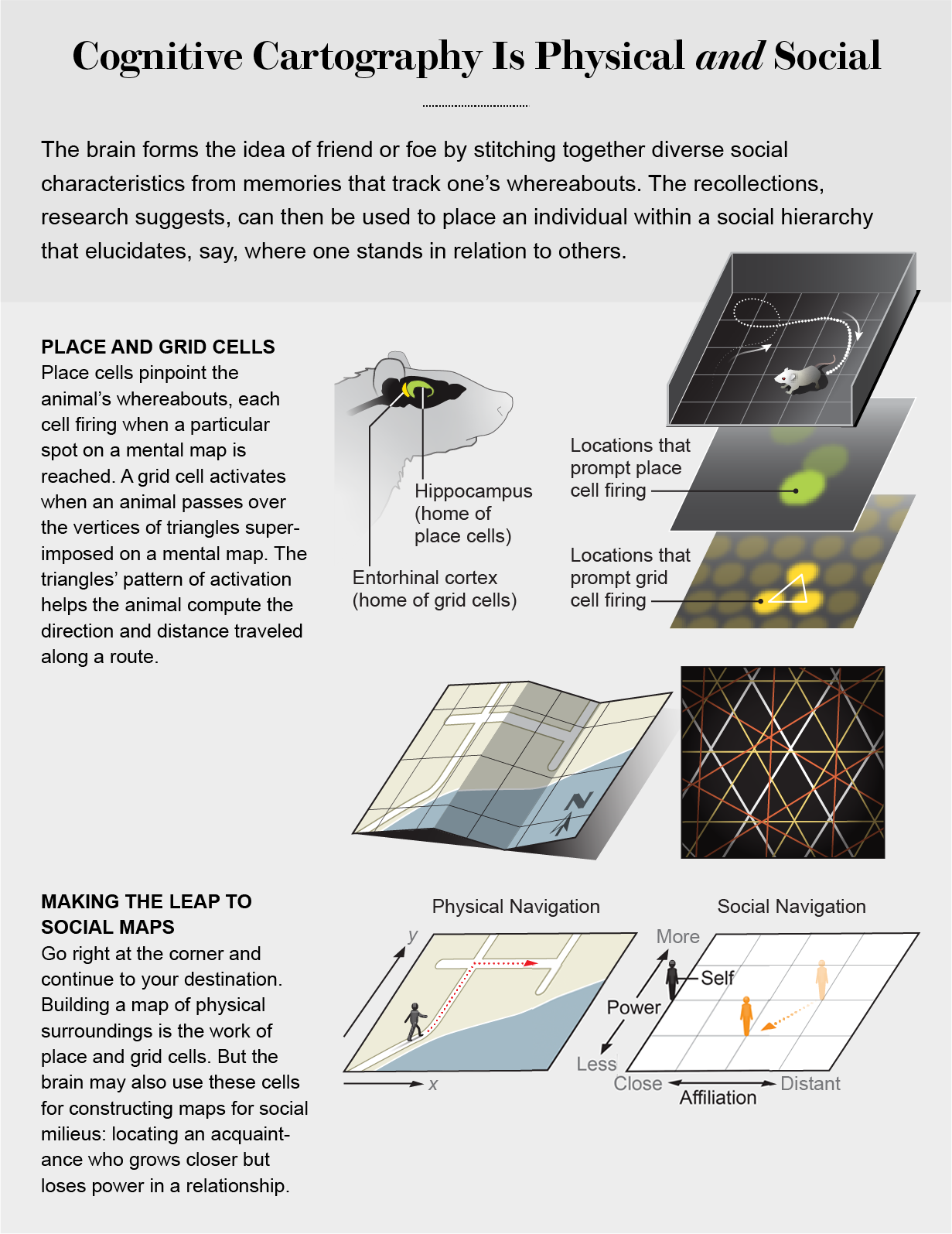
The February 2020 issue of Scientific American includes an article, In Search of The Brain’s Social Road Maps. The article summarizes research that is beginning to describe how the brain and mind might work in terms of monitoring and guiding our movements in space and time, social relations, memory and abstract thinking.

The concept of cognitive maps as a part of the workings of the mind arose in 1948 in experiments with rats that generated data interpreted as rats being able to think abstractly. The data was fully consistent with a brain that could think in terms of locations in space without having physically been to the locations. That was seen when rats knew how to navigate a maze they had never been through.

Later research discovered neurons in the brain that helped keep time, which facilitated mapping of space. The brain maps are little clumps of neurons (place cells) that fire together when sense inputs or abstract thinking lead to known locations. Three clumps of neurons (grid cells) constitute triangles corresponding to a known place. When a known person is encountered a 2-dimensional map for that person is activated with the perceived power of the person and their social closeness being the two axes. Place and grid cells are now hypothesized to play a role in creating social maps. If that is true, then the human mind creates maps for both places in space and the social position of other people relative to the observer.


The Jennifer Aniston Neuron
Our brains create concepts or images of other people they know. Specific neurons are involved. The authors write:
“The progression from the physical to the abstract carries over into the way the brain represents social relationships. Various bits of knowledge about another person are distilled into the concept of that individual. When we see a photograph of someone or hear or see that person’s name, the same hippocampal cells will fire, regardless of the sensory details of the stimulus (for example, the famous “Jennifer Aniston neuron” described by Itzhak Fried of the University of California, Los Angeles, and his colleagues). These hippocampal cells are responsible for representing concepts of specific individuals.

Other hippocampal cells track the physical locations of others and are called social place cells. In an experiment by David Omer of the Hebrew University of Jerusalem, Nachum Ulanovsky of the Weizmann Institute of Science in Rehovot, Israel, and their colleagues, bats observed other bats navigating a simple maze to reach a reward. The task of an observer bat was to simply watch and learn from a navigating bat, enabling it to subsequently navigate the same route to get the same reward. When the observer bat watched, hippocampal cells fired corresponding to the location of the other bat.

Hippocampal activity also tracks social hierarchies: the demands of a boss and a co-worker, for instance, may be valued differently and confer different social standings. Common metaphors illustrate the spatial dimensions of a hierarchy: a person may try to gain status to “climb the social ladder” or “look down” at someone below them. Other factors are also critical. Biological relatedness, common group goals, the remembered history of favors and slights—all determine social proximity or distance. Human relationships can be conceived of as geometric coordinates in social space that are defined by the dimensions of hierarchy and affiliation.”

Thus if bat and human brains work alike, they commingle map information about space and time with images of the social power vs. closeness map location of others. Experiments can follow human brains in space and time as they form various social relationships with characters in computer games. Evolving human relationships in these games can be plotted as trajectories through social space, giving data on angles and lengths of the social vectors our brains create.


The world is too complex, we need to model and map it to simplify it
What all this appears to boil down to is this: The world is too complicated to deal with directly. We cannot test all possibilities in life, so we need some way to think abstractly about them. That avoids the need to test many possibilities without ever directly experiencing them. To simplify and model reality, our brains use clusters of neurons to create and represent physical maps of space, time and other people. Using that information our brains can recall memories, think abstractly and come to new insights and beliefs about their physical and social situation without directly experiencing reality. Maybe this sort of exercise in reviewing and making maps is the basis of consciousness and/or sentience for humans, and possibly other animals.