Etiquette


DP Etiquette

First rule: Don't be a jackass. Most people are good.

Other rules: Do not attack or insult people you disagree with. Engage with facts, logic and beliefs. Out of respect for others, please provide some sources for the facts and truths you rely on if you are asked for that. If emotion is getting out of hand, get it back in hand. To limit dehumanizing people, don't call people or whole groups of people disrespectful names, e.g., stupid, dumb or liar. Insulting people is counterproductive to rational discussion. Insult makes people angry and defensive. All points of view are welcome, right, center, left and elsewhere. Just disagree, but don't be belligerent or reject inconvenient facts, truths or defensible reasoning.

Wednesday, November 18, 2020

Coronavirus Update 15

Pfizer vaccine vials in pizza boxes packed in dry ice


Two bits of good news merit mention. 


Initial indications of long-term immunity
The New York Times writes that some preliminary, not yet peer-reviewed, reports are coming out indicating that immunity to SARS-CoV-2 will likely be long-lasting. If the evidence turns out to be verified and true, this is a very big deal. It means that people might not need to be immunized every year or two, and instead, once they are immunized, they may not need to be re-immunized for years. 

The big caveat here is that the data is from people who recovered from an infection. Vaccines may not generate the same kind of response, so that needs to be investigated in the coming months. But at least, it is possible (likely?) that once a person recovers from an infection, they will remain immune for a long time. There may be some exceptions to that, but the data so far suggests that is rare. The hope is that vaccine responses will be similar to immune responses to natural infection that immunity will last for years instead of just months.

How long might immunity to the coronavirus last? Years, maybe even decades, according to a new study — the most hopeful answer yet to a question that has shadowed plans for widespread vaccination.

Eight months after infection, most people who have recovered still have enough immune cells to fend off the virus and prevent illness, the new data show. A slow rate of decline in the short term suggests, happily, that these cells may persist in the body for a very, very long time to come.

“That amount of memory would likely prevent the vast majority of people from getting hospitalized disease, severe disease, for many years,” said Shane Crotty, a virologist at the La Jolla Institute of Immunology who co-led the new study.

The findings are likely to come as a relief to experts worried that immunity to the virus might be short-lived, and that vaccines might have to be administered repeatedly to keep the pandemic under control.  
And the research squares with another recent finding: that survivors of SARS, caused by another coronavirus, still carry certain important immune cells 17 years after recovering.

The findings are consistent with encouraging evidence emerging from other labs. Researchers at the University of Washington, led by the immunologist Marion Pepper, had earlier shown that certain “memory” cells that were produced following infection with the coronavirus persist for at least three months in the body.

A study published last week also found that people who have recovered from Covid-19 have powerful and protective killer immune cells even when antibodies are not detectable.

In addition to the Pfizer vaccine, another vaccine by Moderna has been shown to be equally effective with the Pfizer product. Moderna is lagging Pfizer by maybe a couple of months, maybe less, so a second vaccine might begin to be available by Q2 or Q3 of 2021, maybe end of Q1.


Vaccine manufacturing and distribution is very complex but on track for 2021
Pfizer reported last week that its vaccine was about 90% effective. Now all the data is in and the final data indicates it is about 95% effective. This vaccine is complicated by a requirement to be shipped at dry ice temperature, about -94 F. The company plans to apply for emergency use authorization within the next several day. The Washington Post writes:
At the core of Pfizer and BioNTech’s vaccine is a powerful but fundamentally transient and unstable genetic material called messenger RNA, ensconced in lipid nanoparticles — tiny fat bubbles. The messenger RNA encodes the blueprint for the hallmark spiky proteins that stud the surface of the coronavirus and, once inside a person’s body, it instructs cells to build replicas of the spike. Those harmless versions teach the immune system to recognize the real thing — in essence, turning the human body into a vaccine factory.

The technology has never been used in an approved medical product. That means Pfizer and BioNTech are inventing the recipes — and tinkering with them to increase the output at almost the same time.

If Pfizer receives the regulatory green light, its freezer farm will become a distribution center, the pizza boxes submerged under 50 pounds of dry ice and sent to points of vaccination, which will be determined by states but could include locations such as hospitals or pharmacies. By the end of the year, Pfizer anticipates sending thousands of shipments each day from Kalamazoo and a second freezer farm in Pleasant Prairie, Wis.

Upon arrival, the thermal shippers must be refreshed with dry ice or the vials must be transferred to ultra-low-temperature freezers. The specifications are exacting if the vials stay in the shippers — the cooler is not to be opened more than twice a day, must be refreshed with dry ice every five days and is designed to be used for 15 days. The vials can stay at refrigerator temperatures for five days before their contents degrade.

The ultracold storage requirement for the vaccine will add a wrinkle to an unprecedented vaccination campaign. Rolling out such a vaccine in the developed world will be challenging; doing so in the developing world could be nearly impossible. The next phase of vaccine production involves creating a more stable freeze-dried version and expanding production capabilities, for example, by finally building those bigger pizza ovens that could make formulation go faster.

Throughout the vaccine effort, government officials have projected hopeful timelines about when doses will be available: High-risk people may be able to get vaccines in the first months of next year, the rest of the population later in the spring and summer. Beneath those projections is a labyrinthine scientific and industrial process, with each node — hundreds of people’s work — coming together to bring the world closer to ending the pandemic.

This is completely new vaccine technology. No RNA vaccine has ever been developed and FDA approved for use in humans. The Moderna uses a completely different technology, which also has never been developed and approved. To meet demand for dry ice, Pfizer is building a dry ice factory on its manufacturing site. The dry ice requirement will probably severely limit the use of this vaccine in third world countries.
Tuesday, November 17, 2020

Double Standards: Trump vs. Biden Legitimacy

Voter fraud found in Pennsylvania!
A republican voted for Trump using his dead mother's ballot
Republicans are right -- dead people voted (for Trump) 


The case for Trump’s illegitimacy
Before and after the 2016 election, information kept coming out suggesting that the Russians were working to help get Trump elected. Facts of record including (1) a clandestine pre-election effort to set up a secret line of communication between Trump the Russian government, and (2) Trump’s unprecedented insistence on communicating with Putin in complete secrecy with no notes taken strongly suggested a conspiracy between Trump and the Russian government or Putin himself. Eventually, former Director of National Intelligence James Clapper publicly stated that “to me, it just exceeds logic and credulity that they [the Russians] didn’t affect the election, and it’s my belief they actually turned it.” 

As time passed, more evidence of Russian influence dribbled out to the public. My assessment of the probability that the Russians were a necessary (but not sufficient alone) factor in Trump’s electoral college win went initially from about 65%, to about 85% and then, including consideration of Clapper’s public statements, to ~98%. My belief was and still is that Trump has been an illegitimate president for his entire time in office.

That opinion was based on evidence in the public record. Where people will differ is in how they analyse the evidence and draw conclusions or whether they accept the evidence as real or relevant. My estimate is that most Trump opponents (~99% ?) believe that Trump was legitimate. My estimate is that most Trump supporters (~99.999% ?) do not believe the evidence is sufficient to conclude he was illegitimate. Most of them (~90% ?) probably do not believe that most or all of the evidence exists, is relevant and/or credible. 


The case for Bidens illegitimacy
During Nov. 8-10, 2020, an Economist/YouGov poll of 1500 registered voters asked at question 38: “Would you say that Joe Biden legitimately won the election or not?” The results of question 38 are shown in the two figures shown below. As shown in the second figure, 86% of the 591 people who voted for Trump believe that Biden did not legitimately win the election. Other polling indicates that at least 70% of republicans do not believe the election was free and fair. 


If the polls are reasonably accurate, most republicans and Trump voters see Biden as illegitimate. What is the evidence for that belief? 

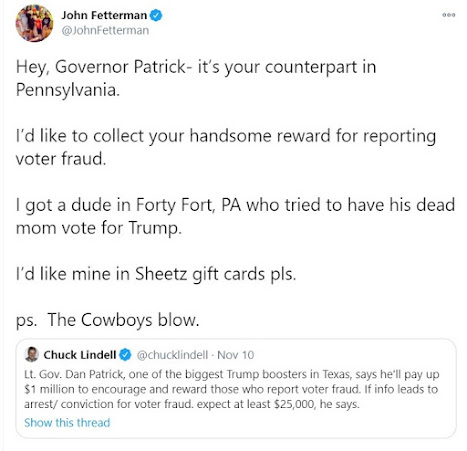
Many people, including republicans and journalists, have looked for evidence of widespread voter fraud or voter intimidation and major vote counting flaws or errors. So far, none has been found. A wealthy Texas republican politician, Lt. Gov. Dan Patrick, even offered a cash reward (minimum $25,000 for an arrest and conviction) for people to come forward with evidence of voter fraud. Apparently, the only claim so far was by a Pennsylvania democrat, Lt. Gov. John Fetterman, who offered evidence that at least one republican committed vote fraud in Pennsylvania. That person voting for Trump using his dead mother's ballot.[1] Two recent discussions here have detailed the lack of evidence of widespread voter fraud (here and here). At this point, it is fair to say there is no evidence that Biden’s win was illegitimate in any way.

So, is there equivalence of evidence here? Equivalence of partisan motivated reasoning? Does the evidence of Biden’s illegitimacy outweigh Trump’s? Is the evidence of Trump illegitimacy too weak to reasonably believe he really is illegitimate?


Footnote:
1. Pennsylvania Lt. Gov. John Fetterman is asking for his share of a reward after he offered up a case of voter fraud to Republican Texas Lt. Gov. Dan Patrick via Twitter. Patrick had announced that he is giving out $1 million in rewards for information that leads to voter fraud arrests and convictions.

“Hey, Governor Patrick — it’s your counterpart in Pennsylvania,” tweeted Fetterman, a Democrat. “I’d like to collect your handsome reward for reporting voter fraud. I got a dude in Forty Fort, PA who tried to have his dead mom vote for Trump. I’d like mine in Sheetz gift cards pls.” 

“They don’t want that kind of voter fraud,” said Fetterman, the former mayor of Braddock. “You can believe if that was a registered Democrat who tried to vote for Biden with his dead mother’s ballot, that would be front page news everywhere in those circles.”


Christian Nationalist Legal Strategy: Weaponize The Free Exercise Clause From Shield To Sword


First Amendment: Congress shall make no law respecting an establishment of religion, or prohibiting the free exercise thereof; or abridging the freedom of speech, or of the press; or the right of the people peaceably to assemble, and to petition the Government for a redress of grievances.

The Free Exercise Clause . . . withdraws from legislative power, state and federal, the exertion of any restraint on the free exercise of religion. Its purpose is to secure religious liberty in the individual by prohibiting any invasions there by civil authority. -- US Supreme Court, Abington School District v. Schempp, 374 US 203, 222-223, 1963 


Context
1. In coming decades, the ideology of Christian Nationalism (CN) will be heavily brought to bear on Americans and American society, governance and law. The contours of the legal strategy are visible and have been for at least 30 years or so. One part of the CN strategy is to change interpretation of the equal protection clause from a shield to protect religious freedom and practices, to a sword to aggressively expand the legal scope, power and influence of Christianity into commerce and secular affairs generally.

2. One the most difficult concepts in politics to grasp is how to reconcile conflicts between conflicting rights. A recent example is the 2015 Supreme Court decision that legalized same-sex marriage. Conservatives vehemently objected and argued that the new rights of same-sex couples would crush religions freedom and practice into oblivion. My own analyses of the freedoms conflicts and burdens indicated that such fears were grossly exaggerated in almost all situations for most people (private speech and practice analysis; speech and practice in commerce analysis). 

3. One of the most difficult endeavors in law is how to interpret the often ambiguous US Constitution. The Constitution was built on compromises that forced ambiguities into the document to get it agreed on and accepted. The Founders were in bitter disagreement and they never resolved critical disagreements in their lifetimes. The ambiguity affords a legal basis to reshape American government and society by reinterpreting law as radical right CN sees it must be in the eyes of sacred God. One goal that CN wants is to legally demolish is the concept of a separation of church from state. Another is to extend the reach of religion deep into secular affairs, which is the topic of this OP.


Shield to Sword
A Sept. 18, 2020 article in The Atlantic by legal scholars Howard Gillman and Erwin Chemerinsky describes how the radical right Supreme Court is weaponizing the equal protection clause. Among other things, the point is to reverse civil rights gains that some groups have gained over the years. Gillman and Chemerinsky write:
The Supreme Court’s conservative majority is in the process of transforming this First Amendment clause [Free Exercise] into a sword that politically powerful Christian conservatives can use to strike down hard-fought advances in civil rights, especially for LGBTQ individuals and women.

At issue is whether religious believers who object to laws governing matters such as health care, labor protections, and antidiscrimination in public accommodations should have a right to an “exemption” from having to obey those laws. .... Religious business owners, such as bakers and florists, who object to same-sex marriage have claimed a right to refuse service to same-sex couples. And employers have successfully asserted a right to deny their workers health-care benefits that they would otherwise be entitled to, such as contraception or abortion counseling.

Providing such religious exemptions has required a dramatic change in the law by the Supreme Court. In 1990, in Employment Division v. Smith, the Supreme Court held that the free-exercise clause of the First Amendment cannot be used as a basis for an exception to a general law, no matter how great the burden on religion, unless the government’s action can be shown to be based on animus to religion. The case involved a claim by Native Americans for a religious exception to an Oregon law prohibiting consumption of peyote.

Justice Antonin Scalia wrote the opinion for the Court ruling against the Native Americans and explained that it would be impossible to provide religious exemptions from civic obligations whenever a person disagreed with the law—there are just too many civic obligations and too many different religious views about those obligations. Also, if the government were to begin down this path, it inevitably would face the impossible task of defining a “religious” belief. Such an approach would force the Court to make intrinsically controversial and discriminatory decisions about which religious views were most deserving of special accommodation and which social values should be considered less important than the favored religious views.

This decision was in line with the approach taken by the Supreme Court, in almost all cases, through American history. Courts long held that the Constitution did not require an exception to general laws on account of religious beliefs—that parents could not deny medical aid to their children, ....

Unfortunately, the conservative justices on the current Court reject Scalia’s reasoning and may be about to overrule Employment Division v. Smith. If they do so, the Supreme Court’s conservative majority will in essence be saying that the views of Christian conservatives are more important than legal protections for workers and people who seek to engage in ordinary commercial activity without suffering discrimination.

The first sign of this shift came with the 2014 decision in Burwell v. Hobby Lobby, when for the first time in American history, the Court held that the religious beliefs of a business’s owner allowed it to refuse to provide employees with a benefit required by law. .... at issue in Hobby Lobby were the rights of the owners of a purely secular business. The five conservative justices held that a family-owned corporation could deny contraceptive coverage to women employees based on the business owners’ religious beliefs.

In June 2020, the Court ruled in Our Lady of Guadalupe School v. Morrissey Berru that teachers at a Catholic school could not sue for employment discrimination. The two cases before the Court involved a teacher who had sued for disability discrimination after losing her job following a breast-cancer diagnosis and a teacher who had sued for age discrimination after being replaced by a younger instructor.

Previously, in Hosanna-Tabor Lutheran Evangelical Lutheran Church and School v. EEOC (2012), the Court said that a narrow exception protects religious organizations from being held liable for choices they make about their “ministers,” which traditionally have been considered “exclusively ecclesiastical questions” that the government should not second-guess. But now the Court has expanded that exception to all religious-school teachers, meaning that the schools can discriminate based on race, sex, religion, sexual orientation, age, and disability with impunity.

In recent months, the Court expanded civil-rights protection for gay, lesbian, and transgender individuals, but there is reason to fear that the conservative justices are about to undercut this. In June 2020, the Supreme Court ruled that the federal law Title VII, which prohibits employment discrimination based on sex, forbids employment discrimination based on sexual orientation or gender identity. But Justice Neil Gorsuch’s majority opinion left open the possibility of giving an exception to employers who discriminate because of their religious beliefs. The Court should emphatically reject such claims. Selling goods and hiring people on the open market is not the exercise of religion, and stopping discrimination based on sexual orientation or gender identity is a compelling government interest that judges should not dismiss because members of a favored religion disagree with the policy. (emphases added)

This is what the face of aggressive Christian theocracy looks like. It is sneaking up on our secular society. Radical right political ideology coupled with CN ideology[1] are proving to be a powerful, socially toxic and highly discriminatory and bigoted political force. That is the direction the authoritarian GOP and conservatism in general want American society and law to go. And, that is where it is going whether the majority wants it or not. 

Questions: Is it fair to see the CN legal movement as a move toward some form of Christian law akin to Sharia law in Islam, which some people see as a serious threat to existing US law and society? If Sharia is threatening, why isn’t Christian Sharia also threatening?


Footnote: 
1. Christians Against Christian Nationalism describe CN ideology and its goals:
Christian nationalism seeks to merge Christian and American identities, distorting both the Christian faith and America’s constitutional democracy. Christian nationalism demands Christianity be privileged by the State and implies that to be a good American, one must be Christian. It often overlaps with and provides cover for white supremacy and racial subjugation. We reject this damaging political ideology and invite our Christian brothers and sisters to join us in opposing this threat to our faith and to our nation.

As Christians, we are bound to Christ, not by citizenship, but by faith. We believe that:
People of all faiths and none have the right and responsibility to engage constructively in the public square.

Patriotism does not require us to minimize our religious convictions.

One’s religious affiliation, or lack thereof, should be irrelevant to one’s standing in the civic community.

Government should not prefer one religion over another or religion over nonreligion.

America’s historic commitment to religious pluralism enables faith communities to live in civic harmony with one another without sacrificing our theological convictions.

Conflating religious authority with political authority is idolatrous and often leads to oppression of minority and other marginalized groups as well as the spiritual impoverishment of religion.

We must stand up to and speak out against Christian nationalism, especially when it inspires acts of violence and intimidation—including vandalism, bomb threats, arson, hate crimes, and attacks on houses of worship—against religious communities at home and abroad.


What biblical moral principles, if any, dictate  
Christian law over secular law?


Plain Talk: This column is full of malarkey


You might say that today's column is full of malarkey.

The word malarkey, you may have noticed, is one that Joe Biden used frequently during the presidential campaign, going all the way back to the Iowa caucuses last year — even having the words "No Malarkey" painted on the side of his bus as he criss-crossed the state in 2019.

He used it during the last heavily-watched presidential debate on Oct. 22 to describe Donald Trump's typically unfounded claims.

"There's a reason why (Trump) is bringing up all this malarkey. There's a reason for it," Biden proclaimed. "He doesn't want to talk about the substantive issues. It's not about his family and my family. It's about your family."

As an admittedly old guy, I knew the word well. It was used all the time in those good, old days, and more than once we'd accuse each other of being "full of malarkey." That was nicer than using another often-used word.

I'm not sure when malarkey went out of vogue, but obviously it did, because younger people watching the debate were puzzled.

Laurie Wermter, a reference librarian at UW-Madison, noticed a report that a lot of people were looking up the word's meaning in online dictionaries that night.

She went to the online edition of the Oxford English Dictionary herself to pinpoint its definition:

"Humbug, bunkum, nonsense; a palaver, racket. (Usually of an event, activity, idea, utterance, etc., seen as trivial, misleading or not worthy of consideration.)"

But, she was surprised to find something else and decided that we at The Capital Times might be interested.

"When I looked it up myself, I discovered that an early usage (1924) of it is credited to the "Capital Times" (Madison, Wisconsin)," she reported in a letter to our editor and publisher Paul Fanlund.

I tried to search our archives to find the story or editorial that used the word, but the search couldn't narrow it down. But, I can imagine William T. Evjue insisting the opponents of "Fighting Bob" La Follette were full of malarkey. It was the year, after all, when the Progressive icon was running for president of the United States.

Laurie Wermter added that she was impressed to find 126 words in the Oxford dictionary in which The Capital Times is cited to document a usage. She added them to the letter she sent.

Among them are "a-go-go" in 1964, "arms control" in 1921, "auto-defrost" in 1940, "barbershopper" in 1930, "brain sucker" in 2002, "color commentator" in 1939, "jack squat" in 1997, "love-bomb" in 1976, "super PAC" in 1993, and "videogram" in 1983.

Thanks to this UW librarian, that's no malarkey. And, hopefully, when these votes are finally all counted, we'll have someone in the White House who remembers what it means.