“Thomas Frank ... criticized liberals’ focus on education as the remedy for inequality: ‘To the liberal class, every big economic problem is really an education problem, a failure by the losers to gain the right skills and get the credentials everyone knows you’ll need in the society of the future. .... It really isn’t an answer at all: it’s a moral judgment handed down by the successful from the vantage of their own success. The professional class is defined by its educational attainment, and every time they tell the country that what it needs is more schooling, they are saying: Inequality is not a failure of the system, it is a failure of you. .... The real problem was one of inadequate worker power, not inadequate worker smarts. The people who produced were losing their ability to demand a share in what they made.’” -- Chapter 4
, Credentialism: The Last Acceptable Prejudice
“[Johnathan] Alter saw a similarity between Kennedy’s team and Obama’s, who ‘shared the ivy league as well as a certain arrogance and a detachment from the everyday lives of most Americans.’ As things turned out, Obama’s economic advisers contributed to a folly of their own, less lethal than Vietnam but consequential nonetheless for the shape of American politics. Insisting on a Wall Street-friendly response to the financial crisis, they bailed out the banks without holding them to account, discredited the democratic party in the eyes of many working people, and helped pave the way to Trump.” -- Chapter 4, Credentialism: The Last Acceptable Prejudice
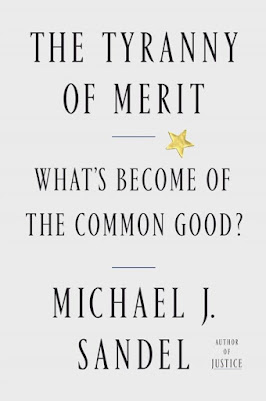
Michael Sandel’s 2020 book,
The Tyranny of Merit: What's Become of the Common Good?, is a detailed analysis of why there was and still is a populist backlash and widespread public support for the president. Sandel’s analysis sheds light on factors he argues are important in driving people to support a authoritarian nationalist. Sandel is a Professor of Government at Harvard and teaches political philosophy. His focus includes political and economic moral philosophy, which he wrote on in several books including his 2012 book,
What Money Can't Buy: The Moral Limits of Markets (
book review here).
The essence of Sandel’s argument is that American politics on the left and right have shifted since the 1960s to a mindset that asserts merit as the moral justification for wealth inequality and equally importantly, social esteem associated with work. In essence, both the right and left latched onto the false concept that if you work hard and play by the rules, you will get your just reward. That is not always true. It is not true most of the time for most people. More than academic credentials, factors such as luck and other fortunate circumstances like being born into a wealthy family are also often relevant.
In poll and interview data, Sandel sees the main complaint among Trump supporters as one of resentment of the bad attitude of liberal elites toward the dignity of working class work and the workers who do not have college educations. Sandel argues that open discrimination against people without college degrees, about two-thirds of the American people, is the last acceptable prejudice. People without a college degree remember and still feel the sting of Hillary Clinton calling them ‘deplorables’ and Obama referring to their security blanket need for ‘guns and bibles’. Those things cut deeply and are still remembered with anger and resentment.
Regarding higher education, Sandel recognizes a need for talent, merit and university education. His criticism focuses on when the educated elites get it wrong. When things go bad, e.g., Vietnam and Iraq, the elites and their elitist attitude, have a hard time seeing their own hubris, failings and weaknesses. He argues that the problem has been worsened by a slow reduction in the number of people without college degrees who participate in high level politics. Overt prejudice against non-college educated people is made socially acceptable by meritocratic ideology.
Several things add to the credibility of Sandel’s argument. Other people could see and predict the resentments among the losers that would arise if a system of merit without social conscience came to dominate thinking and policy in government and society. What we are witnessing today was predicted with amazing accuracy decades ago by British sociologist Michael Young writing in 1958. The reasoning then was the same as what Sandel asserts today. To his credit, Sandel makes the origin of his argument clear. What Sandel has done is fit the current data with the earlier prediction.
One source commented on Young and Sandel:
“THE BRITISH SOCIOLOGIST Michael Young coined “meritocracy” in 1958 in the title of a satire, The Rise of the Meritocracy, which purported to look backward from 2034 at a dystopian United Kingdom on the brink of revolution. Young feared the new meritocrats he saw emerging in the post-World War II order would surmount multiple rounds of rigorous testing for intelligence and talent, then wield their authority over government and business with the assurance that, unlike the aristocrats of yore, they had earned their perch atop a hierarchy. Everyone else would have lost the chance for power and prosperity because of personal failings like laziness—which would fuel resentment among populists who felt shut out of the system. To Young’s dismay, he lived to see the notion of “meritocracy” enter common use as a term not of censure but of praise, used by leaders from Ronald Reagan and Margaret Thatcher to Bill Clinton and Tony Blair. More recently, Barack Obama recited “You can make it if you try” like a personal slogan in more than 140 speeches during his presidency.
The latest entry in this debate comes from Bass professor of government Michael Sandel, the political theorist .... In contrast to Guinier’s reformist account, his The Tyranny of Merit: What’s Become of the Common Good? launches a direct attack on the philosophical underpinnings of meritocracy: he comes not to salvage the concept, but to bury it. Meritocracy, he argues, is obviously imperfect in its current form; it approximates true equality of opportunity only roughly. But even if equality of opportunity were attainable, which Sandel doubts, he thinks meritocracy would be neither desirable nor sustainable: even a perfect meritocracy has multiple flaws that make it unjust. The biggest problem is that meritocracy demands equality of opportunity at the starting line, but legitimates whatever inequalities follow as natural products of innate differences in talent and virtue: hardworkingness, intelligence, perseverance.” (emphasis added)
Both Sandel and Young argue that inequalities sanctioned by meritocracy lead to an insidious self-satisfaction among the winners and a seething resentment among the losers. The losers see a system that is rigged against them, and disrespects them. The winners cannot see the contribution of circumstances, luck and public infrastructure that led to their success based on their innate talents and hard work. Sometimes, winner innate talents are limited, but luck or circumstances more than compensate and the meritocracy doesn't account or for care about that.
One last point that Sandel repeatedly makes needs to be commented on. Meritocracy is focused on people as consumers, not as producers. Most people are both. The consumer focus leads to GDP-based thinking and ignores the well-being of the producers. The ill-effects of globalization, automation and free trade could have been softened, but they were not. Many people who lost good jobs never recovered. Sandel writes:
“Those left behind by four decades of globalization and rising inequality were suffering from more than wage stagnation; the were experiencing what they feared as growing obsolescence. .... [Liberals][1] have been offering working-class and middle-class voters a greater measure of distributive justice -- fairer fuller, access to the fruits of economic growth. But what those voters want even more is a greater measure of contributive justice -- an opportunity to win the social recognition and esteem that go with producing what others need and value. .... It falls to politics to reconcile our identities as consumers and producers. But the globalization project sought to maximize economic growth, and hence the welfare of consumers, with little regard for the effect of outsourcing, immigration and financialization on the well-being of producers. The elites who presided over globalization not only failed to address the inequality it generated; they also failed to appreciate its corrosive effect on the dignity of work. .... the anger abroad in the land is, at least in part, a crisis of recognition. And it is in our role as producers, not consumers, that we contribute to the common good and win recognition for doing so.”
Footnote:
1. Although this review repeatedly mentions failings of liberals and liberalism, Sandel makes it clear throughout his book that conservatism is even more on board with the downsides of the meritocracy illusion. The modern GOP is very hostile to job retraining and income support spending that would soften the blows of globalization and job loss. Sandel wrote: “Looking back across the wreckage we can see why this project failed. First of all, it was never really implemented.” The controlling conservative ideology holds that the losers deserve their plight and that generally makes effective worker protection policy impossible in our broken, polarized government. Obstinate, uncaring conservatism is more toxic than misguided liberalism.
Lack of government can be
a big part of people’s problems