Etiquette


DP Etiquette

First rule: Don't be a jackass. Most people are good.

Other rules: Do not attack or insult people you disagree with. Engage with facts, logic and beliefs. Out of respect for others, please provide some sources for the facts and truths you rely on if you are asked for that. If emotion is getting out of hand, get it back in hand. To limit dehumanizing people, don't call people or whole groups of people disrespectful names, e.g., stupid, dumb or liar. Insulting people is counterproductive to rational discussion. Insult makes people angry and defensive. All points of view are welcome, right, center, left and elsewhere. Just disagree, but don't be belligerent or reject inconvenient facts, truths or defensible reasoning.

Sunday, November 21, 2021

American men being left behind and feeling unhappy about it

Context
Analysis of the 2016 election indicated that a large majority of White men without college degrees supported the EXP (ex-president). The early analyses in peer-reviewed papers indicated that two things were the top vote drivers for the EXP, (i) fear, anger and resentment over demographic and social changes in the US and its place in the world, and (ii) wage stagnation and job worries. 

Other research independent of the election indicates that boys and men are increasingly facing more difficulties than women for a number of reasons that have nothing to do with politics. However, that research plausibly explains some of what astute opportunistic cynics could play on and manipulate for political gain if they were so-inclined. The modern Republican Party is clearly so-inclined.


Some of that other research was summarized in a New York Time editorial about the situation for men and boy, from last September, ‘It’s Become Increasingly Hard for Them to Feel Good About Themselves.’ The NYT writes:
Is there a whole class of men who no longer fit into the social order?

A decade ago, Marianne Bertrand and Jessica Pan, economists at the University of Chicago and the National University of Singapore, concluded in their paper “The Trouble With Boys: Social Influences and the Gender Gap in Disruptive Behavior”:

Family structure is an important correlate of boys’ behavioral deficit. Boys that are raised outside of a traditional family (with two biological parents present) fare especially poorly. For example, the gender gap in externalizing problems when the children are in fifth grade is nearly twice as large for children raised by single mothers compared to children raised in traditional families. By eighth grade, the gender gap in school suspension is close to 25 percentage points among children raised by single mothers, while only 10 percentage points among children in intact families. Boys raised by teenage mothers also appear to be much more likely to act out.

The effects on boys of being raised in a single-parent household are particularly acute in the development of noncognitive skills, according to Bertrand and Pan:

Most striking are our findings regarding gender differences in the noncognitive returns to parental inputs. Across all family structures, we observe that boys’ likelihood to act out is sharply reduced when faced with larger and better parental inputs. For girls, the relationship between parental inputs and behavioral outcomes appear to be much weaker. As these parental inputs are typically higher and of better quality in intact families, this largely contributes to why boys with single mothers are so much more disruptive and eventually face school suspension.

First, an excerpt from a 2016 paper by David Autor, an economist at M.I.T., and four colleagues:

In the United States in 2016, the female high school graduation rate exceeded the male rate by five percentage points, and the female college graduation rate exceeded the male rate by seven percentage points. What explains these gender gaps in educational attainment? Recent evidence indicates that boys and girls are differently affected by the quantity and quality of inputs received in childhood.

I sent the four references above to Arlie Hochschild, a professor of sociology at Berkeley and the author of “Strangers in Their Own Land: Anger and Mourning on the American Right,” for her views. She emailed back:

Since the 1970s offshoring and automation have hit blue collar men especially hard. Oil, coal — automating, manufacturing, offshoring, and truck-driving about to go down. Non-B.A. males are in an especially vulnerable place. I saw it in Louisiana, and again where I’m interviewing in Appalachia. It’s become increasingly hard for them to feel good about themselves.

In a 2018 essay in The New York Review of Books, “Male Trouble,” Hochschild described the predicament of less well educated men:

Compared to women, a shrinking proportion of men are earning B.A.s, even though more jobs than ever require a college degree, including many entry-level positions that used to require only a high school diploma. Among men between twenty-five and thirty-four, 30 percent now have a B.A. or more, while 38 percent of women in that age range do. The cost of this disadvantage has only grown with time: of the new jobs created between the end of the recession and 2016, 73 percent went to candidates with a B.A. or more. A shrinking proportion of men are even counted as part of the labor force; between 1970 and 2010, the percentage of adult men in a job or looking for work dropped from 80 to 70 while that of adult women rose from 43 to 58. Most of the men slipping out lack B.A.s.

While many of the men Hochschild writes about see a future of diminished, if not disappearing, prospects, men in elite professions continue to dominate the ranks of chief executives, top politicians and the highest-paying professorships.

Frances E. Jensen, chair of the department of neurology at the University of Pennsylvania’s Perelman School of Medicine, taking a different tack, argues that boys’ brains mature more slowly than girls’ brains do, a difference that is particularly striking in the adolescent years. In a 2017 interview with the School Superintendents Association, Jensen stressed the crucial role the still maturing brain plays in the lives of teenagers:

Teens go through a period of increased emotional fluctuation and are like a Ferrari with weak brakes. The emotional center of the brain, the limbic system, which controls emotions, is fully connected, but the frontal lobe that sharpens critical thinking isn’t well-connected. That means the part of the brain that makes them pause and say to themselves, “Bad idea. Don’t post that on Facebook because it might hurt my chances of getting a job in the future” or “Don’t jump in the lake, there may be a rock,” isn’t mature.

The brain also becomes more efficient, Jensen said,

during a process called myelination. This is when a fatty substance called myelin grows slowly and wraps itself around miles of brain cells to better insulate them. Insulation makes the brain more efficient at sending and receiving signals. Myelination is a slow process that finishes in the mid-20s. Our brains have thousands of miles of networks and to insulate all of them with myelin takes over two and a half decades to finish.

Using M.R.I. images, Jensen continued,

you can actually see the brain is laying down a layer of myelin over time when looked at year over year. You can measure those layers and see a dynamic process where the insulation is sharpening the rapidity of our signaling from one part of our brain to another.

And then she added a crucial point:

In adolescence, on average girls are more developed by about two to three years in terms of the peak of their synapses and in their connectivity processes.

In a 2019 paper, “Family Disadvantage and the Gender Gap in Behavioral and Educational Outcomes,” Autor and Wasserman, along with David Figlio, Krzysztof Karbownik and Jeffrey Roth, conclude that:

Family disadvantage disproportionately negatively affects the behavioral and academic outcomes of school-age boys relative to girls. The differential effect of family disadvantage on the outcomes of boys relative to girls is already evident by the time of kindergarten entry, is further manifested in behavioral and educational gaps in elementary and middle school performance, and crystallizes into sharp differences in high school graduations by age 18.

In a 2020 article, “Educational Gender Gaps,” Lundberg argues:

Social and cultural forces linked to gender identity are important drivers of educational goals and performance. A peer-driven search for masculine identity drives some boys toward risk-taking and noncompliance with school demands that hampers school achievement, relative to girls. Aspirations are linked to social identities — what you want and expect depends on who you think you are — and profound differences in the norms defining masculinity and femininity create a gender gap in educational trajectories.


What is going on here?
This kind of research provides some plausible explanations for why White men without college degrees would feel some combination of fear, anger, alienation and/or resentment. Not only is America’s social and economic sand shifting under their feet, their brains develop more slowly and males tend to be treated differently than females in at least some stressed families, e.g., single parent families, low income households, etc. 

All of that provides the raw material, i.e., a pliable mindset, that cynical political opportunists can take advantage of. Thus, instead of suggesting possible actions to ameliorate the situation, opportunists use propaganda to play on the pliable mind for political advantage. Cynics do things such as turning minorities into enemies, elevating wedge issues into moral outrages, vilifying political opposition as the reason for personal problems, and so forth. That is cynical politics.

By contrast, good faith politics would look at the problems and their sources to inform and guide policy. For example, teaching in ways that boys are known to respond to (boys are kinesthetic learners who benefit from hands-on activities where they learn by touch, exploration and manipulation[1]), adding a year to public education and an optional year or two of public service between high school and college would give male’s brains more time to mature. That might leave them at least somewhat better able to succeed in college.


Parents sense there is a problem with the boys
Poll data analysis shows that parents are more concerned about the success of their sons than their daughters. In 2020, the Brookings Institution commented on the results of the American Family Survey. All four groups analyzed, liberals, conservatives, mothers, and fathers, indicated that all are more worried about their sons than their daughters.  


Despite the foregoing, it is still the case that men tend to hold the high level positions and power. Nonetheless, the changes that society is experiencing are complicated. This generates significant psychological discomfort with how society is changing and how that affects people's lives. If some children and young adults are experiencing difficulties government could play a constructive role if it is allowed to do so. To the extent is it not being allowed to act, the reasons for that are pretty clear, e.g., anti-government ideology, etc.


Acknowledgement: This post was inspired by some remarks and links to information that PD gave in this comment.


Questions: 
1. Are the concerns about some men and their mental states that researchers identified mostly real and significant or mostly academic curiosities with little real world impacts in politics, the economy and/or society in general? 

2. Should government try to foster policies directed to reducing the psychological discomfort that many men are experiencing?


Footnote: 
1. That article comments:
The absence of these opportunities during the pandemic when so many students were learning online has had a considerable impact on educational advancement, especially so for boys.

In all-boys schools and classrooms, where teachers are focused on the unique social, emotional and learning needs of boys, young men are thriving. But I’m not issuing a rallying cry to nationalize single-gender education.

All-boys and all-girls schools work well for some students and not as well for others. Exploring different schooling options for your child is just common sense.

Saturday, November 20, 2021

An essay about American authoritarianism


The Atlantic published this essay recently:
Representative Paul Gosar’s murderous and misogynistic video takes a page—albeit an extreme one—straight out of the authoritarian playbook.

Authoritarianism has evolved over the past century, and old-school dictatorships are now joined by electoral autocracies. Yet at least one constant remains: Illiberal political solutions tend to take hold when increased gender equity and emancipation spark anxieties about male authority and status. A conquest-without-consequences masculinity, posing as a “return to traditional values,” tracks with authoritarianism’s rise and parallels the discarding of the rule of law and accountability in politics. We commonly associate autocracy with state restrictions on behavior, but the removal of checks on actions deemed unethical in democratic contexts (lying, thievery, even rape and murder) is equally important to its operation and appeal.

That’s why it’s unsurprising to see a culture of lawless masculinity developing within the GOP, which adopted an authoritarian political culture during the Trump years. Renouncing democratic norms, the Republicans have normalized disinformation, election subversion, and violence as a means of governance, as expressed in their support for the January 6 coup attempt and the fiction that Donald Trump, not Joe Biden, won the 2020 election.

It’s symptomatic that a recent Fox News chyron trumpeted the need to “embrace masculinity,” and that Republican Senator Josh Hawley of Missouri now styles himself the defender of “traditional masculine virtues—things like courage and independence and assertiveness” against a left trying to “feminize” men. The fist pump Hawley gave to the insurgents who had gathered to assault the Capitol hints at the real political agenda behind such calls for renewed male strength.

Whether or not Trump returns to office, the GOP has made his brand of outlaw glamour its own. A real man takes what he wants, when he wants it, whether in the bedroom, the workplace, or politics, and pays no penalty. As the Republican quest to destroy democracy intensifies, so will abusive, predatory, and criminal behavior be further enabled and justified. For a century, “getting away with it” has been central to authoritarianism’s allure, and it will be no different as the American version of illiberal rule unfolds.

This is just another voice that sees the obvious danger that tens of millions of adult Americans cannot see.

One can wonder whether authoritarian Republicans like Hawley really believe that they are defending traditional masculine virtues, or are just cynical opportunists seeking power and wealth.

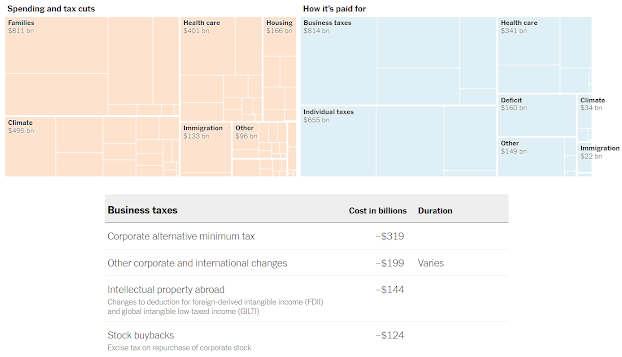
What is in the BBB the House passed a couple of days ago

These images are from a New York Times article that breaks the spending and taxes down for the Build Back Better Bill (BBB) the House passed a few days ago. Only some of it is shown because the images cannot be put on single screens.


How BBB money will be spent


Taxes to pay for BBB


Not shown in the revenue to pay for BBB is $127 billion the CBO estimated for increased IRS enforcement of tax law to recover some of the trillions in unpaid taxes that tax cheats do not pay. Congressional Republicans hate this. They are hell-bent on protecting tax cheats to starve the beast, i.e., the federal government, of revenue to do most domestic spending, including this bill. 

The White House disputes The CBO estimate and claims that the added $80 billion to the IRS for tax compliance and enforcement funding will raise ~$400 billion. Over a 10 year period, about $12 trillion will be lost to the tax cheats that congressional Republicans want left untouched.

Republicans have criticized this bill as evil socialist or communist tyranny. As usual from that crowd, that's a lie. Note that some of the provisions affect all people, not just Democrats as some conservatives like to falsely claim. 

BBB includes $24 billion to fund worker retraining when jobs are lost. For years, congressional Republicans have opposed and cut spending programs to protect workers who lose their jobs. That reflects of their blind ideological hate of most domestic spending. BBB also provides for health care protections for consumers, paid family leave and government power to negotiate Medicare drug prices, thereby reducing government spending by $76 billion. 

Kyrsten Sinema will probably required removal of the drug price negotiation provision to protect drug companies. Drug companies are major donors to Sinema, so she owes them payback for the hundreds of thousands they have given her. $76 billion seems a fair ROI (return on investment).


Questions: 
1. Is this evil Democratic Party socialist or communist tyranny, something worse, or something that looks reasonably good, despite Republican criticisms?
 
2. Based on the BBB bill and other policies, does the Democratic or Republican Party show more concern for average people, including workers?

3. Is  American two-party pay-to-play politics mostly corrupt and damaging to the public interest, mostly honest and beneficial to the public interest, or mostly something else? 

Friday, November 19, 2021

Fiscal responsibility and starving the beast: The sacred tax gap rears its head once again


America has two parties that hold power in Washington. One, the Democratic Party, is fiscally responsible and conservative, while the other is mostly fiscally irresponsible and spendthrift. For example, the opposite party passed a tax cut for rich people and corporations law in December of 2017 and that fiscally irresponsible beast is projected to add about $0.9 trillion to federal debt each year, with ~75% of the benefits flowing to the top ~20% of earners and foreigners. Most everyone else got a small to tiny tax cut. A few households, like mine, experienced a tax hike, running at about $9,000 this year. Big corporations also saw significant tax cut benefits.


To be clear, opposite party policy reflects its decades-ling strategy known as Starve the Beast. The starvation strategy is to limit government, something the Republican Party hates with a vengeance and constantly lies about. Accompanying the Starve the Beast strategy as a "rationale" is economic crackpottery called things like supply side economics, trickle down economics or, my favorite, horse and sparrow economics. The horse and sparrow theory holds that if you feed the horse enough oats, some will pass through and some stuff will fall on the ground, which the sparrows can pick through and find a few oats to eat. I suppose one could also call that the pass-through economic theory. Trickle down or whatever one wants to call it, works like about this in practice:


At present, the Democratic Party is trying to find ways to pay for the second infrastructure bill called Build Back Better (BBB). Not surprisingly, Republicans hate it with a vengeance because it involves government spending money for things other than rich people and big corporations. The situation looks not so good for finding ways to pay for BBB. The New York Times reports:
The nonpartisan Congressional Budget Office said on Thursday that President Biden’s sprawling climate change and social policy package would increase the federal budget deficit by $160 billion over the next 10 years.

That determination was at odds with Mr. Biden’s pledge to fully pay for the $1.85 trillion legislation but was unlikely to stop House Democrats from approving the bill.

Plans to do so Thursday evening, however, were derailed when a marathon speech by Representative Kevin McCarthy of California, the minority leader, prompted Democratic leaders to send members home with plans to reconvene at 8 a.m. on Friday.

The budget office’s analysis found that the bill’s tax cuts and spending programs were almost — but not entirely — offset by new revenue and spending cuts. The package would be largely paid for with tax increases on high earners and corporations, which were estimated to bring in nearly $1.5 trillion over 10 years. Savings in government spending on prescription drugs were estimated to bring in another $260 billion.
The NYT goes on to report that House Democrats are disputing the CBO about how much the Internal Revenue Service would collect by cracking down on people and companies that cheat on their taxes. The difference between what is owed and paid is the tax gap. It is running at about $1.2 trillion/year at present. In my opinion, that's a lot of tax cheating. The CBO rejects the White House assertion that the IRS would collect about $207 billion from tax cheats over ten years. 

Say what??

Think about that a moment. Over 10 years, tax cheats will make off with about $12 trillion in unpaid taxes if the tax gap stays the same as it is now. And Democrats, in the face of Republican opposition to going after tax cheats have to struggle to just claw back a piddly ~$207 billion in the name of Starve the Beast ideology. For context, ~$207 billion amounts to 1.72% of $12 trillion.

Starve the Beast dogma is so powerful that it demands that tax cheats be protected in service to starving the government to death. And what would the evil Democrats and government do with the tax cheat money if only there was some way to get it? 

Horrible, horrible things like imposing environmental protection regulations, expanding health care, controlling drug prices, and adding education and child care support. Those things are so horrible that some polling indicates most Americans support it.[1] Presumably, the Republican Party hates BBB because it feeds the beast and shows that government can actually do some good and non-trivial things for average people.


Questions: 
1. Is it too much of a burden or otherwise bad to try to recover some revenue lost to tax cheats to pay for a part BBB spending?

2. Should the beast be starved as the Republican Party wants and domestic spending programs like social security, Medicare, food stamps and the like be eliminated?

3. Which party, Democratic or Republican, is more fiscally responsible and conservative? 

4. Is trickle down or horse and sparrow a better label for the supply side economic theory the Republicans rely heavily on?


Footnote:
1. Yes, this is a puzzle. Congressional Republicans paint BBB as socialist or communist tyranny, fiscal irresponsibility, the end of civilization as we know it, against God's will, deep state subversion and pedophilia, and/or whatever else they can think to smear and attack it with. Why most average people might support it is a real head scratcher. (sarcasm)