This 8 minute video goes into some detail about Manchin and his family and how Manchin serves the people of West Virginia. I have argued here before that both Joe Manchin and Kyrsten Sinema are corrupt. This gives a hint at how deeply corrupt Manchin really is. This is more evidence that ethics in the federal government is a toothless norm that has been blown to smithereens. Ethics in government is now mostly extinct in view of how corrupt a US Senator can be and not be prosecuted.
Thursday, November 25, 2021
The disappearing small family farm

Jeff Uhler in his 1980s vintage harvester that
he cannot afford to replace so keeps repairing himself
The New York Times writes about the impossible economic situation that many small and medium sized farms face. The economics are just not there to support small or midscale farming. The NYT writes about a struggling farm family in Nebraska:
In his earliest memories of his family’s farm, Ethan Uhlir rides in an old truck with his grandfather Arden, feeding cattle and mending fences.
Before Arden’s death five years ago, he “reminded me that I was a good cattleman,” Ethan said, and “I have to keep it like that.”
Ethan, now 17, still notices his grandfather’s wiring technique in fence posts scattered across the farm in the rolling plains of northeast Nebraska, along the South Dakota border. He walks along the same paths as six generations of Uhlirs, but Ethan may be the last to work the land.“There’s enough labor for four people but not enough income for one,” his father, Jeff, said.
Like most farmers, Jeff sells his cattle, corn and soybeans at prices set by a global commodities market, but only large farms can absorb the narrow profit margins.Though the family’s small farm is valuable — its 880 acres [1.375 sq. mi.] are assessed at $1.3 million — property taxes eat up most of the money it does make.
Even in a good year when the farm grosses $60,000, Jeff feels lucky if he has money left over for savings. [what constitutes a bad year, ~$40,000?]
“I’ll have to work an hour before my funeral,” Jeff, 51, said. “I have no retirement.”For families like the Uhlirs, farming is increasingly unsustainable, as drought and extreme weather, fluctuating commodity prices and rising costs alter the economics of running a small- to midsize operation. Hundreds of family farms file for bankruptcy each year in the United States, with the largest share routinely coming from the Midwest.
Nebraska’s high property taxes, which it collects from its 93 counties and reapportions, are compounded by Knox County’s shrinking population.About 8,400 people live in the county, down 26.8 percent over the last 40 years. With fewer taxpayers, farmers who own hundreds of acres must shoulder the cost of schools, roads and other public services. After paying for necessities like fertilizer, seed and pesticides, Jeff must cover a $15,965.68 property tax bill.Nebraska’s agricultural land property taxes are 46 percent higher than the national average, according to a 2019 report by the University of Nebraska, Lincoln, and most farmers pay 50 to 60 percent of their net income in taxes [that seems too high].
Sixty percent of Nebraska property taxes pay for schools.Next fall, Ethan hopes to pursue an associate degree in nursing. “I don’t think that I would be able to financially support myself just living off the farm,” he said.
On a crisp, bright afternoon in early October, Ethan watched his father weld their broken 1980s combine harvester head, which cuts and threshes corn.Most of “the equipment we have, my grandfather bought,” Ethan said.
Ethan had once hoped to be named the Future Farmers of America’s “Star Farmer,” just like his grandfather Arden in 1960.
During the 1980s farm crisis, Arden nearly lost the farm. He took on debt and worked to pay it off up until the last few years of his life. His wife, Karen, worked for 16 years in an Alzheimer’s unit at an assisted-living facility in Verdigre.
“They never went to the dentist. They couldn’t afford to,” Jeff said. “They never went on vacation. They never spent any money on each other.”
Seeing his parents struggle, Jeff has avoided debt.“I’d love to be able to buy land close to me and expand what I do, but there ain’t no way at 51 years old,” he said. “I’d have to live to 160 to be able to pay it off.”
Jeff’s financial situation is worse than previous generations, he said. “Every year, the property valuations get higher and everything else don’t keep up.”
The family has farmed the land for 151 years, he said. “How do I sell it?”Knox County classifies four soil types when taxing agricultural use of land, and much of Jeff’s soil received the highest rating and a higher tax rate, despite lower yields than farms in other counties with less sandy soil. “We're taxed based on sales and soil composition,” he said. “At no point does rainfall become a factor.” [F]or more than two months, “we didn’t get a drop” of rain. Drought yielded short ears of corn and tiny, pea-sized soybeans.
Farming becomes more challenging as he ages, Jeff says, and he wonders what it will be like without Ethan next year, when he’s at college. “As my helper goes away, things get tougher.”
“At some point, the people raising your food are going to be dead,” Jeff said. “Once we’re gone, we’re not coming back.”

Karen and Jeff Uhler
This story resonated because my dad worked on farms all over Eastern Nebraska years ago. He probably worked on the Uhlir farm at some time or another. I might have worked there with him. Back in the 1960s and 1970s, the farm economy was better and small to medium sized farm operations generally did better. The little towns still had some life in them. Now many small towns are withering away. The economy is forcing many family farmers to sell, sometimes to agriculture giants like Cargill ($115 billion revenue in 2020) and ADM ($64 billion).
When the economy does not support something, it has to eventually cease operating or be independently supported somehow. What, if anything, should be done?
Wednesday, November 24, 2021
American democracy gets downgraded as it drifts into right wing authoritarianism

American fascists exercising their right to
speech and assembly
After the 2020 US presidential election Donald Trump refused to concede, alleging widespread and unparalleled voter fraud. Trump’s supporters deployed several statistical arguments in an attempt to cast doubt on the result. Reviewing the most prominent of these statistical claims, we conclude that none of them is even remotely convincing. The common logic behind these claims is that, if the election were fairly conducted, some feature of the observed 2020 election result would be unlikely or impossible. In each case, we find that the purportedly anomalous fact is either not a fact or not anomalous. --- A.C. Eggers, H. Garro, and J. Grimmer, Proceedings of the National Academy of Science, Nov. 9, 2021, 118 (45) e2103619118; https://doi.org/10.1073/pnas.2103619118
Perhaps the greatest blow to democratic ideals was the fall of the people’s government in Afghanistan, which has seen war being waged for the sake of preserving democratic principles. Significantly, the United States, the bastion of global democracy, fell victim to authoritarian tendencies itself, and was knocked down a significant number of steps on the democratic scale.This is a story in which democracies are being weakened because the underlying polis—without which no set of democratic institutions is durable—is being rent asunder by different forces, from the polarization nurtured by social media and disinformation to grotesque levels of economic inequality. It is also a tale in which democracies are hollowed out by the citizens’ loss of faith in the ability of democratic institutions to respond to social demands and solve problems, as well as by the toxic disease of corruption, which demolishes any semblance of trust. Add to this the credibility-sapping blunders performed by leading democratic powers over the past two decades—from the invasion of Iraq to the global financial crisis of 2008-2009 and to the violently contested elections in the United States—and the simultaneous emergence of credible alternative models of governance, and we have the equivalent of a witches’ brew for the global health of democracy. The pandemic has simply made that brew thicker and more poisonous.The Global State of Democracy 2021 shows that more countries than ever are suffering from ‘democratic erosion’ (decline in democratic quality), including in established democracies. The number of countries undergoing ‘democratic backsliding’ (a more severe and deliberate kind of democratic erosion) has never been as high as in the last decade, and includes regional geopolitical and economic powers such as Brazil, India and the United States.More than a quarter of the world’s population now live in democratically backsliding countries. Together with those living in outright non-democratic regimes, they make up more than two-thirds of the world’s population.Electoral integrity is increasingly being questioned, often without evidence, even in established democracies. The former US President Donald Trump’s baseless allegations during the 2020 US presidential election have had spillover effects, including in Brazil, Mexico, Myanmar and Peru, among others.Democratically elected governments, including established democracies, are increasingly adopting authoritarian tactics. This democratic backsliding has often enjoyed significant popular support.Authoritarianism is deepening in non-democratic regimes (hybrid and authoritarian regimes). The year 2020 was the worst on record, in terms of the number of countries affected by deepening autocratization.Disputes about electoral outcomes are on the rise, including in established democracies. A historic turning point came in 2020–2021 when former President Donald Trump questioned the legitimacy of the 2020 election results in the United States. Baseless allegations of electoral fraud and related disinformation undermined fundamental trust in the electoral process, which culminated in the storming of the US Capitol building in January 2021.Over the past two pandemic years, different groups’ varying levels of enjoyment of civil and political liberties have also become apparent. In many of these cases, these inequalities are longstanding; the context of the pandemic, however, has refocused attention on them. In the United States, for example, research indicates that some states’ voter registration and voting laws, either recently approved or currently under discussion, end up disproportionately affecting minorities in a negative way.
The United States has joined an annual list of "backsliding" democracies for the first time, the International IDEA think-tank said on Monday, pointing to a "visible deterioration" that it said began in 2019. Globally, more than one in four people live in a backsliding democracy, a proportion that rises to more than two in three with the addition of authoritarian or "hybrid" regimes, according to the Stockholm-based International Institute for Democracy and Electoral Assistance.
"This year we coded the United States as backsliding for the first time, but our data suggest that the backsliding episode began at least in 2019," it said in its report titled "Global State of Democracy 2021."International IDEA bases its assessments on 50 years of democratic indicators in around 160 countries, assigning them to three categories: democracies (including those that are "backsliding"), "hybrid" governments and authoritarian regimes.
"The visible deterioration of democracy in the United States, as seen in the increasing tendency to contest credible election results, the efforts to suppress participation (in elections), and the runaway polarization... is one of the most concerning developments," said International IDEA secretary-general Kevin Casas-Zamora.
Questions:
1. Although Republicans claim their new election laws are not intended to suppress votes or rig elections and instead just attack the massive vote fraud that made the 2020 election invalid, is their explanation credible based on facts available to the public and unbiased reasoning?
2. The think tank analysis claims that American democratic deterioration became visible in 2019, but were there earlier signs of decline such as how the Republican Party ignored political norms, e.g., with the Merrick Garland nomination, refusal to compromise and refusal to exercise power in good faith? Or, has the GOP been exercising power in good faith all along, including in its messaging?
Tuesday, November 23, 2021
The elite conservative Republican mindset: Authoritarian, deceived and enraged
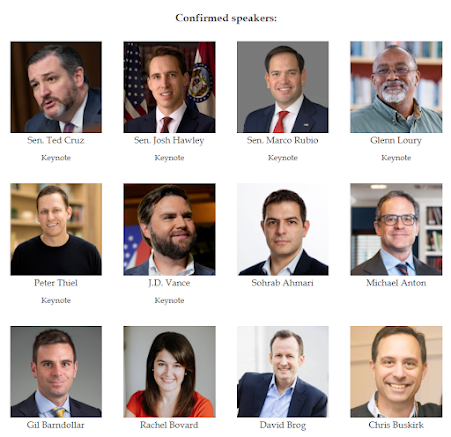
Some of the speakers at the conference
“The left’s ambition is to create a world beyond belonging,” said Hawley. “Their grand ambition is to deconstruct the United States of America. .... The deconstruction of America depends on the deconstruction of American men.”
“The left’s attack is on America. The left hates America,” said Cruz. “It is the left that is trying to use culture as a tool to destroy America.”
“We are confronted now by a systematic effort to dismantle our society, our traditions, our economy, and our way of life,” said Rubio. -- Republican Senators speaking to the National Conservative convention in Orlando, Florida, Oct. 31 - Nov. 2, 2021
Rachel Bovard is one of the thousands of smart young Americans who flock to Washington each year to make a difference. She’s worked in the House and Senate for Republicans Rand Paul, Pat Toomey, and Mike Lee, was listed among the “Most Influential Women in Washington Under 35” by National Journal, did a stint at the Heritage Foundation, and is now policy director of the Conservative Partnership Institute, whose mission is to train, equip, and unify the conservative movement. She’s bright, cheerful, and funny, and has a side hustle as a sommelier. And, like most young people, she has absorbed the dominant ideas of her peer group.
One of the ideas she’s absorbed is that the conservatives who came before her were insufferably naive. They thought liberals and conservatives both want what’s best for America, disagreeing only on how to get there. But that’s not true, she believes. “Woke elites—increasingly the mainstream left of this country—do not want what we want,” she told the National Conservatism Conference, which was held earlier this month in a bland hotel alongside theme parks in Orlando. “What they want is to destroy us,” she said. “Not only will they use every power at their disposal to achieve their goal,” but they’ve already been doing it for years “by dominating every cultural, intellectual, and political institution.”As she says this, the dozens of young people in her breakout session begin to vibrate in their seats. Ripples of head nodding are visible from where I sit in the back. These are the rising talents of the right—the Heritage Foundation junior staff, the Ivy League grads, the intellectual Catholics and the Orthodox Jews who have been studying Hobbes and de Tocqueville at the various young conservative fellowship programs that stretch along Acela-land. In the hallway before watching Bovard’s speech, I bumped into one of my former Yale students, who is now at McKinsey.
Bovard has the place rocking, training her sights on the true enemies, the left-wing elite: a “totalitarian cult of billionaires and bureaucrats, of privilege perpetuated by bullying, empowered by the most sophisticated surveillance and communications technologies in history, and limited only by the scruples of people who arrest rape victims’ fathers, declare math to be white supremacist, finance ethnic cleansing in western China, and who partied, a mile high, on Jeffrey Epstein’s Lolita Express.”
The atmosphere is electric. She’s giving the best synopsis of national conservatism I’ve heard at the conference we’re attending—and with flair! Progressives pretend to be the oppressed ones, she tells the crowd, “but in reality, it’s just an old boys’ club, another frat house for entitled rich kids contrived to perpetuate their unearned privilege. It’s Skull and Bones for gender-studies majors!” She finishes to a rousing ovation. People leap to their feet.
I have the sinking sensation that the thunderous sound I’m hearing is the future of the Republican Party.
This is national conservatism pursued to its logical conclusion: using state power to break up and humble the big corporations and to push back against coastal cultural values. The culture war merges with the economic-class war—and a new right emerges in which an intellectual cadre, the national conservatives, rallies the proletarian masses against the cultural/corporate elites. All your grandparents’ political categories get scrambled along the way.
The NatCons are wrong to think there is a unified thing called “the left” that hates America. This is just the apocalyptic menace many of them had to invent in order to justify their decision to vote for Donald Trump.
They are wrong, too, to think there is a wokeist Anschluss taking over all the institutions of American life. For people who spend so much time railing about the evils of social media, they sure seem to spend an awful lot of their lives on Twitter. Ninety percent of their discourse is about the discourse. Anecdotalism was also rampant at the conference—generalizing from three anecdotes about people who got canceled to conclude that all of American life is a woke hellscape. They need to get out more.
Brooks points out that there are three groups in the NatCon authoritarian movement. The old guard of conservatives over 50 who have been radicalized by liberals and their rhetoric and behavior. Liberal rhetoric about race radicalized one of these people, a Brown University economist. The second group consists of mid-career politicians and operatives who adapting to the populist rage. This group includes Ted Cruz (Princeton, Harvard), J. D. Vance (Yale Law), and Josh Hawley (Stanford and Yale).
NatCons (national conservatives), as they call themselves, see a world in where corporate, media, political and academic elites are all bound together into an axis of evil. According to the NatCon narrative (propaganda and lies), the liberal axis dominates all institutions and it controls the “channels of thought.” One can only wonder, if the channels of thought the that liberals control include Breitbart, Fox News, The Federalist, and the like, these NatCon folks are seriously deluded and way beyond radical extremist conservatism -- they are pure dictator material.
These people are serious about all of this. And, they are resentful, enraged and organized.
NatCons see big tech companies as part of the enemy axis, despite being long-term major donors to Republicans. Ted Cruz summed the NatCon anti-big tech mindset up for the Florida crowd: “Big Tech is malevolent. Big Tech is corrupt. Big Tech is omnipresent.” The NatCons see America as a surveillance state, with every move monitored in the name of liberal control. The propaganda holds that big tech czars secretly decide what ideas and stories get promoted, what get suppressed as part of how “surveillance capitalism” works day-to-day.
NatCon martyrdom propaganda includes sad stories of how evil big tech companies like Twitter and Facebook suppressed a New York Post story on Hunter Biden’s laptop. In the minds of NatCons, radical right lies and propaganda are reality and reality is lies and propaganda. That state of affairs is what Hannah Arendt warned the world about in 1951. Brooks writes that NatCon narrative is one where “profiteers of surveillance capitalism see all and control all.” That is the kind of terrifying deep surveillance state that China has made itself into and uses to monitor and control and shape reality, thought and behavior.
Questions:
1. Is American big tech and liberal politics really as pervasive and all-powerful as the NatCon narrative says? Do liberals routinely arrest conservative dissidents?
2. If what Brooks writes is basically accurate is it reasonable to see the NatCon movement, or whatever one calls this thing, as authoritarian, mostly deceived by propaganda and lies and/or enraged and resentful?
3. Does this article evince what appears to me to be massive projection by what the the radical right believes and does onto the left, e.g., Ted Cruz arguing “It is the left that is trying to use culture as a tool to destroy America”?
4. Is there a liberal axis of evil among big tech (which tends to donate to Democrats), liberal academics, etc., that operates in the name of surveillance capitalism with the aims of destroying America and imposing some form of atheist or socialist liberal tyranny?
Subscribe to:
Posts (Atom)