Etiquette


DP Etiquette

First rule: Don't be a jackass. Most people are good.

Other rules: Do not attack or insult people you disagree with. Engage with facts, logic and beliefs. Out of respect for others, please provide some sources for the facts and truths you rely on if you are asked for that. If emotion is getting out of hand, get it back in hand. To limit dehumanizing people, don't call people or whole groups of people disrespectful names, e.g., stupid, dumb or liar. Insulting people is counterproductive to rational discussion. Insult makes people angry and defensive. All points of view are welcome, right, center, left and elsewhere. Just disagree, but don't be belligerent or reject inconvenient facts, truths or defensible reasoning.

Tuesday, December 14, 2021

The Republican Party’s Leviathan of lies poisons American society

A campaign email from third ranking House Republican Representative Elise Stefanik 
of New York lied when it claimed that the Justice Department was targeting parents
as “domestic terrorists” for challenging critical race theory teaching
Credit...


A new York Times article focuses on blatant lies that at least some Republican candidates now routinely employ to help them raise money for campaigns. The NYT writes:
A few weeks ago, Representative Dan Crenshaw, a Texas Republican, falsely claimed that the centerpiece of President Biden’s domestic agenda, a $1.75 trillion bill to battle climate change and extend the nation’s social safety net, would include Medicare for all.

It doesn’t, and never has. But few noticed Mr. Crenshaw’s lie because he didn’t say it on Facebook, or on Fox News. Instead, he sent the false message directly to the inboxes of his constituents and supporters in a fund-raising email.

Lawmakers’ statements on social media and cable news are now routinely fact-checked and scrutinized. But email — one of the most powerful communication tools available to politicians, reaching up to hundreds of thousands of people — teems with unfounded claims and largely escapes notice.

The New York Times signed up in August for the campaign lists of the 390 senators and representatives running for re-election in 2022 whose websites offered that option, and read more than 2,500 emails from those campaigns to track how widely false and misleading statements were being used to help fill political coffers.

But Republicans included misinformation far more often: in about 15 percent of their messages, compared with about 2 percent for Democrats. In addition, multiple Republicans often spread the same unfounded claims, whereas Democrats rarely repeated one another’s.

At least eight Republican lawmakers sent fund-raising emails containing a brazen distortion of a potential settlement with migrants separated from their families during the Trump administration. One of them, Senator John Kennedy, Republican of Louisiana, falsely claimed that President Biden was “giving every illegal immigrant that comes into our country $450,000.”

Campaign representatives for Mr. Kennedy and Mr. Crenshaw did not respond to multiple requests for comment. The Republican House and Senate campaign committees also did not respond to a request for comment.

The people behind campaign emails have “realized the more extreme the claim, the better the response,” said Frank Luntz, a Republican pollster. “The more that it elicits red-hot anger, the more likely people donate. And it just contributes to the perversion of our democratic process. It contributes to the incivility and indecency of political behavior.”

The messages also underscore how, for all the efforts to compel platforms like Facebook and Twitter to address falsehoods, many of the same claims are flowing through other powerful channels with little notice.

[One expert commented to the NYT:] “Politicians and the consulting firms behind them, they know that this kind of messaging is not monitored to the same extent, so they can be more carefree with what they’re saying.” 
Mr. Luntz, the Republican pollster, runs frequent focus groups with voters and said they tended to accept misinformation uncritically.

“It may be a fund-raising pitch, but very often people look at it as a campaign pitch,” he said. “They think of it as context, they think of it as information — they don’t necessarily see this as fund-raising, even though that’s what it is. And so misleading them in an attempt to divide them from their money is pure evil, because you’re taking advantage of people who just don’t know the difference.

The NYT article comments that one democrat they contacted about false information responded by saying it was a mistake and future emails would be more carefully fact checked. At least there is some respect for truth in that. By contrast, Republicans and the GOP refused to comment to the NYT about lies by Republicans. That probably means the Republicans are not going to stop lying. The Republican Party leadership arguably is in a state of full-blown moral rot, with respect for inconvenient facts and truths almost completely gone. 

Winning, power and wealth are the only moral values left in the GOP leadership now that the moral rot has finished its job. All that is left is a stinking husk of what used to be a reasonably principled political institution. 


Question: Is it pure evil as Mr. Luntz said to deceive people by enraging them or instilling terror in them with lies (emotional manipulation[1]) to raise money for campaigns, or for that matter anything else?


Footnote: 
1. I constantly use the phrase emotional manipulation here. It is useful to understand what I mean by that phrase. I mean it to refer to an emotional state of mind, most commonly from unwarranted fear and anger, but also from unwarranted distrust, moral outrage and disgust. The reason that propagandists appeal to negative emotions is because an emotional state of mind is well-known in cognitive science to cause minds to be more open to the messages that accompany emotion triggers. These emotional states of mind are fact and reason killers and all professional propagandists and high-level politicians know it. Speaking to emotional minds is much a more effective way to get what one wants, including money and votes. Making up anger- or fear-inducing lies is usually the best way to establish the pliant emotional state of mind that propagandists need to do their dirty work. Sometimes truth can establish fear and/or anger, but truth and reality is usually less effective.

A post here from last February focused on this issue in the context of emotions in preaching to Evangelical Christian congregations. To increase congregation size and cash donations, pastors are told to instill fear and anger. The emotional manipulation tactic is not limited to just politics.  It also causes moral rot in religion, commerce and probably most everything else. 
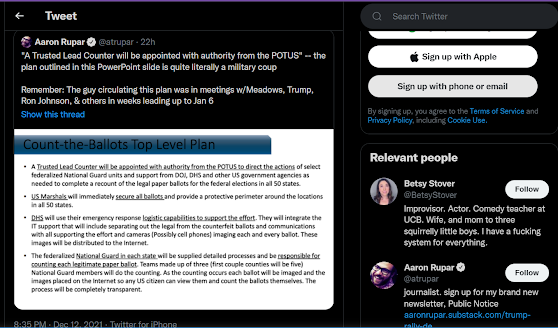
Trump’s next coup attempt has begun

Tweet describing some of the plan high-level Republicans 
were circulating before the 1/6 coup attempt


Republican attacks on democracy are not close to over. They are expanding and building the infrastructure to put the ex-president back in power in 2024. The Atlantic writes in a long, discouraging Dec. 6, 2021 article:
January 6 was practice. Donald Trump’s GOP is much better positioned to subvert the next election.

Technically, the next attempt to overthrow a national election may not qualify as a coup. It will rely on subversion more than violence, although each will have its place. If the plot succeeds, the ballots cast by American voters will not decide the presidency in 2024. Thousands of votes will be thrown away, or millions, to produce the required effect. The winner will be declared the loser. The loser will be certified president-elect.

The prospect of this democratic collapse is not remote. People with the motive to make it happen are manufacturing the means. Given the opportunity, they will act. They are acting already.

Who or what will safeguard our constitutional order is not apparent today. It is not even apparent who will try. Democrats, big and small D, are not behaving as if they believe the threat is real. Some of them, including President Joe Biden, have taken passing rhetorical notice, but their attention wanders. They are making a grievous mistake.

“The democratic emergency is already here,” Richard L. Hasen, a professor of law and political science at UC Irvine, told me in late October. Hasen prides himself on a judicious temperament. Only a year ago he was cautioning me against hyperbole. Now he speaks matter-of-factly about the death of our body politic. “We face a serious risk that American democracy as we know it will come to an end in 2024,” he said, “but urgent action is not happening.”

For more than a year now, with tacit and explicit support from their party’s national leaders, state Republican operatives have been building an apparatus of election theft. Elected officials in Arizona, Texas, Georgia, Pennsylvania, Wisconsin, Michigan, and other states have studied Donald Trump’s crusade to overturn the 2020 election. They have noted the points of failure and have taken concrete steps to avoid failure next time. Some of them have rewritten statutes to seize partisan control of decisions about which ballots to count and which to discard, which results to certify and which to reject. They are driving out or stripping power from election officials who refused to go along with the plot last November, aiming to replace them with exponents of the Big Lie. They are fine-tuning a legal argument that purports to allow state legislators to override the choice of the voters.

By way of foundation for all the rest, Trump and his party have convinced a dauntingly large number of Americans that the essential workings of democracy are corrupt, that made-up claims of fraud are true, that only cheating can thwart their victory at the polls, that tyranny has usurped their government, and that violence is a legitimate response.

As we near the anniversary of January 6, investigators are still unearthing the roots of the insurrection that sacked the Capitol and sent members of Congress fleeing for their lives. What we know already, and could not have known then, is that the chaos wrought on that day was integral to a coherent plan. In retrospect, the insurrection takes on the aspect of rehearsal.

Even in defeat, Trump has gained strength for a second attempt to seize office, should he need to, after the polls close on November 5, 2024. It may appear otherwise—after all, he no longer commands the executive branch, which he tried and mostly failed to enlist in his first coup attempt. Yet the balance of power is shifting his way in arenas that matter more.  
Trump is successfully shaping the narrative of the insurrection in the only political ecosystem that matters to him. The immediate shock of the event, which briefly led some senior Republicans to break with him, has given way to a near-unanimous embrace.  
Trump has reconquered his party by setting its base on fire. Tens of millions of Americans perceive their world through black clouds of his smoke. His deepest source of strength is the bitter grievance of Republican voters that they lost the White House, and are losing their country, to alien forces with no legitimate claim to power. This is not some transient or loosely committed population. Trump has built the first American mass political movement in the past century that is ready to fight by any means necessary, including bloodshed, for its cause.  
“It’s the community’s support that is creating a mantle of legitimacy—a mandate, if you would, that justifies the violence” of a smaller, more committed group, Pape said. “I’m very concerned it could happen again, because what we’re seeing in our surveys … is 21 million people in the United States who are essentially a mass of kindling or a mass of dry wood that, if married to a spark, could in fact ignite.”

Democracy will be on trial in 2024. A strong and clear-eyed president, faced with such a test, would devote his presidency to meeting it. Biden knows better than I do what it looks like when a president fully marshals his power and resources to face a challenge. It doesn’t look like this.

The midterms, marked by gerrymandering, will more than likely tighten the GOP’s grip on the legislatures in swing states. The Supreme Court may be ready to give those legislatures near-absolute control over the choice of presidential electors. And if Republicans take back the House and Senate, as oddsmakers seem to believe they will, the GOP will be firmly in charge of counting the electoral votes.

Against Biden or another Democratic nominee, Donald Trump may be capable of winning a fair election in 2024. He does not intend to take that chance.

The article goes on at length about deceived believers, increased openness about willingness to resort to violence to get justice and defend democracy as they see those things. The delusions and false beliefs come this authoritarian political movement come out loud and clear. The article discusses other deeply troubling aspects of this toxic, anti-democratic pro-Trump movement.  


Questions: How many Americans believe this narrative? Does Biden or the Democratic Party? How can one apportion blame for this, assuming one sees any blame to apportion, e.g., ~55% Trump, ~45% the Republican Party leadership and its rank and file supporters? 


Nov. 6, 2020 Stop the Steal protest in Detroit --
the rage and hate is palpable, and so is the delusion

Monday, December 13, 2021

Time Person of the Year - Elon Musk?


Elon Musk named Time magazine's 2021 Person of the Year


EGADS! Seriously?

Time's Person of the Year, 1927-Present


Elon Musk? Don't say it is so!!

OK, so - what would YOUR choice have been?

Fauci? Pelosi? Why an American? How about Angela Merkel? She was legendary in her time as Chancellor for Germany and for the EU. A nice honor for her on her parting politics?

My idea? There is precedence for my choice:

2014
Person of the YearThe Ebola Fighters

So why not the Health Care Workers of the World for 2021? THAT would have been my choice.

The kinds of things the 1/6 insurrectionist conspirators did


The ex-president's former chief of staff has stopped cooperating with the Democratic House investigation of the 1/6 coup attempt about who was involved and what they did. Nearly all congressional Republicans refuse to talk about it. The New York Times lists some of the reasons the Democrats are citing in their contempt of Congress charge against Meadows. Emails and text messages that Meadows had turned over and the House wanted to ask him about includes the following matters:
  • A Nov. 7 email that discussed an attempt to arrange with state legislators to appoint slates of pro-Trump electors instead of the Biden electors chosen by the voters. Mr. Meadows’s text messages also showed him asking members of Congress how to put Mr. Trump in contact with state legislators.
  • Text messages Mr. Meadows exchanged with an unidentified senator in which he recounted Mr. Trump's view on Vice President Mike Pence’s ability to reject electors from certain states. Mr. Trump “thinks the legislators have the power, but the VP has power too,” Mr. Meadows wrote.
  • A Jan. 5 email in which Mr. Meadows said the National Guard would be present at the Capitol on Jan. 6 to “protect pro Trump people.”
  • Emails from Mr. Meadows to Justice Department officials on Dec. 29, Dec. 30 and Jan. 1 in which he encouraged investigations of voter fraud, including allegations already rejected by federal investigators and courts
  • Text messages Mr. Meadows exchanged with members of Congress as violence engulfed the Capitol on Jan. 6 in which lawmakers encouraged him to persuade Mr. Trump to discourage the attack, as well as a text message sent to one of the president’s family members in which Mr. Meadows said he was “pushing hard” for Mr. Trump to “condemn this.”
  • Text messages reflecting Mr. Meadows’s private skepticism about some of the wild public statements about allegations of widespread election fraud and compromised voting machines that were put forth by Sidney Powell, a lawyer working with Rudolph W. Giuliani, Mr. Trump’s personal lawyer.

Some of those things are truly damning for people who argue the 1/6 coup attempt was no big deal and not anything to be concerned about. It was a huge, deeply concerning event. It also shows the ex-president knew full well that he was fomenting lies about the 2020 election being stolen. The mendacity of the GOP on this matter is blatant. The lies should be shocking, but the the morally rotten ex-president and morally rotted Republican Party have normalized blatant partisan mendacity. These days, most everyone either expects blatant lies or they believe Republican mendacity does not exist, but Democrats lie all the time.

The NYT also pointed out that the Democrats cited Meadows’s new book “The Chief’s Chief” as evidence that his refusal to testify to Congress was untenable. His voluntary public statements in the book and social media show his willingness to talk about these issues. The 51 page House report[1] comments: “Mr. Meadows has shown his willingness to talk about issues related to the Select Committee’s investigation across a variety of media platforms — anywhere, it seems, except to the Select Committee.” 

Whether the House contempt charge allegation will amount to anything of significance for Meadows is an open question. The Biden administration has unilaterally abandoned the rule of law for Republican political criminals. That, coupled with the glacial pace of how House Democrats are proceeding, indicates that Meadows will probably face no significant legal repercussions. Once the Dems lose the House to the Repubs after the 2022 elections, Republicans in control will drop the 1/6 investigation. They will then rewrite history and simply state that the 1/6 coup attempt as just a teapot tempest of no significance.
 

Question: It is reasonable to think the Biden administration has unilaterally abandoned the rule of law for Republican political criminals? 


Footnote: 
1. The House resolution includes this: 
An individual who fails or refuses to comply with a House subpoena may be cited for contempt of Congress. Pursuant to 2 U.S.C. § 192, the willful refusal to comply with a congressional subpoena is punishable by a fine of up to $100,000 and imprisonment for up to 1 year. .... proving criminal intent in this context is no more than showing a ‘‘deliberate’’ ‘‘refusal to answer pertinent questions’’; it does not require a showing of ‘‘moral turpitude.’’ .... A committee may vote to seek a contempt citation against a recalcitrant witness. This action is then reported to the House. If a resolution to that end is adopted by the House, the matter is referred to a U.S. Attorney, who has a duty to refer the matter to a grand jury for an indictment.