Opinion: GOP ‘built on fraud, fear and fascism’? If the jackboot fits...There were even more vermin than usual in Washington this week. A rabid fox at the Capitol bit at least nine people, including Rep. Ami Bera (D-Calif.). And Democratic National Committee Chair Jaime Harrison attacked Sen. Tom Cotton (R-Ark.) with an insult most entomological.After Cotton implied that Supreme Court Justice-designate Ketanji Brown Jackson is a Nazi sympathizer, Harrison referred to Cotton as a “little maggot-infested man” on MSNBC’s “Morning Joe.”
Fake news! Cotton may go low, but, at 6-foot-5, he is not little. Also, maggots typically feed on dead things, and Cotton, though stiff, is not currently deceased. The man likes to carry on, but he is not carrion.Harrison went on to censure the Republican Party as a whole: “It is a party built on fraud, fear and fascism.” Interestingly, a statement from the Republican National Committee taking offense at the “maggot-infested” charge did not dispute the “fraud, fear and fascism” formulation. As your self-appointed fact-checker, I have therefore examined the merits of the accusation.
FraudSixteen months after President Donald Trump’s claims of election fraud failed in some 60 court cases, we have finally found evidence of potential voter fraud. Trump’s White House staff chief, Mark Meadows, reportedly registered to vote in 2020 using the address of a mobile home he never lived in. And former Trump State Department official Matt Mowers, a current congressional candidate, voted twice during the 2016 primaries, in New Hampshire and New Jersey.
The “big lie” about a rigged election, accepted by two-thirds of Republican voters, has spawned new frauds about the dangers of coronavirus vaccines (leading to sharply higher death rates in heavily Republican counties) and the promise, touted by Sen. Ron Johnson (R-Wis.) of the deworming drug ivermectin to treat covid-19; an exhaustive new study finds the drug useless.
Then there are the little everyday frauds. Just days after Rep. Madison Cawthorn (R-N.C.) told the world that his colleagues engage in coke-fueled orgies, Rep. Lisa McClain (R-Mich.) declared at a Trump rally that it was Trump who “caught Osama bin Laden,” record-low unemployment is at a “40-year high” and there weren’t “any wars” during Trump’s presidency. Never mind Syria and Afghanistan.
Fear
Sen. Ted Cruz (R-Tex.) said people like Ketanji Brown Jackson become public defenders because “their heart is with the murderers.” Cotton said Justice Robert H. Jackson “left the Supreme Court to go to Nuremberg and prosecute the case against the Nazis. This Judge Jackson might have gone there to defend them.”
Republican senators used the Jackson confirmation to stir fear of minorities and vulnerable groups with manufactured crises about transgender athletes (of the 200,000 participants in women’s collegiate sports, perhaps 50 are transgender) and “critical race theory” (which isn’t taught in public schools [Note: that assertion is open to dispute]).
Ohio Republican Senate candidate J.D. Vance released an ad saying “Biden’s open border is killing Ohioans, with more illegal drugs and more Democrat voters pouring into this country.”At a Trump-hosted screening at Mar-a-Lago this week of “Rigged: The Zuckerberg Funded Plot to Defeat Donald Trump,” a poster showed Mark Zuckerberg “devilishly grabbing cash,” The Post’s Josh Dawsey reported. The film repeatedly describes the Jewish billionaire’s money as “Zuckerbucks” — even though the Anti-Defamation League objected to the term as an antisemitic trope about wealthy Jewish control.
Fascism
Sixty-three House Republicans — 30 percent of the caucus — voted against a resolution this week affirming unequivocal support for NATO as authoritarian Russia attacks democratic Ukraine.
A Republican National Committee resolution, never rescinded, refers to the Capitol insurrection not as an authoritarian attempt to overthrow democracy and keep the defeated Trump in power but as “legitimate political discourse.” And Trump expresses regret he didn’t march to the Capitol with the insurrectionists.
Republican-run states are racing to follow Florida’s “don’t say gay” legislation that bans teaching about sexual orientation or gender identity, which follows similar efforts to ban certain teaching about race and history, and widespread efforts to ban books about race, sexuality, gender and police brutality.
The Florida legislature approved an “election crimes” police force for Gov. Ron DeSantis (R), with the potential to intimidate voters, while various GOP-led states move forward with new provisions providing residents with incentives to inform on each other.
The newly-revealed text messages of Justice Clarence Thomas’s activist wife, Ginni, show her sharing with the Trump White House her “hope” that the “Biden crime family” as well as elected officials, bureaucrats and journalists would be taken to “barges off GITMO to face military tribunals for sedition.”
**
Is the GOP “a party built on fraud, fear and fascism”? Certainly, not all Republicans think this way. But too many others are subverting democracy, cavorting with white nationalists, spreading racist fears and fantasizing about extrajudicial punishment for political opponents and the media. For them, the jackboot fits.
Pragmatic politics focused on the public interest for those uncomfortable with America's two-party system and its way of doing politics. Considering the interface of politics with psychology, cognitive biology, social behavior, morality and history.
Etiquette
Friday, April 8, 2022
I think some of the Dems are starting to get it, finally
Thursday, April 7, 2022
The terrifying iron grip of Christian nationalism on the GOP
The Growing Religious Fervor in the American Right: ‘This Is a Jesus Movement’Rituals of Christian worship have become embedded in conservative rallies, as praise music and prayer blend with political anger over vaccines and the 2020 election.They opened with an invocation, summoning God’s “hedge of thorns and fire” to protect each person in the dark Phoenix parking lot.
They called for testimonies, passing the microphone to anyone with “inspirational words that they’d like to say on behalf of our J-6 political prisoners,” referring to people arrested in connection with the Jan. 6, 2021, attack on the Capitol, whom they were honoring a year later.
Then, holding candles dripping wax, the few dozen who were gathered lifted their voices, a cappella, in a song treasured by millions of believers who sing it on Sundays and know its words by heart:Way maker, miracle worker, promise keeperLight in the darkness, my GodThat is who you are …
This was not a church service. It was worship for a new kind of congregation: a right-wing political movement powered by divine purpose, whose adherents find spiritual sustenance in political action.
The Christian right has been intertwined with American conservatism for decades, culminating in the Trump era. And elements of Christian culture have long been present at political rallies. But worship, a sacred act showing devotion to God expressed through movement, song or prayer, was largely reserved for church. Now, many believers are importing their worship of God, with all its intensity, emotion and ambitions, to their political life.At events across the United States, it is not unusual for participants to describe encountering the divine and feel they are doing their part to install God’s kingdom on earth. For them, right-wing political activity itself is becoming a holy act.
These Christians are joining secular members of the right wing, including media-savvy opportunists and those touting disinformation. They represent a wide array of discontent, from opposing vaccine mandates to promoting election conspiracy theories. For many, pandemic restrictions that temporarily closed houses of worship accelerated their distrust of government and made churchgoing political.
At a Trump rally in Michigan last weekend, a local evangelist offered a prayer that stated, “Father in heaven, we firmly believe that Donald Trump is the current and true president of the United States.” He prayed “in Jesus’ name” that precinct delegates at the upcoming Michigan Republican Party convention would support Trump-endorsed candidates, whose names he listed to the crowd. “In Jesus’ name,” the crowd cheered back.
With spiritual mission driving political ideals, the stakes of any conflict, whether over masks or school curriculums, can feel that much larger, and compromise can be even more difficult to achieve. Political ambitions come to be about defending God, pointing to a desire to build a nation that actively promotes a particular set of Christian beliefs.
“What is refreshing for me is, this isn’t at all related to church, but we are talking about God,” said Patty Castillo Porter, who attended the Phoenix event. She is an accountant and officer with a local Republican committee to represent “the voice of the Grassroots/America First posse,” and said she loved meeting so many Christians at the rallies she attends to protest election results, border policy or Covid mandates.
“Now God is relevant,” she said. “You name it, God is there, because people know you can’t trust your politicians, you can’t trust your sheriffs, you can’t trust law enforcement. The only one you can trust is God right now.”
Why Conservative Parts of the U.S. Are So Angry
Decades of political decisions and policies have created a massive and growing chasm between the economic and social disaster unfolding in small-town and rural parts of the United States, and the prosperity and safety of cities and suburbs. Many of those successful urban and suburban areas have reaped the rewards of electing largely moderate, competent Democratic leaders. Meanwhile, rural areas have elected Republicans drawn from a party that is increasingly incompetent, corrupt, and willing to engage in outright racism to win elections.
This disparity may affirm progressive ideas about successful and inclusive governance, but it also holds grave implications for the country as a whole.
Anger is roiling in Republican America, along with conspiratorial fabrications about who to blame for their condition. A harbinger of this trend is Antlers, Oklahoma, where I grew up: a once-thriving town in the southeastern part of the state, bordering the lush Ouachita foothills of dense forests, abundant agriculture, and lucrative tourism resources. The town rebuilt after a devastating 1945 tornado, but it has not weathered 21st century politics.
Racially and politically, Antlers is typical of much of rural Oklahoma, a state forged from the 19th century territory set aside for Native American tribes forcibly removed from other parts of the United States. Antlers is now 75% White and 22% Native American or mixed race, but with very few Latino, Asian, or Black residents. In 2020, Antlers and its county, Pushmataha—which supported former President Bill Clinton in 1996 and even Jimmy Carter over Ronald Reagan in 1980—voted for Republicans, 85% to the Democrats’ 14%, up from an 80% share for Republicans in 2016, 54% in 2000, and 34% in 1996.
Antlers’ social statistics are beyond alarming. Nearly one-third of its residents live in poverty. The median household income, $25,223, is less than half Oklahoma’s $55,557, which in turn is well below the national median of $74,099 in January 2022.
The best-off ethnic group in Antlers is Native Americans (median household income, $35,700; 48% with education beyond high school; 25% living in poverty). That’s still well below the national median, but the conditions of the White population are dismal: a median household income of $24,800, only 41% with any post-high school education, and 30% living in poverty.
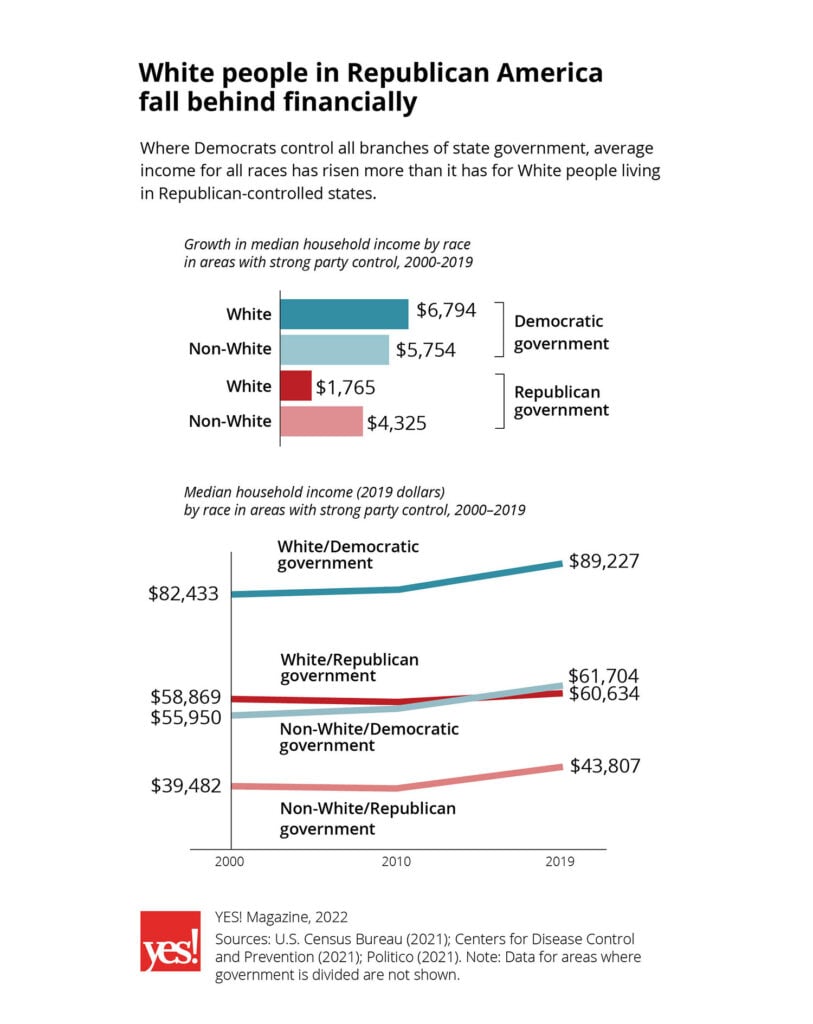
In a growing nationwide trend, the median household incomes of people of color, according to the U.S. Census Bureau, now exceed those of White people in nearly 200 of the 1,500 Republican-trifecta counties—those in which the party controls the governor’s office and both legislative chambers of state government (see Figure 1). This is a visible factor that has fueled Trump voters’ complaints alleging White people’s diminished status.

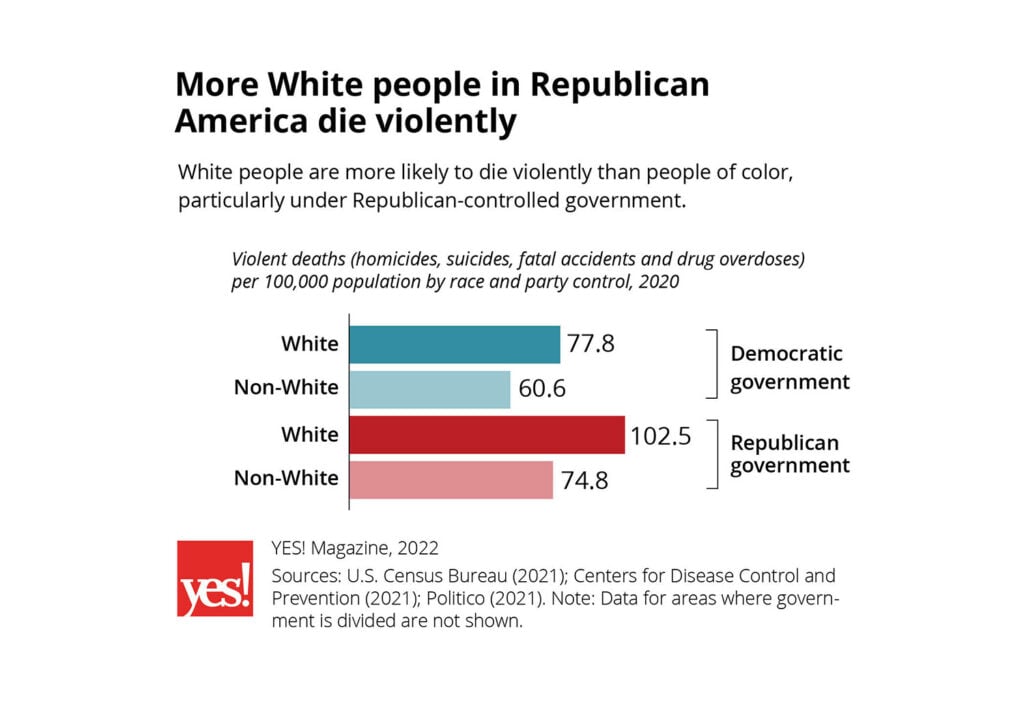
In the most telling statistics, White people in Antlers are nearly twice as likely to die by guns as Native Americans (see Figure 2). Compared with Whites nationally, Antlers Whites suffer excessive death rates from drugs and alcohol (1.3 times the national average), suicide (1.5 times), all violent deaths (1.8 times), homicide (2.5 times), and gunfire (2.6 times).

The numbers on paper look bad enough. Seeing them on the ground is a new kind of scary. When I was growing up in Antlers 60 years ago and visited it 20 years ago, my family’s old block consisted of well-kept middle-class homes fronting yards for chickens and horses. On my latest visit in January 2022, I found the houses all boarded up or blowing open in the wind (see photo at top). There are hundreds of abandoned dwellings with collapsing roofs and walls and junk-filled empty lots alongside barely intact, yet still occupied, houses.
Antlers is not all devastation, however. It sports a gleaming Choctaw-built travel center financed by casino revenues, which are also invested in local Native Americans’ well-being. And there are some thriving neighborhoods, including a ritzy mansion suburb uphill from town. Antlers’ 2,300 residents can avail three liquor stores and seven new marijuana dispensaries.
A Widening Social and Economic Chasm
Across America, the partisan gap in gross domestic product per capita is also huge and growing: $77,900 in Democratic-voting areas, compared with $46,600 in Republican-voting areas. Antlers and Pushmataha County are hardly alone: 444 Republican counties have a GDP per capita of under $30,000, and 10 times as many people live in those counties than in the seven similarly low-GDP Democratic counties. Whites in about 40% of all Republican counties lost income over the past two decades. And Trump’s administration was no help to his base. During his presidency, the overall Democrat–Republican GDP per capita gap widened by another $1,800.
This is not simply an urban–rural divide. For the largest urbanized states, the three with Democratic control of all branches of government (California, New York, and Illinois) had GDPs per capita vastly higher than the three biggest Republican-controlled states (Texas, Florida, and Ohio).
The right-wing canard that hardworking White people subsidize welfare-grubbing cities is backward. Democrat-voting counties, with 60% of America’s population, generate 67% of the nation’s personal income, 70% of the nation’s GDP, 71% of federal taxes, 73% of charitable contributions, and 75% of state and local taxes.
Mirroring Antlers, White Republican America also suffers violent death rates, including from suicide, homicide, firearms, and drunken driving crashes, far higher than Whites in Democratic America and higher than non-White people everywhere. To top it off, Republican-governed Americans are substantially more likely to die from COVID-19. As the death gap between Republican and Democratic areas widens over time, the life expectancy for Whites in Republican-voting areas (77.6 years) is now three years shorter than that of Whites in Democratic areas (80.6 years), shorter than those of Asians and Latino people everywhere, and only a few months longer than Black and Native Americans in Democratic areas.
Misplaced Blame
Surveys and studies consistently find Trump’s generally older, White supporters enraged at “loss of status” and in fear of being “replaced” by non-White people. That White people are falling behind across key economic, health, and safety indexes is not due to victimization by immigrants and liberal conspiracies, however, but to victimization by other Whites and self-inflicted alcoholism, drug overdose, and suicide.
Is the solution to undividing America massive federal programs to improve Republican America’s struggling economies and troubled social conditions, then? Aside from the problem that Republican members of congress (and two recalcitrant Democrats) have sabotaged beneficial initiatives, former President Barack Obama already tried that. From 2010 to 2016, the Obama administration’s economic recovery measures fostered millions of new jobs and thousands of dollars in real median income growth for Whites in urban and most rural areas alike, reversing the recession under Republican George W. Bush’s presidency.
Yet, despite these gains, White voters vehemently rejected Democrats in successive elections. Today, Trump’s base voters are electing candidates who share their racial resentment and imagined victimization, not those who actually are advancing their safety and economic well-being.
Despite the superficial resemblance of the crumbling neighborhoods, junk-filled lots, and widespread poverty of Antlers and conditions in a devastated city of color like Camden, New Jersey, the origins of their devastations are very different. Camden is the product of systemic racism and industrial abandonment inflicted on poor, primarily non-White residents powerless to prevent their exploitation. Antlers is the predictable endgame of White majorities who had better options instead empowering incompetent, corrupt demagogues (segregationist Democrats in the past; nihilist Republicans today) who flatter White claims to racial and religious privilege while awarding largesse to rapacious outsiders.
Poverty in cities and on reservations requires mainly the sustained political will to work with populations who welcome the effort. In stark contrast, fixing rural White poverty against the angry, anti-democratic recalcitrance of most Whites themselves requires an entirely new political thinking we have yet to imagine.
![]() | MIKE MALES is a senior researcher for the Center on Juvenile and Criminal Justice, the principal investigator for YouthFacts, and the author of five books on American youth. |
Tuesday, April 5, 2022
Disintegration of deterrence against nuclear war
Russia’s military doctrine encompasses a broad range of potential national security threats, including local, or small-scale wars, regional, or large-scale wars, internal and foreign military threats, the Russian military’s budget, and a host of military-related technical, political, social, and economic issues. Additionally, the doctrine defines the circumstances under which nuclear weapons are to be used by the Armed Forces of the Russian Federation in response to a threat to Russia’s national security.
The current edition of the Russian military doctrine—when compared to the national security strategy and military doctrine published in 1993—significantly lowers the threshold under which the use of nuclear weapons is permitted. While the 1993 doctrine allowed the first use of nuclear weapons only when the “existence of the Russian Federation” is threatened, the versions published since 2000 explicitly state that Russia “reserves the right to use nuclear weapons to respond to all weapons of mass destruction attacks” on Russia and its allies.
Furthermore, the doctrine released in 2000—and all subsequent versions—allows for nuclear weapons use “in response to large-scale aggression utilizing conventional weapons in situations critical to the national security of the Russian Federation.” Succinctly put, Russia’s entire national security strategy is predicated on the concept of nuclear de-escalation.
Since Russia released its 2014 National Defense Strategy, and especially after the publication of America’s 2018 Nuclear Posture Review, U.S. officials, pundits, and national security wonks have used the phrase either to describe Russia’s strategy, or as a launching point to criticize that description. Buzz phrases like “escalate to de-escalate” tend to spread through officialdom where they are misunderstood and misused as quickly as they are shared. The problem with the term is not that Russia doesn’t have capacity or plans to use calculated escalation (nuclear or otherwise) to contain or terminate a conflict. It’s that such escalation is only one part of a larger strategic approach, and the focus on Moscow’s nuclear threshold risks missing the forest for the trees.
Russia’s approach to conflict is better described as “escalation control,” a concept that was a part of the American strategy lexicon until the end of the Cold War. The United States, facing non-peer adversaries in post-Cold War conflicts, has been able to dominate opponents at any level of conflict where an adversary is capable. Under this framework of “escalation dominance,” careful calculations of thresholds and escalation triggers have been more a matter of preference than necessity for state survival. Russia, on the other hand, has had no such advantage vis-ร -vis the West and has instead adopted escalation control — a strategic approach that relies on carefully calculated, proactive measures to ensure a conflict is contained at lower, more acceptable levels. Through this approach Russia can control the level of conflict escalation, dominating the mechanics and circumstances of escalation rather than dominating conflict levels themselves. De-escalating actions are just one tool in this strategy’s larger toolbox.
“Escalate to de-escalate” tends to focus solely on Russia’s thresholds for nuclear weapons use, rather than taking a holistic approach to conflict. De-escalatory strikes are essentially an action to deter further aggression — that is, to control escalation – but such actions do not need to take place in the nuclear realm. For instance, Russia “escalated to de-escalate” in 2015 and 2016, when it deployed S-400 and S-300 air defense systems to Syria, against the backdrop of increasing tensions between U.S. and Russian forces operating in close proximity there. As one U.S. official quipped when asked about the intent behind the 2016 S-300 deployments, “Nusra doesn’t have an air force do they?” The United States took note of the possibility Russians might shoot down a U.S. aircraft. The increased risk that both nations would stumble into a conflict forced the Pentagon to avoid sustained unilateral actions against regime forces (limited cruise missile strikes aside) because the potential gains did not justify the risk of direct conflict with Russia. In ZAPAD-2017, another example, tactical nuclear weapons were not incorporated into the exercise scenario, but the exercise nonetheless showed how Russia planned to use overwhelming artillery and rocket fire to change the enemy’s cost-benefit analysis. De-escalatory actions don’t have to use nuclear weapons.
In the world of nuclear weapons, tactical means an exceedingly large amount of explosive energy and strategic means even larger. Most nuclear weapons today are variable-yield, or “dial-a-yield,” providing a set amount of explosive energy that can range from fractions of a kiloton to multiples of a megaton. (For example, the U.S.’s newest version of its B61 nuclear bomb can release 0.3, 1.5, 10 or 50 kilotons of explosive energy. In comparison, the Hiroshima bomb was about 15 kilotons.) Russia has about 4,500 nuclear warheads in its arsenal. Of these, the ones of largest yield—the “strategic” weapons—are deployed on submarines, bombers and intercontinental ballistic missiles.
But Russia also possesses some 2,000 tactical nuclear weapons kept in storage facilities throughout the country, developed to be used against troops and installations in a small area or in a limited engagement. Such weapons can be launched on the same short-range missiles Russia is currently using to bombard Ukraine, such as its Iskander ballistic missile, which has a range of about 500 kilometers. And these are not the only tactical weapons that could be deployed; the United States has about 100 nuclear “gravity bombs” (with less sophisticated guidance) stationed around Europe.
Tactical nuclear weapons exist because each side fears it would be deterred from using its big city-razing weapons by their very destructiveness. By making nuclear weapons smaller and the targeting more precise, their use becomes more thinkable. Paradoxically, while this makes deterrence threats more credible, it also makes the arms more tempting to use first, rather than simply in retaliation.
No one should imagine, however, that it makes sense to use a tactical nuclear weapon. A thermonuclear explosion of any size possesses overwhelming destructive power. Even a “small-yield” nuclear weapon (0.3 kilotons) would produce damage far beyond that of a conventional explosive.