Etiquette


DP Etiquette

First rule: Don't be a jackass. Most people are good.

Other rules: Do not attack or insult people you disagree with. Engage with facts, logic and beliefs. Out of respect for others, please provide some sources for the facts and truths you rely on if you are asked for that. If emotion is getting out of hand, get it back in hand. To limit dehumanizing people, don't call people or whole groups of people disrespectful names, e.g., stupid, dumb or liar. Insulting people is counterproductive to rational discussion. Insult makes people angry and defensive. All points of view are welcome, right, center, left and elsewhere. Just disagree, but don't be belligerent or reject inconvenient facts, truths or defensible reasoning.

Monday, May 1, 2023

Science: Electronic circuits learning by mimicking neurons and brains

Neuron anatomy

An interesting area of research is efforts to build electronic circuitry that works like what is known so far about how the human brain works. As one might imagine, progress is slow and incremental. But at least progress is still not stymied by some fundamental barrier that cannot be overcome. So, machines continue to slowly pick up aspects of what goes on in brains, or at least what is believed to go on in brains.

Science Daily writes about a recent physics paper in Science Advances, Neuromorphic learning, working memory, and metaplasticity in nanowire networks:
"In this research we found higher-order cognitive function, which we normally associate with the human brain, can be emulated in non-biological hardware," Dr Loeffler said.

"This work builds on our previous research in which we showed how nanotechnology could be used to build a brain-inspired electrical device with neural network-like circuitry and synapse-like signalling.

"Our current work paves the way towards replicating brain-like learning and memory in non-biological hardware systems and suggests that the underlying nature of brain-like intelligence may be physical."

Nanowire networks are a type of nanotechnology typically made from tiny, highly conductive silver wires that are invisible to the naked eye, covered in a plastic material, which are scattered across each other like a mesh. The wires mimic aspects of the networked physical structure of a human brain. 
Advances in nanowire networks could herald many real-world applications, such as improving robotics or sensor devices that need to make quick decisions in unpredictable environments. 
To test the capabilities of the nanowire network, the researchers gave it a test similar to a common memory task used in human psychology experiments, called the N-Back task.

For a person, the N-Back task might involve remembering a specific picture of a cat from a series of feline images presented in a sequence. An N-Back score of 7, the average for people, indicates the person can recognise the same image that appeared seven steps back.

When applied to the nanowire network, the researchers found it could 'remember' a desired endpoint in an electric circuit seven steps back, meaning a score of 7 in an N-Back test.

"What we did here is manipulate the voltages of the end electrodes to force the pathways to change, rather than letting the network just do its own thing. We forced the pathways to go where we wanted them to go," Dr Loefflersaid.

"When we implement that, its memory had much higher accuracy and didn't really decrease over time, suggesting that we've found a way to strengthen the pathways to push them towards where we want them, and then the network remembers it.

"Neuroscientists think this is how the brain works, certain synaptic connections strengthen while others weaken, and that's thought to be how we preferentially remember some things, how we learn and so on."  
The researchers said when the nanowire network is constantly reinforced, it reaches a point where that reinforcement is no longer needed because the information is consolidated into memory.

"It's kind of like the difference between long-term memory and short-term memory in our brains," Professor Kuncic said.
The paper's discussion hints at the incremental, small-step nature of this kind of research:
This study is the first to demonstrate a nontrivial cognitive task— inspired by the WM n-back task—in a physical non–CMOS (complementary metal-oxide semiconductor) substrate with native neuromorphic properties (i.e., not requiring implementation of neuromorphic algorithms). 

In a previous study, Neftci and colleagues (53) demonstrated a simple cognitive task by emulating spiking neurons in a CMOS system. Their method used an intermediate computational layer in which silicon neurons are configured as soft winner-take-all (WTA) networks (54).  
In conclusion, by applying supervised and reinforcement learning strategies similar to those operating in the brain, we have demonstrated working memory and memory consolidation in nanowire networks. These higher-order cognitive functions were achieved by implementing a nontrivial cognitive task routinely applied to human subjects. Results reveal that neuromorphic learning paradigms implemented in nanowire networks leverage similar mechanisms to the brain, namely, synaptic metaplasticity and synaptic strengthening and pruning, to optimize working memory and memory consolidation.
Working memory ≈ short term memory used for tasks a brain is working on; a small amount of information in the mind that is readily available for a short period of time; when short-term memories are not actively maintained, they last a few seconds then disappear; current data indicates that human short-term memory can hold only seven items at once, plus or minus two

Memory consolidation ≈ long term memory


How a nanowire network (NWN) is made,
what it looks like and what it acts like  
A NWN was first made, and its possession of some neuron-like properties described, in this paper in 2019. Although I don't completely understand what is going on here, a NWN strikes me as a strange, fascinating and improbable way to mimic a brain. 

Short segments, ~14 nanometer long, of ~360 nanometer diameter polymer coated silver (Ag) wire in a ethanol and polymer solution are placed into an area of silica on an electronic device having small gold electrodes at the edges of the area (An average human hair has a diameter of 80 micrometers, or 80,000 nanometers). The wire, actually more like particles or little cylinders of silver ~14 nanometer long, has a thin coating of a biocompatible polymer (polyvinylpyrrolidone or PVP in this case). Once the ethanol evaporates, a mesh of silver wires/particles is left behind in between the gold electrodes. In places where the cylinders touch, the material at that point acts like an electrical switch that resembles a synapse in neurons.
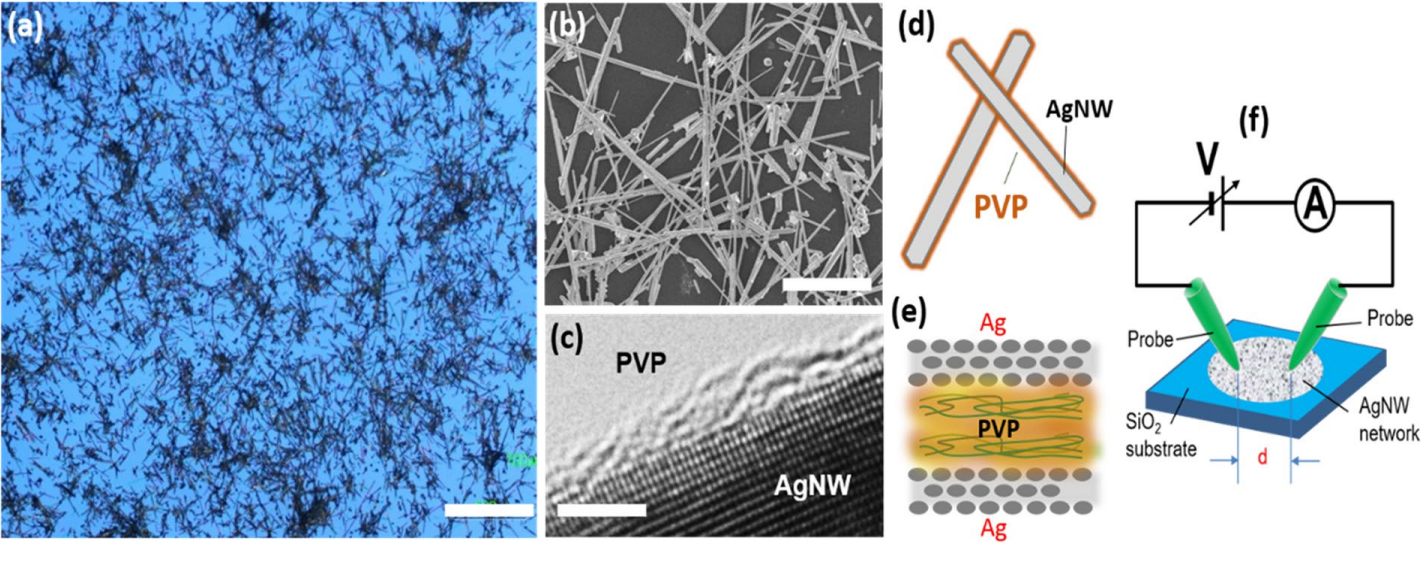
Figure 1. Morphological and structural properties of PVP-coated Ag (silver) nanowires and nanowire network. (a) Optical micrograph image of nanowire network layout after drop-cast deposition on a silica substrate. (b) Scanning electron micrograph image of nanowire interconnectivity in a selected area of the network. (c) High resolution transmission electron micrograph image showing the atomic planes of the facet of a Ag nanowire with the nanometric PVP layer embedded on the lateral surface of the nanowire. Figures (d,e) sketch the detail of the insulating junctions formed by the polymeric PVP layer between the Ag surfaces of overlapping nanowires. (f) Scheme of the measurement system. Two tungsten probes, separated by distance d=500 μm, act as electrodes, contacting the nanowire network deposited on SiO2. The scale bars for figures (a–c) are 100 μm, 10 μm and 2nm, respectively.

Let all of this sink in for a minute. Little chunks of silver coated with an electrically insulating polymer an act like synapses at points where the chunks are in direct physical contact. Those contact points where the polymer coatings touch somehow act like switches resembling a synapse. The entire network can learn and remember things. Somehow, circuits in the network can be strengthened and once they are strengthened they remain and can remember what was taught to the circuit. So, not only does a NWN have electrical properties that resemble a synapse between neurons, it can also reinforce electrical pathways, which looks to me sort of like neural plasticity* in the brain, i.e., what is believed to happen when a brain learns new things. 

Neural plasticity refers to the capacity of the nervous system to modify itself, functionally and structurally, in response to experience and injury.

A neuron's myelin sheath acts as an electrical insulator that keeps the 
electrical signal from the neuron from simply dissipating 
(short circuiting) into the tissue the neuron sits in 

Unless I analyze or understand this wrong, (i) something physical has to be happening when a NWN circuit "learns" some new thing (most likely at least a few silver atoms electrically breaching the polymer layer somehow), and/or (ii) information itself apparently carried by electrical currents has some capacity to somehow influence physical matter, which is the NWN in this case. From what I can tell, i and ii amount to the two things necessary for NWN behavior. 

Maybe it is time to seriously consider the possibility of a machine closely mimicking at least some complex cognitive tasks that the human mind is capable of. How far this line of research can go is unclear to me.

Sunday, April 30, 2023

Social science: Diversity in Human Concepts

When there is disagreement, people talking about politics and religion tend to talk past each other and misunderstand reasons for disagreement. Being constantly bombarded by disinformation, misinformation, lies, deceit, irrational emotional manipulation and the like is a major source of honest misunderstanding. But a recent research paper, Latent Diversity in Human Concepts, focuses on a another major source of honest misunderstanding. Specifically, humans use certain words to refer to certain concepts, but the actual meaning of those words varies widely among individuals.

These discrepant views—[e.g., differing personal] concepts of penguins—are the kind of information researchers at the University of California, Berkeley, elicited from participants in a study that was published last month. The team’s results show that even the plainest of nouns can invoke dozens of distinct concepts in individuals’ mind. “People have wondered for a long time how to put a number on how much overlap there is, and it’s really low. It blows my mind,” says psychologist Celeste Kidd of the U.C. Berkeley, who was senior author of the study.

To make matters worse, the researchers found that people are usually oblivious to these differences and believe that most other people think like they do even when almost nobody does. This may be one reason people so often are at loggerheads. “We think it can explain a lot of disagreements people have,” Kidd says. “It’s an approach to understanding why people talk past each other.” Being more aware of how often we might not be comprehending one another may help us “get on the same page when it matters,” she adds.  
It is well known that abstract, high-concept words such as “knowledge” and “fairness”** provoke frequent debates about exactly what is meant. But researchers have struggled to formally characterize how people’s concepts differ and to quantify how often that happens. Past efforts have stumbled, Kidd says, because we do not fully understand what concepts consist of. 
** And, one of my favorites, “fascism.”  
Participants believed around two thirds would agree with them when the actual proportion was usually much smaller. In some cases, people believed they were in the majority when virtually nobody agreed. This shows that people are typically oblivious to the extent to which others share their concepts. “That was cool,” Gelman says, “and may have implications for when we think we’re communicating but aren’t.”  
The study may offer hope that we can sometimes overcome our differences by simply becoming aware of them. “When people disagree, it might not be for the reasons they think,” Kidd says. “It could just be because their concepts aren’t aligned.” Her advice: “Hash it out,” she says. “Questions like ‘What do you mean?’ can go a long way toward preventing a dispute going off the rails.”
That last paragraph states why I look to find stasis with people I disagree with. Stasis is a point in mutual understanding where people know why they disagree. Since minds in disagreement rarely change, getting to mutual understanding is about the best that can be done. In my opinion, reaching stasis is pro-democracy and usually or always in the public interest. Leaving disagreements unclarified is pro-authoritarianism and usually in the elite's interests.

The paper includes these comments:
Many social and legal conflicts hinge on semantic disagreements. Understanding the origins and implications of these disagreements necessitates novel methods for identifying and quantifying variation in semantic cognition between individuals. .... Our results show at least ten to thirty quantifiably different variants of word meanings exist for even common nouns. Further, people are unaware of this variation, and exhibit a strong bias to erroneously believe that other people share their semantics. This highlights conceptual factors that likely interfere with productive political and social discourse.  
Even when two individuals use the same word, they do not necessarily agree on its meaning. Disagreements about meaning are common in debates about terms like “species” (Zachos, 2016), “genes” (Stotz et al., 2004), or “life” (Trifonov, 2011) in biology; “curiosity” (Grossnickle, 2016), “knowledge” (Lehrer, 2018), or “intelligence” (Sternberg, 2005) in psychology; and “measurement” in physics (Wigner, 1995). Ernst Mach and Albert Einstein even disagreed about what constitutes a “fact” (de Waal & ten Hagen, 2020). In contemporary society, social issues often hinge on the precise meaning of terms like “equity” (Benjamin, 2019), “pornography” (Stewart, 1964), “peace” (Leshem & Halperin, 2020), or the “right to bear arms” (Winkler, 2011). Sometimes these debates are settled by fiat—for example, the U.S. Supreme court decided that a tomato counted as a vegetable (not a fruit) for tax purposes because the law should follow the “ordinary meaning” of words rather than their botanical meaning (see Goldfarb, 2021; Nix v. Hedden, 149 U.S. 304, 1893).  
Despite the frequency of such terminological debates, these conflicts have not been characterized using cognitive psychology methods.
This kind of misunderstanding arises mostly (completely?) from essentially contested concepts (ECCs). The ECC is a concept that was first prominently articulated in 1956, but was known at least by propagandists and deceivers for millennia. This linguistic phenomenon is not new. It's just inherent in the human condition. According to the recent paper and despite knowledge about this important aspect of human cognition, this kind of research is new. I suspect that in the last couple of years, the severity of the plague of ECCs has dawned on social science generally. That's probably what motivated researchers to begin studying the phenomenon.

As usual, this kind of knowledge is sharp and maybe at least two-edged. It will be used by propagandists, tyrants and deceivers ('bad people') to get what they want if this kind of knowledge can be leveraged that way. If so, then it would also be useful for societies to add to their defenses against the dark arts that bad people use to manipulate and deceive.

My conception is broader:
Two different things or arguments are asserted 
or implied to be about the same when their actual 
differences make them significantly dissimilar

News bits: Continuing GOP attacks on elections; Clueless Democrats; Etc.

A wild card in the 2024 elections will be how effective Republican Party efforts to suppress non-Republican voters and rig elections in their favor will be. That alone could tip the election to Trump. The NYT writes in an opinion piece:
When Nikki Haley, the former South Carolina governor and United Nations ambassador, announced her campaign for the Republican presidential nomination in February, she remarked that the Republican Party had “lost the popular vote in seven out of the last eight presidential elections.” That, she said, “has to change.”

Her fellow Republicans appear to disagree. Across the country, Republican officeholders and activists have abandoned any pretense of trying to win over a majority of voters. Last week, for example, Cleta Mitchell — a top Republican lawyer, strategist and fund-raiser — told donors to the Republican National Committee that conservatives had to limit voting on college campuses and tighten rules for voter registration and mail-in ballots. Only then, she said, could Republicans level the playing field for the 2024 presidential election. “The left has manipulated the electoral systems to favor one side — theirs,” she said in her presentation. “Our constitutional Republic’s survival is at stake.”

The Republican Party’s hostility to popular government is most apparent on issues where the majority stands sharply opposed to conservative orthodoxy. Rather than try to persuade voters or compromise on legislation, much of the Republican Party has made a conscious decision to insulate itself as much as possible from voters and popular discontent.  
In the face of public opposition to their unpopular views on abortion, Republicans had three choices: make the case to voters that tough abortion restrictions were worthwhile; compromise and bend to public opinion; or change the rules so that their opponents could not protect abortion rights against the will of a legislature that wants to ban the procedure.  
Ahead of an effort to enshrine abortion rights into the state Constitution with a ballot measure that would go to voters in a November general election, Ohio Republicans are advancing a ballot measure that would raise the threshold for passing such a measure to 60 percent. If they get their way, the measure could go to voters in an August special election (previously, Ohio Republicans had opposed August special elections). This new rule requiring a supermajority would take only a simple majority to pass.
This is what the American tyranny of the minority looks like. Elections have to be subverted. Contrary public opinion has to be blocked from manifesting itself, e.g., in the form of voter initiated ballot measures, which is what the GOP is doing right now.

The point is simple: American radical right authoritarians have not given up on subverting elections. In their minds, the job is not done yet. Subverting the 2024 elections is a high priority fascist Republican Party goal. The fascists are right about one thing here. Our constitutional Republic’s survival is at stake.

_________________________________________________________
_________________________________________________________

From the Clueless Democrats Files: The AP writes:
AP Interview: Pelosi says Ukraine, democracy ‘must win’

The steady stream of arrivals in Kyiv has served to amplify a political and military partnership between the U.S. and Ukraine for the world to see, one that will be tested anew when Congress is again expected this year to help fund the war to defeat Russia.

“We must win. We must bring this to a positive conclusion — for the people of Ukraine and for our country,” Pelosi said.

“There is a fight in the world now between democracy and autocracy, its manifestation at the time is in Ukraine.”
Pelosi truly does not understand where the main threat to democracy lies. It lies here in the US. The leader of the radical right GOP has made his opinion on this completely clear. If he is re-elected in 2024 as president, he will let Putin annex the entire Ukraine. 

If democracy falls in the US, it will fall everywhere else. The leadership of the Democratic Party either simply does not understand the domestic authoritarian threat to democracy and elections, or it does not believe it is a serious threat. Either way, the clueless Dem leadership is tragically wrong. 
_________________________________________________________
_________________________________________________________


Poll on gun safety laws: A recent poll indicates that solid majorities of Americans want some significant gun safety laws passed. Recent politics indicates that (i) Americans in red states are not going to see any significant gun safety laws passed, and (ii) the Supreme Court will continue to overturn existing gun safety laws nationwide. That is how tyranny of the minority deals with inconvenient public opinion.


That poll also indicates that 61% favor banning assault rifles and semi-automatic weapons. 52% oppose the idea of encouraging more people to carry guns to defend against attackers, while 45% support it.

Judicial rot watch: Supreme Court whines about criticism; Comment on jury duty

Sam Alito Says Criticism of Supreme Court Is 'Unfair': 
'Practically Nobody Is Defending Us'

"We are being hammered daily, and I think quite unfairly in some of these instances," the justice complained to the Wall Street Journal amid ethics scandals 

Alito told the Wall Street Journal in an interview published Friday that attacks on the “legitimacy” of the high court are “new during [his] lifetime.”

“We are being hammered daily, and I think quite unfairly in a lot of instances. And nobody, practically nobody, is defending us,” he said. “The idea has always been that judges are not supposed to respond to criticisms, but if the courts are being unfairly attacked, the organized bar will come to their defense.” But “if anything,” the justice continued, “they’ve participated to some degree in these attacks.”
Jaw dropping, cynical arrogance is insufficient to describe that. 

Q: Why would Alito think anyone would step up and defend the indefensible? 

A: Because he is a radical authoritarian who actually, or more likely cynically, believes our unethical and deeply corrupt Supreme Court is ethical and therefore its corruption is actually defensible.

That is not the standard
for the US Supreme Court
It has no moral benchmarks

__________________________________________________________
__________________________________________________________

By contrast with Alito's blatantly pro-corruption, anti-democracy mindset, the judge in our dinky little misdemeanor crimes case was a flamethrower about a rigid set ethics that applied to himself, the attorneys, the defendant, witnesses, the bailiffs, the court reporter and us jurors. The slightest hint of any appearance of favoritism or bias, a form of corruption, had to be immediately reported to the bailiff, who would report it to the judge. Nothing other than people breathing happened in that courtroom until the microphones recording the proceedings were turned back on and the court officially called into question. Nothing was off the record.

When I complained to the bailiff about the lights being too bright for slides to be clearly seen, I had to report it to the bailiff as a juror. The bailiff reported that a juror complained about lights being too bright, but the judge not only didn't know my juror number, he also didn't know my name. 

The judge gave us an example of an example of possible favoritism or bias that had to be reported to him on one of his cases some years ago. This example was trivial, but it still counted. At a break, one juror was in the bathroom with one of the attorneys on the case. The juror said to the attorney that she liked her shoes asked the attorney where she bought them. The attorney, didn't answer, walked out and reported the incident to the bailiff. The problem the attorney had was a catch 22. If she answered, it could bias the juror in favor of that attorney, but if she didn't answer, perceived rudeness could bias the juror against that attorney. 

Now, compare that level of concern for ethical conflicts by a state lower court, with the shocking disregard for ethics by all nine justices sitting on our corrupt, morally rotted US Supreme Court. 

Qs: Is it just me being hyperbolic about corruption, morals and ethics, or is there maybe something more than trivially wrong with our Supreme Court's ethical standards, which BTW, exist only in cynical lip service and no actually meaningful form? Can anyone see the gigantic double standard here?

If the judges are so moral and ethical, why do they resist applying ethics rules to themselves? What manner and amount of sleaze and corruption are they hiding?

__________________________________________________________
__________________________________________________________

About rules for judges, apparently except US Supreme Court judges:
Code of Conduct for United States Judges

The Code of Conduct for United States Judges includes the ethical canons that apply to federal judges and provides guidance on their performance of official duties and engagement in a variety of outside activities

Canon 2: A Judge Should Avoid Impropriety and the Appearance of Impropriety in all Activities

(B) Outside Influence. A judge should not allow family, social, political, financial, or other relationships to influence judicial conduct or judgment. A judge should neither lend the prestige of the judicial office to advance the private interests of the judge or others nor convey or permit others to convey the impression that they are in a special position to influence the judge. A judge should not testify voluntarily as a character witness.

Canon 5: A Judge Should Refrain from Political Activity

(A) General Prohibitions. A judge should not:

(1) act as a leader or hold any office in a political organization;

(2) make speeches for a political organization or candidate, or publicly endorse or oppose a candidate for public office; or

(3) solicit funds for, pay an assessment to, or make a contribution to a political organization or candidate, or attend or purchase a ticket for a dinner or other event sponsored by a political organization or candidate.

(C) Other Political Activity. A judge should not engage in any other political activity. This provision does not prevent a judge from engaging in activities described in Canon 4.
Sounds good in theory. In practice, not so much.