Etiquette


DP Etiquette

First rule: Don't be a jackass. Most people are good.

Other rules: Do not attack or insult people you disagree with. Engage with facts, logic and beliefs. Out of respect for others, please provide some sources for the facts and truths you rely on if you are asked for that. If emotion is getting out of hand, get it back in hand. To limit dehumanizing people, don't call people or whole groups of people disrespectful names, e.g., stupid, dumb or liar. Insulting people is counterproductive to rational discussion. Insult makes people angry and defensive. All points of view are welcome, right, center, left and elsewhere. Just disagree, but don't be belligerent or reject inconvenient facts, truths or defensible reasoning.

Tuesday, May 2, 2023

Was Abraham Lincoln Black?

 Inside The Curious Question Of The Great Emancipator’s Race

During Lincoln’s presidency from 1860 to 1865, some suggested that Lincoln had — in their view — an unnaturally close bond with African-Americans. They printed political cartoons, passed around pamphlets, and even dubbed Lincoln “Abraham Africanus I.”


Was Abraham Lincoln Black? Here’s The Evidence

Those who believe that Abraham Lincoln was Black point to two factors: his appearance and his unknown family history.

For starters, Lincoln described himself as having a “dark complexion” and “coarse black hair.” His own father, Lincoln said, had a “swarthy” complexion, “black” hair,” and “brown” eyes. For some contemporaries, this was enough to confirm that Lincoln was black.

British journalist Edward Dicey also noted Lincoln’s “uncombed and uncombable lank dark hair, that stands out in every direction at once… and a few irregular blotches of black bristly hair in the place where beard and whiskers ought to grow.”

Dicey went on to describe Lincoln’s “nose and ears, which have been taken by mistake from a head of twice the size.”

And American writer Nathanial Hawthorne offered up a similar description, noting, “[Lincoln’s] hair was black, still unmixed with gray, stiff, somewhat bushy, and had apparently been acquainted with neither brush nor comb.”

Hawthorne added, “His complexion is dark and sallow… he has thick black eyebrows and an impending brow; his nose is large, and the lines about his mouth are strongly defined.”

But beyond these superficialities, Lincoln came from a somewhat unknown background. His law partner, good friend, and biographer, William Herndon, noted that: “There was something about his origin he never cared to dwell upon.”

Lincoln was especially reticent to discuss his mother, Nancy, which led historian and author J.A. Rogers to speculate that Lincoln “was the illegitimate son of a Negro by Nancy Hanks.”

But if Lincoln was Black, he could be one of several “white” U.S. presidents who may have had multiracial roots. Historians like Rogers have argued that Andrew Jackson, Thomas Jefferson, Warren G. Harding, Dwight Eisenhower, and Calvin Coolidge could have been Black.

(And here we all thought Obama was our first black President) 


Science chunks: Advances in AI mind reading; A warning about AI

The NYT writes about current state of the art in AI (artificial intelligence software) reading human minds. When I mentioned the existence of mind reading research to a small group of people a few weeks ago, the universal reaction was that I was full of baloney and/or fibbing because such a thing is impossible. They flat out denied that mind reading could ever be possible. They were wrong and not otherwise convincible. The NYT writes:
A.I. Is Getting Better at Mind-Reading

In a recent experiment, researchers used large language models to translate brain activity into words

Person's thoughts ---------------------- AI translating thoughts

On Monday, scientists from the University of Texas, Austin, made another step in [toward mind reading by machines]. In a study published in the journal Nature Neuroscience, the researchers described an A.I. that could translate the private thoughts of human subjects by analyzing fMRI [functional magnetic resonance imaging] scans, which measure the flow of blood to different regions in the brain.

Scientists recorded M.R.I. data from three participants as they listened to 16 hours of narrative stories to train the model to map between brain activity and semantic features that captured the meanings of certain phrases and the associated brain response. .... The researchers used a large language model to match patterns in brain activity to the words and phrases that the participants had heard.

Already, researchers have developed language-decoding methods to pick up the attempted speech of people who have lost the ability to speak, and to allow paralyzed people to write while just thinking of writing. But the new language decoder is one of the first to not rely on implants. In the study, it was able to turn a person’s imagined speech into actual speech and, when subjects were shown silent films, it could generate relatively accurate descriptions of what was happening onscreen.

Large language models like OpenAI’s GPT-4 and Google’s Bard are trained on vast amounts of writing to predict the next word in a sentence or phrase. In the process, the models create maps indicating how words relate to one another. A few years ago, Dr. Huth noticed that particular pieces of these maps — so-called context embeddings, which capture the semantic features, or meanings, of phrases — could be used to predict how the brain lights up in response to language.

In a basic sense, said Shinji Nishimoto, a neuroscientist at Osaka University who was not involved in the research, “brain activity is a kind of encrypted signal, and language models provide ways to decipher it.”  
In their study, Dr. Huth and his colleagues effectively reversed the process, using another A.I. to translate the participant’s fMRI images into words and phrases. The researchers tested the decoder by having the participants listen to new recordings, then seeing how closely the translation matched the actual transcript.

Almost every word was out of place in the decoded script, but the meaning of the passage was regularly preserved. Essentially, the decoders were paraphrasing.
Original transcript: “I got up from the air mattress and pressed my face against the glass of the bedroom window expecting to see eyes staring back at me but instead only finding darkness.” 
Decoded from brain activity: “I just continued to walk up to the window and open the glass I stood on my toes and peered out I didn’t see anything and looked up again I saw nothing.”
What might be an inherent limit to how well AI can translate thoughts? Maybe diversity in how human brains think about various concepts (discussed here a couple of days ago). Science seems to be getting fairly close, e.g., within ~20 years, to a knowledge point where fundamental barriers to deciphering minds will apparently exist or not.  

________________________________________________________________
________________________________________________________________


The NYT writes about an expert warning about the potential for AI software to hurt people:

AI expert Dr. Geoffrey Hinton
‘The Godfather of A.I.’ Leaves Google and Warns of Danger Ahead

For half a century, Geoffrey Hinton nurtured the technology at the heart of chatbots like ChatGPT. Now he worries it will cause serious harm.

Geoffrey Hinton was an artificial intelligence pioneer. In 2012, Dr. Hinton and two of his graduate students at the University of Toronto created technology that became the intellectual foundation for the A.I. systems that the tech industry’s biggest companies believe is a key to their future.

On Monday, however, he officially joined a growing chorus of critics who say those companies are racing toward danger with their aggressive campaign to create products based on generative artificial intelligence, the technology that powers popular chatbots like ChatGPT.

Dr. Hinton said he has quit his job at Google, where he has worked for more than a decade and became one of the most respected voices in the field, so he can freely speak out about the risks of A.I. A part of him, he said, now regrets his life’s work.

“I console myself with the normal excuse: If I hadn’t done it, somebody else would have,” Dr. Hinton said during a lengthy interview last week in the dining room of his home in Toronto, a short walk from where he and his students made their breakthrough.
As Larry Motuz commented a day or two ago, humans go where Angels fear. That seems to be about right. As a species, humans sometimes (not always) charge ahead with things and then either try to react to and soften adverse consequences or just let the bad stuff just play itself out.


Dave: Oops!

Monday, May 1, 2023

Science: Electronic circuits learning by mimicking neurons and brains

Neuron anatomy

An interesting area of research is efforts to build electronic circuitry that works like what is known so far about how the human brain works. As one might imagine, progress is slow and incremental. But at least progress is still not stymied by some fundamental barrier that cannot be overcome. So, machines continue to slowly pick up aspects of what goes on in brains, or at least what is believed to go on in brains.

Science Daily writes about a recent physics paper in Science Advances, Neuromorphic learning, working memory, and metaplasticity in nanowire networks:
"In this research we found higher-order cognitive function, which we normally associate with the human brain, can be emulated in non-biological hardware," Dr Loeffler said.

"This work builds on our previous research in which we showed how nanotechnology could be used to build a brain-inspired electrical device with neural network-like circuitry and synapse-like signalling.

"Our current work paves the way towards replicating brain-like learning and memory in non-biological hardware systems and suggests that the underlying nature of brain-like intelligence may be physical."

Nanowire networks are a type of nanotechnology typically made from tiny, highly conductive silver wires that are invisible to the naked eye, covered in a plastic material, which are scattered across each other like a mesh. The wires mimic aspects of the networked physical structure of a human brain. 
Advances in nanowire networks could herald many real-world applications, such as improving robotics or sensor devices that need to make quick decisions in unpredictable environments. 
To test the capabilities of the nanowire network, the researchers gave it a test similar to a common memory task used in human psychology experiments, called the N-Back task.

For a person, the N-Back task might involve remembering a specific picture of a cat from a series of feline images presented in a sequence. An N-Back score of 7, the average for people, indicates the person can recognise the same image that appeared seven steps back.

When applied to the nanowire network, the researchers found it could 'remember' a desired endpoint in an electric circuit seven steps back, meaning a score of 7 in an N-Back test.

"What we did here is manipulate the voltages of the end electrodes to force the pathways to change, rather than letting the network just do its own thing. We forced the pathways to go where we wanted them to go," Dr Loefflersaid.

"When we implement that, its memory had much higher accuracy and didn't really decrease over time, suggesting that we've found a way to strengthen the pathways to push them towards where we want them, and then the network remembers it.

"Neuroscientists think this is how the brain works, certain synaptic connections strengthen while others weaken, and that's thought to be how we preferentially remember some things, how we learn and so on."  
The researchers said when the nanowire network is constantly reinforced, it reaches a point where that reinforcement is no longer needed because the information is consolidated into memory.

"It's kind of like the difference between long-term memory and short-term memory in our brains," Professor Kuncic said.
The paper's discussion hints at the incremental, small-step nature of this kind of research:
This study is the first to demonstrate a nontrivial cognitive task— inspired by the WM n-back task—in a physical non–CMOS (complementary metal-oxide semiconductor) substrate with native neuromorphic properties (i.e., not requiring implementation of neuromorphic algorithms). 

In a previous study, Neftci and colleagues (53) demonstrated a simple cognitive task by emulating spiking neurons in a CMOS system. Their method used an intermediate computational layer in which silicon neurons are configured as soft winner-take-all (WTA) networks (54).  
In conclusion, by applying supervised and reinforcement learning strategies similar to those operating in the brain, we have demonstrated working memory and memory consolidation in nanowire networks. These higher-order cognitive functions were achieved by implementing a nontrivial cognitive task routinely applied to human subjects. Results reveal that neuromorphic learning paradigms implemented in nanowire networks leverage similar mechanisms to the brain, namely, synaptic metaplasticity and synaptic strengthening and pruning, to optimize working memory and memory consolidation.
Working memory ≈ short term memory used for tasks a brain is working on; a small amount of information in the mind that is readily available for a short period of time; when short-term memories are not actively maintained, they last a few seconds then disappear; current data indicates that human short-term memory can hold only seven items at once, plus or minus two

Memory consolidation ≈ long term memory


How a nanowire network (NWN) is made,
what it looks like and what it acts like  
A NWN was first made, and its possession of some neuron-like properties described, in this paper in 2019. Although I don't completely understand what is going on here, a NWN strikes me as a strange, fascinating and improbable way to mimic a brain. 

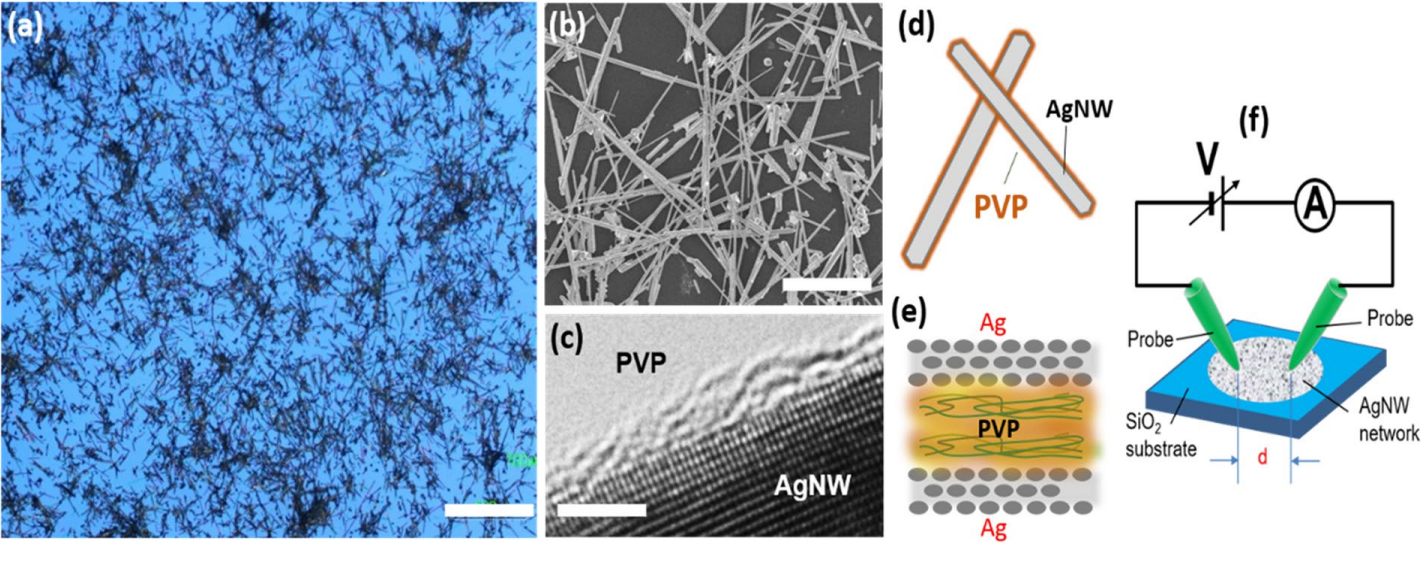
Short segments, ~14 nanometer long, of ~360 nanometer diameter polymer coated silver (Ag) wire in a ethanol and polymer solution are placed into an area of silica on an electronic device having small gold electrodes at the edges of the area (An average human hair has a diameter of 80 micrometers, or 80,000 nanometers). The wire, actually more like particles or little cylinders of silver ~14 nanometer long, has a thin coating of a biocompatible polymer (polyvinylpyrrolidone or PVP in this case). Once the ethanol evaporates, a mesh of silver wires/particles is left behind in between the gold electrodes. In places where the cylinders touch, the material at that point acts like an electrical switch that resembles a synapse in neurons.

Figure 1. Morphological and structural properties of PVP-coated Ag (silver) nanowires and nanowire network. (a) Optical micrograph image of nanowire network layout after drop-cast deposition on a silica substrate. (b) Scanning electron micrograph image of nanowire interconnectivity in a selected area of the network. (c) High resolution transmission electron micrograph image showing the atomic planes of the facet of a Ag nanowire with the nanometric PVP layer embedded on the lateral surface of the nanowire. Figures (d,e) sketch the detail of the insulating junctions formed by the polymeric PVP layer between the Ag surfaces of overlapping nanowires. (f) Scheme of the measurement system. Two tungsten probes, separated by distance d=500 μm, act as electrodes, contacting the nanowire network deposited on SiO2. The scale bars for figures (a–c) are 100 μm, 10 μm and 2nm, respectively.

Let all of this sink in for a minute. Little chunks of silver coated with an electrically insulating polymer an act like synapses at points where the chunks are in direct physical contact. Those contact points where the polymer coatings touch somehow act like switches resembling a synapse. The entire network can learn and remember things. Somehow, circuits in the network can be strengthened and once they are strengthened they remain and can remember what was taught to the circuit. So, not only does a NWN have electrical properties that resemble a synapse between neurons, it can also reinforce electrical pathways, which looks to me sort of like neural plasticity* in the brain, i.e., what is believed to happen when a brain learns new things. 

Neural plasticity refers to the capacity of the nervous system to modify itself, functionally and structurally, in response to experience and injury.

A neuron's myelin sheath acts as an electrical insulator that keeps the 
electrical signal from the neuron from simply dissipating 
(short circuiting) into the tissue the neuron sits in 

Unless I analyze or understand this wrong, (i) something physical has to be happening when a NWN circuit "learns" some new thing (most likely at least a few silver atoms electrically breaching the polymer layer somehow), and/or (ii) information itself apparently carried by electrical currents has some capacity to somehow influence physical matter, which is the NWN in this case. From what I can tell, i and ii amount to the two things necessary for NWN behavior. 

Maybe it is time to seriously consider the possibility of a machine closely mimicking at least some complex cognitive tasks that the human mind is capable of. How far this line of research can go is unclear to me.

Sunday, April 30, 2023

Social science: Diversity in Human Concepts

When there is disagreement, people talking about politics and religion tend to talk past each other and misunderstand reasons for disagreement. Being constantly bombarded by disinformation, misinformation, lies, deceit, irrational emotional manipulation and the like is a major source of honest misunderstanding. But a recent research paper, Latent Diversity in Human Concepts, focuses on a another major source of honest misunderstanding. Specifically, humans use certain words to refer to certain concepts, but the actual meaning of those words varies widely among individuals.

These discrepant views—[e.g., differing personal] concepts of penguins—are the kind of information researchers at the University of California, Berkeley, elicited from participants in a study that was published last month. The team’s results show that even the plainest of nouns can invoke dozens of distinct concepts in individuals’ mind. “People have wondered for a long time how to put a number on how much overlap there is, and it’s really low. It blows my mind,” says psychologist Celeste Kidd of the U.C. Berkeley, who was senior author of the study.

To make matters worse, the researchers found that people are usually oblivious to these differences and believe that most other people think like they do even when almost nobody does. This may be one reason people so often are at loggerheads. “We think it can explain a lot of disagreements people have,” Kidd says. “It’s an approach to understanding why people talk past each other.” Being more aware of how often we might not be comprehending one another may help us “get on the same page when it matters,” she adds.  
It is well known that abstract, high-concept words such as “knowledge” and “fairness”** provoke frequent debates about exactly what is meant. But researchers have struggled to formally characterize how people’s concepts differ and to quantify how often that happens. Past efforts have stumbled, Kidd says, because we do not fully understand what concepts consist of. 
** And, one of my favorites, “fascism.”  
Participants believed around two thirds would agree with them when the actual proportion was usually much smaller. In some cases, people believed they were in the majority when virtually nobody agreed. This shows that people are typically oblivious to the extent to which others share their concepts. “That was cool,” Gelman says, “and may have implications for when we think we’re communicating but aren’t.”  
The study may offer hope that we can sometimes overcome our differences by simply becoming aware of them. “When people disagree, it might not be for the reasons they think,” Kidd says. “It could just be because their concepts aren’t aligned.” Her advice: “Hash it out,” she says. “Questions like ‘What do you mean?’ can go a long way toward preventing a dispute going off the rails.”
That last paragraph states why I look to find stasis with people I disagree with. Stasis is a point in mutual understanding where people know why they disagree. Since minds in disagreement rarely change, getting to mutual understanding is about the best that can be done. In my opinion, reaching stasis is pro-democracy and usually or always in the public interest. Leaving disagreements unclarified is pro-authoritarianism and usually in the elite's interests.

The paper includes these comments:
Many social and legal conflicts hinge on semantic disagreements. Understanding the origins and implications of these disagreements necessitates novel methods for identifying and quantifying variation in semantic cognition between individuals. .... Our results show at least ten to thirty quantifiably different variants of word meanings exist for even common nouns. Further, people are unaware of this variation, and exhibit a strong bias to erroneously believe that other people share their semantics. This highlights conceptual factors that likely interfere with productive political and social discourse.  
Even when two individuals use the same word, they do not necessarily agree on its meaning. Disagreements about meaning are common in debates about terms like “species” (Zachos, 2016), “genes” (Stotz et al., 2004), or “life” (Trifonov, 2011) in biology; “curiosity” (Grossnickle, 2016), “knowledge” (Lehrer, 2018), or “intelligence” (Sternberg, 2005) in psychology; and “measurement” in physics (Wigner, 1995). Ernst Mach and Albert Einstein even disagreed about what constitutes a “fact” (de Waal & ten Hagen, 2020). In contemporary society, social issues often hinge on the precise meaning of terms like “equity” (Benjamin, 2019), “pornography” (Stewart, 1964), “peace” (Leshem & Halperin, 2020), or the “right to bear arms” (Winkler, 2011). Sometimes these debates are settled by fiat—for example, the U.S. Supreme court decided that a tomato counted as a vegetable (not a fruit) for tax purposes because the law should follow the “ordinary meaning” of words rather than their botanical meaning (see Goldfarb, 2021; Nix v. Hedden, 149 U.S. 304, 1893).  
Despite the frequency of such terminological debates, these conflicts have not been characterized using cognitive psychology methods.
This kind of misunderstanding arises mostly (completely?) from essentially contested concepts (ECCs). The ECC is a concept that was first prominently articulated in 1956, but was known at least by propagandists and deceivers for millennia. This linguistic phenomenon is not new. It's just inherent in the human condition. According to the recent paper and despite knowledge about this important aspect of human cognition, this kind of research is new. I suspect that in the last couple of years, the severity of the plague of ECCs has dawned on social science generally. That's probably what motivated researchers to begin studying the phenomenon.

As usual, this kind of knowledge is sharp and maybe at least two-edged. It will be used by propagandists, tyrants and deceivers ('bad people') to get what they want if this kind of knowledge can be leveraged that way. If so, then it would also be useful for societies to add to their defenses against the dark arts that bad people use to manipulate and deceive.

My conception is broader:
Two different things or arguments are asserted 
or implied to be about the same when their actual 
differences make them significantly dissimilar