The Next Front in the GOP’s War on Women: No-Fault DivorceSTEVEN CROWDER, THE right-wing podcaster, is getting a divorce. “No, this was not my choice,” Crowder told his online audience last week. “My then-wife decided that she didn’t want to be married anymore — and in the state of Texas, that is completely permitted.”
Crowder’s emphasis on “the state of Texas” makes it sound like the Lone Star State is an outlier, but all 50 states and the District of Columbia have no-fault divorce laws on the books — laws that allow either party to walk away from an unhappy marriage without having to prove abuse, infidelity, or other misconduct in court.
It was a hard-fought journey to get there. It took more than four decades to end fault-based divorce in America: California was the first state to eliminate it, in 1969; New York didn’t come around until 2010. (And there are caveats: Mississippi and South Dakota still only allow no-fault divorce if both parties agree to dissolve the marriage, for example.)
Researchers who tracked the emergence of no-fault divorce laws state by state over that period found that reform led to dramatic drops in the rates of female suicide and domestic violence, as well as decreases in spousal homicide of women. The decreases, one researcher explained, were “not just because abused women (and men) could more easily divorce their abusers, but also because potential abusers knew that they were more likely to be left.”
Today, more than two-thirds of all heterosexual divorces in the U.S. are initiated by women.
Republicans across the country are now reconsidering no-fault divorce. There isn’t a huge mystery behind the campaign: Like the crusades against abortion and contraception, making it more difficult to leave an unhappy marriage is about control. Crowder’s home state could be the first to eliminate it, if the Texas GOP gets its way. Last year, the Republican Party of Texas added language to its platform calling for an end to no-fault divorce: “We urge the Legislature to rescind unilateral no-fault divorce laws, to support covenant marriage, and to pass legislation extending the period of time in which a divorce may occur to six months after the date of filing for divorce.”
The MJ article points out that similar proposals are being worked on by the Republican Party of Louisiana, while the Nebraska GOP has affirmed its belief that no-fault divorce should only be available to couples without children. At the 2016 Republican National Convention in 2016 delegates considered adding language declaring, “Children are made to be loved by both natural parents united in marriage. Legal structures such as No Fault Divorce, which divides families and empowers the state, should be replaced by a Fault-based Divorce.”
So, do no fault divorce laws divide families or allow one spouse to get away from the other? What if one spouse wants to get out of a marriage for no particular reason?
This is another front on the radical right's war on secularism, equality and civil liberties. Core Christian nationalism dogma, not fringe crackpottery, holds that in God's eyes wealthy White heterosexual men are superior, chosen by him to rule, and must be obeyed by everyone else.
The MJ article suggests that the evidence indicates that Crowder’s position may have been worse if Texas still had fault-based divorce. Shortly after he announced he and his wife had separated, a 2021 video emerged of him berating his eight months pregnant wife. Her failure was to do “wifely things.” One can only wonder what was behind those failures to do wifely things.
Also worth considering is this: The judge, Matthew Kacsmaryk, who recently ruled to block access to birth control and mifepristone has repeatedly criticized the idea that the “sexual revolution” ushered in “permissive contraception policies,” abortion and no-fault divorce. These Christofascists are dead serious about controlling private lives as much as God demands.
___________________________________________________________
___________________________________________________________
Trial court rejects Trumps' defamation lawsuit against the NYT: The NYT writes:
Former President Donald J. Trump, who had sued The Times, three of its reporters and his niece over an investigation into his tax returns, was ordered to pay The Times’s legal expenses.When Mr. Trump filed the lawsuit in 2021, he accused the paper and three of its reporters of conspiring in an “insidious plot” with his estranged niece, Mary L. Trump, to improperly obtain his confidential tax records for a series of stories published in 2018.“Courts have long recognized that reporters are entitled to engage in legal and ordinary news-gathering activities without fear of tort liability — as these actions are at the very core of protected first amendment activity,” Justice Reed wrote.
The judge also ordered Mr. Trump to pay legal expenses and associated costs for The Times and its reporters, Susanne Craig, David Barstow and Russ Buettner.
The Times’s reporters “went well beyond the conventional news-gathering techniques permitted by the First Amendment,” Trump’s lawyer, Alina Habba, said, and added: “All journalists must be held accountable when they commit civil wrongs.”
As usual, the fascist DJT attacks and undermines the courts and rule of law by making statements like his corrupted lawyer made. One can only wonder exactly what was beyond protected conventional news-gathering techniques. Just asking embarrassing questions? As usual, one is left to wonder. reading the party’s filings and/or the court ruling would be necessary to know what civil law(s) DJT alleged the NYT was breaking. That’s worth a blog post.
It is unusual for a court to order the losing side to pay costs. Maybe that signals the judge’s belief the case was nuts to begin with. If DJT appeals this ruling, he probably would lose all appeals including to the US Supreme Court. But, if the Supreme Court does agree to hear his appeal, that would signal the radical right Republican court is seriously considering changing the law to make it easier for people like DJT to win defamation lawsuits.
Some radical right elites have wanted this to change defamation law for decades. Others do not because they understand that it would be a to edged sword, making radical right slander and smear propaganda more dangerous, unless the court could devise a rule that favors anti-democratic speech, corruption and/or authoritarianism. The anti-democratic goal for changing the law is to shut the press up by intimidation and threat defamation liability. Corruption and authoritarianism both virulently hate a free press, even the seriously weakened press we have today. For evidence, consider the tyranny models Russia and China.
___________________________________________________________
___________________________________________________________
Federal debt Armageddon watch: This issue is heating up. Time is running out before the fascist Republican Party in congress pushes the federal government into defaulting on its (our) debt. The WaPo points out that there are few days in June when congress is in session and the president is in D.C. Presumably, those are the days most likely to result in some kind of resolution to avoid default.
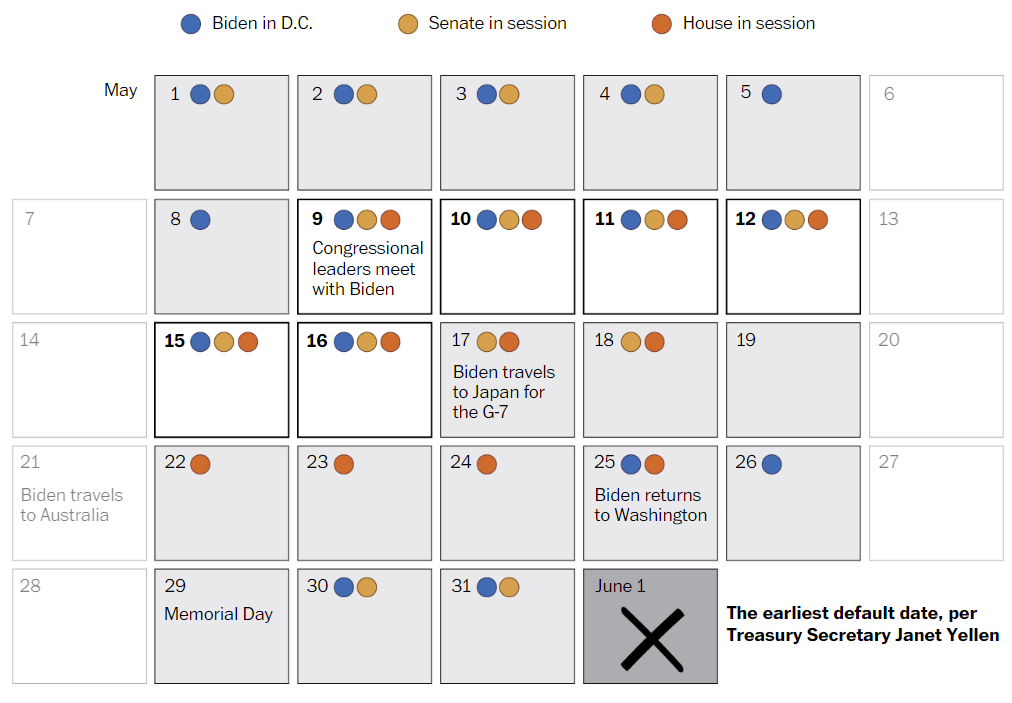
Q: Should the debt ceiling be used to coerce policy changes and the radical right Republican House demands, or should it be a separate matter, or should it not be possible for congress to allow a default under the 14th Amend., Sec. 4 as some experts have argued?
Although it probably is dangerous, the Constitution should govern, not partisan politics, which is at least as dangerous.
14th Amendment, Section 4: The validity of the public debt of the United States, authorized by law, including debts incurred for payment of pensions and bounties for services in suppressing insurrection or rebellion, shall not be questioned.


