Etiquette


DP Etiquette

First rule: Don't be a jackass. Most people are good.

Other rules: Do not attack or insult people you disagree with. Engage with facts, logic and beliefs. Out of respect for others, please provide some sources for the facts and truths you rely on if you are asked for that. If emotion is getting out of hand, get it back in hand. To limit dehumanizing people, don't call people or whole groups of people disrespectful names, e.g., stupid, dumb or liar. Insulting people is counterproductive to rational discussion. Insult makes people angry and defensive. All points of view are welcome, right, center, left and elsewhere. Just disagree, but don't be belligerent or reject inconvenient facts, truths or defensible reasoning.

Monday, July 3, 2023

Neuroscience: Brain synchrony

From the We're on the Same Wavelength Files: A Scientific American article:
Brain Waves Synchronize when People Interact

The minds of social species are strikingly resonant

Collective neuroscience, as some practitioners call it, is a rapidly growing field of research. An early, consistent finding is that when people converse or share an experience, their brain waves synchronize. Neurons in corresponding locations of the different brains fire at the same time, creating matching patterns, like dancers moving together. Auditory and visual areas respond to shape, sound and movement in similar ways, whereas higher-order brain areas seem to behave similarly during more challenging tasks such as making meaning out of something seen or heard. The experience of “being on the same wavelength” as another person is real, and it is visible in the activity of the brain.

Such work is beginning to reveal new levels of richness and complexity in sociability. In classrooms where students are engaged with the teacher, for example, their patterns of brain processing begin to align with that teacher's—and greater alignment may mean better learning. Neural waves in certain brain regions of people listening to a musical performance match those of the performer—the greater the synchrony, the greater the enjoyment. Couples exhibit higher degrees of brain synchrony than nonromantic pairs, as do close friends compared with more distant acquaintances.

But how does synchrony happen? Much about the phenomenon remains mysterious—even scientists occasionally use the word “magic” when talking about it.

Given that synchronized experiences are often enjoyable, researchers suspect this phenomenon is beneficial: it helps us interact and may have facilitated the evolution of sociality. This new kind of brain research might also illuminate why we don't always “click” with someone or why social isolation is so harmful to physical and mental health.


The article goes on to describe an experiment where a person in one of two fMRI machines 130 miles apart were talking to each other in 30 second time periods. They made up an evolving story in their time allotments. Over time, their brains came into synchrony.

It that magic? Of course not. As the image above indicates, when people do not interact, their brains do not synchronize. From the jointly made-up story experiment, it is clear that brain synchrony can arise from two people talking over the phone. One can imagine that synchrony can also arise from watching other people. 

So, when I talk about politics originating in cognitive biology and social behavior, don't underestimate the social behavior part. This line of research shows that social interaction directly influences cognitive biology when brain synchrony comes into play.

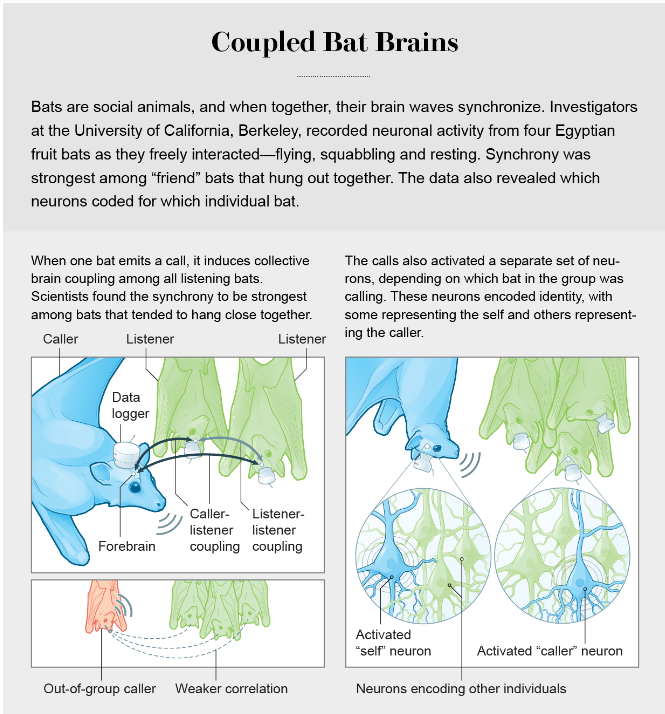
Think about that a moment. Consider a person unconsciously cognitively biased about an issue talking politics with an person unbiased, e.g., unfamiliar, with that issue. Could the unconscious biased brain influence the unbiased brain via synchrony? I can't see why that would be impossible. And, consider the data from bats summarized in the picture below:

Friend bat brains synchronize  
more than non-friend brains

Can you see where some of the origin of the things we call tribalism and cultism might come from? I can. In-group brains synchronize better than out-group brains.

In my opinion, if one does not understand at least some cognitive biology and social behavior science, one cannot understand politics. 

News bits: AOC comments on tyranny; Digital tyranny commentary; Digital tyranny update

An article in The Hill quotes AOC's comments about a rising threat of authoritarianism coming from the US Supreme Court:
Rep. Alexandria Ocasio-Cortez (D-N.Y.) on Sunday warned of an “authoritarian expansion of power” by the Supreme Court after it released several controversial opinions in it’s last week of the term.

“The courts, if they were to proceed without any check on their power, without any balance on their power, then we will start to see an undemocratic and, frankly, dangerous authoritarian expansion of power in the Supreme Court,” Ocasio-Cortez said on CNN’s “State of the Union.”

“Which is what we are seeing now, from the overturning of abortion rights to the ruling that discrimination and, frankly, stripping the full personhood and dignity of LGBTQ people in the United States. … These are the types of rulings that signal a dangerous creep towards authoritarianism and centralization of power in the court,” the New York Democrat said.
Note her argument that the court is centralizing power in itself. A couple of law experts who analyzed the flow of power coming from the radical decisions find a pattern of generally withdrawing power from the executive and legislative branches and from citizen's civil liberties. 

Power then generally flows to special interests, including brass knuckles capitalists, Christian nationalists, kleptocrats and the Republican Party itself. The power flows are not precisely controlled, but the general thrust is toward some form of corrupt authoritarianism, corrupt Christian theocracy and corrupt single-party politics dominated by Republican elites.

Thoughts of the day: Always keep eyes fixed on where power flows from and to. Look for winners and losers. Authoritarians rarely or never look for win-win power flow scenarios. They play zero sum politics and look for win-lose scenarios.
____________________________________________________________________
____________________________________________________________________

Digital tyranny commentary
Several posts here have focused on the sophisticated, all-encompassing digital tyranny that China has pioneered. Chinese dictators have achieved a relatively complete development and implementation of total digital tyranny. It's not just a matter of putting cameras up everywhere to watch for possible political opposition. The goal of the tyrants is far more encompassing and intrusive. 

In China, every cell phone must be trackable for location, purchases and identity of people who communicate or go online to do anything. Every cell phone contains means, e.g., apps, designed to monitor everything and to coerce people to perceive, act and think in support of what the dictators tell them to see, do and believe. Digital tyranny amounts to a vast, sophisticated social engineering project. This is cutting edge cognitive biology and sociology/social behavior science put in service to authoritarianism. There is nothing like this anywhere else on Earth. 

The Nazis in 1930s and 1940s Germany would die of envy at what the Chinese have been able to do and are clearly going to do. What the Chinese dictators are trying to do is build a tyranny that cannot be challenged from the inside. It is hard to imagine how the Chinese people could rise up and overthrow the dictators when every move they make and every person they interact with is monitored.

The Chinese Communist Party has gained the ability to spy on more than 100 million citizens via a heavily promoted official app, a report suggests. Analysis of the Study the Great Nation app found hidden elements that could help monitor use and copy data, said phone security experts Cure 53. The app gives the government "super-user" access, the security firm said.

The app pushes out official news and images and encourages people to earn points by reading articles, commenting on them and playing quizzes about China and its leader, Xi Jinping. Use of the app is mandatory among party officials and civil servants and it is tied to wages in some workplaces. Starting this month, native journalists must pass a test on the life of President Xi, delivered via the app, in order to obtain a press card which enables them to do their jobs.

On behalf of the Open Technology Fund, which campaigns on human rights issues, Germany cyber-security firm Cure 53 took apart the Android version of the app and said it found many undocumented and hidden features. In its lengthy report, Cure 53 said Study the Great Nation had "extensive logging" abilities and seemed to try to build up a list of the popular apps an individual had installed on their phone.

The app also weakened encryption used to scramble data and messages, making it easy for a government to crack security. "The app contains code resembling a back door, which is able to run arbitrary commands with super-user privileges," said the report.

Adam Lynn, research director at the Open Technology Fund, told the Washington Post, which broke the story: "It's very, very uncommon for an application to require that level of access to the device, and there's no reason to have these privileges unless you're doing something you're not supposed to be."
In China, there is nothing the Chinese government does that it is not supposed to be doing. That's what dictatorship is. 
____________________________________________________________________
____________________________________________________________________

Digital tyranny update
Putin has taken note of the ongoing advance in dictator tactics and technology in China. Since Putin started his mass murder and destruction campaign in the Ukraine, he has vastly stepped up his efforts to set up his own digital tyranny infrastructure in Russia. The NYT writes:
Cracking Down on Dissent, Russia Seeds a Surveillance Supply Chain

Russia is incubating a cottage industry of new digital surveillance tools to suppress domestic opposition to the war in Ukraine

As the war in Ukraine unfolded last year, Russia’s best digital spies turned to new tools to fight an enemy on another front: those inside its own borders who opposed the war.

To aid an internal crackdown, Russian authorities had amassed an arsenal of technologies to track the online lives of citizens. After it invaded Ukraine, its demand grew for more surveillance tools. That helped stoke a cottage industry of tech contractors, which built products that have become a powerful — and novel — means of digital surveillance.

The technologies have given the police and Russia’s Federal Security Service, better known as the F.S.B., access to a buffet of snooping capabilities focused on the day-to-day use of phones and websites. The tools offer ways to track certain kinds of activity on encrypted apps like WhatsApp and Signal, monitor the locations of phones, identify anonymous social media users and break into people’s accounts, according to documents from Russian surveillance providers obtained by The New York Times, as well as security experts, digital activists and a person involved with the country’s digital surveillance operations.

President Vladimir V. Putin is leaning more on technology to wield political power as Russia faces military setbacks in Ukraine, bruising economic sanctions and leadership challenges after an uprising led by Yevgeny V. Prigozhin, the commander of the Wagner paramilitary group. In doing so, Russia — which once lagged authoritarian regimes like China and Iran in using modern technology to exert control — is quickly catching up.

“It’s made people very paranoid, because if you communicate with anyone in Russia, you can’t be sure whether it’s secure or not. They are monitoring traffic very actively,” said Alena Popova, a Russian opposition political figure and digital rights activist. “It used to be only for activists. Now they have expanded it to anyone who disagrees with the war.”

The authorities are “essentially incubating a new cohort of Russian companies that have sprung up as a result of the state’s repressive interests,” said Adrian Shahbaz, a vice president of research and analysis at the pro-democracy advocacy group Freedom House, who studies online oppression. The spillover effects will be felt first in the surrounding region, then potentially the world.”

Sunday, July 2, 2023

Take heart…

You’re not slower, you’re maybe just smarter. 😮

Interesting article on BigThink.com a couple of days ago, challenging how IQ has always been measured. 

Bottom line: Faster information processing (i.e., “thinking speed”) is not necessarily the key to intelligence.

Key Takeaways:

  • A new study challenges the belief that higher intelligence scores are associated with faster information processing.
  • It also reveals a link between problem-solving ability and differences in brain connectivity and synchrony between the frontal and parietal lobes.
  • The findings suggest that there is a tradeoff between speed and accuracy in cognitive processes, highlighting the importance of slower and more effortful thinking for solving difficult problems and making better decisions. 

Full article here.

I don’t know but this article makes me, and my frequent second-guessing, feel kinda good.  How about you?  Any IQ stories to tell us about?  Have you ever been measured?  When, where?

Saturday, July 1, 2023

Democratic justices blast majority opinion on student debt

This is an unusual situation where Democratic Supreme Court justices harshly criticize radical right Republicans for judicial over-reach to say the least. Elena Kagan wrote the Democratic dissent in JOSEPH R. BIDEN, PRESIDENT OF THE UNITED STATES, ET AL., PETITIONERS v. NEBRASKA, ET AL.  The issue in the case is whether the Secretary of Education has authority under the Higher Education Relief Opportunities for Students Act of 2003 (HEROES Act) to depart from the existing provisions of the Education Act and establish a student loan forgiveness program that will cancel about $430 billion in debt principal and affect nearly all borrowers. In her dissent, Kagan wrote:
In every respect, the Court today exceeds its proper, limited role in our Nation’s governance.

I
The Court’s first overreach in this case is deciding it at all. Under Article III of the Constitution, a plaintiff must have standing to challenge a government action. And that requires a personal stake—an injury in fact. We do not allow plaintiffs to bring suit just because they oppose a policy. Neither do we allow plaintiffs to rely on injuries suffered by others. Those rules may sound technical, but they enforce “fundamental limits on federal judicial power.” Allen v. Wright, 468 U. S. 737, 750 (1984). They keep courts acting like courts. Or stated the other way around, they prevent courts from acting like this Court does today.

If the plaintiff has no such stake, a court must stop in its tracks. To decide the case is to exceed the permissible boundaries of the judicial role. That is what the Court does today.

The plaintiffs here are six States: Arkansas, Iowa, Kansas, Missouri, Nebraska, and South Carolina. They oppose the Secretary’s loan cancellation plan on varied policy and legal grounds. But as everyone agrees, those objections are just general grievances; they do not show the particularized injury needed to bring suit. And the States have no straightforward way of making that showing—of explaining how they are harmed by a plan that reduces individual borrowers’ federal student-loan debt. So the States have thrown no fewer than four different theories of injury against the wall, hoping that a court anxious to get to the merits will say that one of them sticks.  The most that can be said of the theory the majority selects, proffered solely by Missouri, is that it is less risible [laughable] than the others. It still contravenes a bedrock principle of standing law—that a plaintiff cannot ride on someone else’s injury.

II
The majority finds no firmer ground when it reaches the merits. The statute Congress enacted gives the Secretary broad authority to respond to national emergencies. 

The majority picks the statute apart piece by piece in an attempt to escape the meaning of the whole. But the whole—the expansive delegation—is so apparent that the majority has no choice but to justify its holding on extrastatutory grounds. So the majority resorts, as is becoming the norm, to its so-called major-questions doctrine.

The tell comes in the last part of the majority’s opinion. When a court is confident in its interpretation of a statute’s text, it spells out its reading and hits the send button. Not this Court, not today. This Court needs a whole other chapter to explain why it is striking down the Secretary’s plan. And that chapter is not about the statute Congress passed and the President signed, in their representation of many millions of citizens. It instead expresses the Court’s own “concerns over the exercise of administrative power.”

But assume the opposite; there is, even on that view, nothing like those circumstances here. (Or, to quote the majority quoting me, those “case[s are] distinguishable from this one.” Ante, at 23.) In this case, the Secretary responsible for carrying out the student-loan programs forgave student loans in a national emergency under the core provision of a recently enacted statute empowering him to provide student-loan relief in national emergencies. Today’s decision thus moves the goalposts for triggering the major-questions doctrine. Who knows—by next year, the Secretary of Health and Human Services may be found unable to implement the Medicare program under a broad delegation because of his actions’ (enormous) “economic impact.”

Similarly unavailing is the majority’s reliance on the controversy surrounding the program. Student-loan cancellation, the majority says, “raises questions that are personal and emotionally charged,” precipitating “profound debate across the country.” Ante, at 22. I have no quarrel with that description. Student-loan forgiveness, and responses to COVID generally, have joined the list of issues on which this Nation is divided. But that provides yet more reason for the Court to adhere to its properly limited role.

From the first page to the last, today’s opinion departs from the demands of judicial restraint. At the behest of a party that has suffered no injury, the majority decides a contested public policy issue properly belonging to the politically accountable branches and the people they represent. In saying so, and saying so strongly, I do not at all “disparage[]” those who disagree. Ante, at 26. The majority is right to make that point, as well as to say that “[r]easonable minds” are found on both sides of this case. Ante, at 25. And there is surely nothing personal in the dispute here. But Justices throughout history have raised the alarm when the Court has overreached—when it has “exceed[ed] its proper, limited role in our Nation’s governance.” Supra, at 1. It would have been “disturbing,” and indeed damaging, if they had not. Ante, at 25. The same is true in our own day.[1]

The majority’s opinion begins by distorting standing doctrine to create a case fit for judicial resolution. But there is no such case here, by any ordinary measure. The Secretary’s plan has not injured the plaintiff-States, however much they oppose it. And in that respect, Missouri is no different from any of the others.
What one sees here is an indication of the radical right's increasing reliance on the major questions doctrine. That doctrine allows the Supreme Court to bring congressionally delegated spending authority for major laws into question. That means that congress can write a law and delegate authority about how the spending is implemented to the federal agency involved, e.g., loan forgiveness in a national emergency as is the case here.

When Kagan mentioned the possibility of nullification of spending authority for Medicare, she was not pulling that out of thin air. One of the core targets for radical right government domestic spending haters is Medicare, along with Medicaid and social security. The student loan forgiveness at issue here is fairly small game, ~$430 billion. What the radicals really want to hunt is the bigger game like Medicare, Medicaid and social security. This case marks a precedent on the road to killing the really big targets.

In essence, what Kagan is doing here is bluntly warning us about what is to come if the radical right remains dominant in the Supreme Court.  


Footnote:
1. The Hill writes about the response of the radical right chief justice Roberts to Kagan's bitter dissent:
Roberts takes aim at liberal justices in 
defending Supreme Court’s legitimacy

Chief Justice John Roberts’s majority opinion striking down the Biden administration’s student debt relief plan ended with a note taking aim at the court’s liberal justices in defending the Supreme Court’s legitimacy.

Roberts, in response, took issue with Kagan’s take.

“It has become a disturbing feature of some recent opinions to criticize the decisions with which they disagree as going beyond the proper role of the judiciary,” Roberts wrote.

Kagan’s dissent was joined by fellow liberal Justices Sonia Sotomayor and Ketanji Brown Jackson. Kagan read portions of her dissent aloud from the bench, a rare occurrence that signals the significance of the justices’ disagreement.

“Reasonable minds may disagree with our analysis — in fact, at least three do,” Roberts wrote in his student debt decision, referencing the dissent.

Can you feel the temperature rising in the Supreme Court? I can. At least Roberts and Kagan are still openly saying they are not criticizing each other personally. They are just disagreeing on what this court is doing. For some that criticism can be seen as questioning the court's legitimacy because, e.g., it makes the Republicans on the court look like partisans taking an active part in advancing the Republican Party and its dominant ideology agendas.