Etiquette


DP Etiquette

First rule: Don't be a jackass. Most people are good.

Other rules: Do not attack or insult people you disagree with. Engage with facts, logic and beliefs. Out of respect for others, please provide some sources for the facts and truths you rely on if you are asked for that. If emotion is getting out of hand, get it back in hand. To limit dehumanizing people, don't call people or whole groups of people disrespectful names, e.g., stupid, dumb or liar. Insulting people is counterproductive to rational discussion. Insult makes people angry and defensive. All points of view are welcome, right, center, left and elsewhere. Just disagree, but don't be belligerent or reject inconvenient facts, truths or defensible reasoning.

Sunday, October 8, 2023

The radical Right: Libertarianism and why Republican elites embrace cruelty

A long opinion piece by Thom Hartmann, Libertarianism and why Republicans embrace cruelty, published by Raw Story describes a very interesting argument about the origin of the now fully radicalized, cruel libertarian anti-government dogma. Why the radical right rank and file support their own demise is not discussed. Hartmann writes
Last night was the Republican debate, where we heard lots of predictable rants about crushing the “welfare state” and restoring “freedom” and “self-reliance.”

So, once again, why are Republicans so cruel and why do they seem so fond of libertarianism? .... Why does Donald Trump target people for assassination by his followers? Why does Ron DeSantis revel in keeping tens of thousands of low-income Florida children from getting Medicaid?

Yesterday, I laid out the terrible impact Libertarian policies, which have infected the GOP for five decades, have had on the United States. But where did the whole idea of libertarianism come from, and who started the Libertarian Party?

How is it that Republicans so often embrace casual cruelty like tearing mothers from their children or throwing pregnant women in poverty off public assistance? Why have 12 GOP-controlled states refused to this day to expand Medicaid for their 30 million minimum-wage working people when the federal government covers 90 percent of the cost? Why are Republicans so committed to destroying Medicare and Social Security?

Why are Democratic members of Congress having to armor their own homes, having received over 9000 death threats so far this year, virtually all of them from domestic terrorists who Republicans refuse to repudiate? The FBI still is looking for a Matt Gaetz supporter who threatened to murder Gaetz’s Democratic opponent: why are these people attracted to the GOP?

It turns out this is not just politics; the roots of this brutal movement in today’s GOP run from a 1927 child murderer, through a greedy real-estate lobbying group, to Ronald Reagan putting both of their philosophies into actual practice and bringing morbidly rich rightwing billionaires into the GOP fold.

As a result, Republican policies over the past 42 years not only gutted America’s middle class and transferred $50 trillion from working people to the top 1 percent, but also led straight to the Trump presidency and the attack on the Capitol on January 6th that he led.

The Libertarians

Back in the 1940s, a real estate lobbying group came up with the idea of creating a new political party to justify deregulating the real estate and finance industries so they could make more money.

This new “Libertarian Party” would give an ideological and political cover to their goal of becoming government-free, and they developed an elaborate pretense of governing philosophy around it.

Their principal argument was that if everybody acted separately and independently, in all cases with maximum selfishness, such behavior would actually benefit society. There would be no government needed beyond an army and a police force, and a court system to defend the rights of property owners. It was a bizarre twisting of Adam Smith’s reference to the “invisible hand” that regulated trade among nations.

In 1980, billionaire David Koch ran for vice president on the newly formed Libertarian Party ticket.

His platform included calls to privatize the Post Office, end all public schools, give Medicare and Medicaid to big insurance companies, end all taxation of the morbidly rich, terminate food and housing support and all other forms of “welfare,” deregulate all corporate oversight while shutting down the EPA and FDA, and selling off much of the federal government’s land and other assets to billionaires and big corporations.

Reagan, who won that 1980 election, embraced this view in his inaugural address, saying, “[G]overnment is not the solution to our problem; government is the problem.” He then doubled down on the idea by beginning the systematic process of gutting and crippling governmental institutions that historically had supported working people and the middle class.

The child-killer who inspired a movement

Reagan wasn’t just echoing the Libertarian vision; he was also endorsing Ayn Rand’s “objectivist” view of the world, which traces its roots to a murderous psychopath in 1927.

Back in 2015, Donald Trump told USA Today’s Kirsten Powers that his favorite book was Ayn Rand’s raped-girl-decides-she-likes-it novel, “The Fountainhead.”

“It relates to business, beauty, life and inner emotions,” he told Powers. “That book relates to … everything.”

Ayn Rand’s novels have informed libertarian Republicans like former Speaker of the House of Representatives and current Fox News board member Paul Ryan, who required interns to read her books when they joined his staff.

Paul Ryan and Ayn Rand
(photoshopped)

Powers added, “He [Trump],” told her that he “identified with Howard Roark, the protagonist who designs skyscrapers and rages against the establishment.”

Rand’s hero Roark, in fact, “raged” so much in her novel that he blew up a public housing project with dynamite.

Rand, in her Journals, explained where she got her inspiration for Howard Roark and the leading male characters in so many of her other novels. She writes that the theme of The Fountainhead, for example, is:

“One puts oneself above all and crushes everything in one’s way to get the best for oneself.”

On Trump’s hero Howard Roark, she wrote that he:

“…has learned long ago, with his first consciousness, two things which dominate his entire attitude toward life: his own superiority and the utter worthlessness of the world. He knows what he wants and what he thinks. He needs no other reasons, standards or considerations. His complete selfishness is as natural to him as breathing.”

It turns out that Roark and many of her other characters were based on a real person. The man who so inspired Ayn Rand’s fictional heroes was named William Edward Hickman, and he lived in Los Angeles during the Roaring Twenties.

Ten days before Christmas in 1927, Hickman, a teenager with slicked dark hair and tiny, muted eyes, drove up to Mount Vernon Junior High School in Los Angeles and kidnapped Marion Parker — the daughter of a wealthy banker in town.

Hickman held the girl ransom, demanding $1,500 from her father — back then about a year’s salary. Supremely confident that he would elude capture, Hickman signed his name on the ransom notes, “The Fox.”

After two days, Marion’s father agreed to hand over the ransom in exchange for the safety of his daughter. What Perry Parker didn’t know is that Hickman never intended to live up to his end of the bargain.

The Pittsburgh Press detailed what Hickman, in his own words, did next.

“It was while I was fixing the blindfold that the urge to murder came upon me,” he said. “I just couldn’t help myself. I got a towel and stepped up behind Marion. Then, before she could move, I put it around her neck and twisted it tightly.”

Hickman didn’t hold back on any of these details: he was proud of his cold-bloodedness.

“I held on and she made no outcry except to gurgle. I held on for about two minutes, I guess, and then I let go. When I cut loose the fastenings, she fell to the floor. I knew she was dead.”

But Hickman wasn’t finished:

“After she was dead I carried her body into the bathroom and undressed her, all but the underwear, and cut a hole in her throat with a pocket knife to let the blood out.”

Hickman then dismembered the child piece-by-piece, putting her limbs in a cabinet in his apartment, and then wrapped up the carved-up torso, powdered the lifeless face of Marion Parker, set what was left of her stump torso with the head sitting atop it in the passenger seat of his car, and drove to meet her father to collect the ransom money.

He even sewed open her eyelids to make it look like she was alive.

On the way, Hickman dumped body parts out of his car window, before rendezvousing with Marion Parker’s father.

Armed with a shotgun so her father wouldn’t come close enough to Hickman’s car to see that Marion was dead, Hickman collected his $1,500, then kicked open the door and tossed the rest of Marion Parker onto the road. As he sped off, her father fell to his knees, screaming.

Days later, the police caught up with a defiant and unrepentant Hickman in Oregon. His lawyers pleaded insanity, but the jury gave him the gallows.

To nearly everyone, Hickman was a monster. The year of the murder, the Los Angeles Times called it “the most horrible crime of the 1920s.” Hickman was America’s most despicable villain at the time.

Ayn Rand falls in love with a “superman”

But to Alissa Zinovievna Rosenbaum, a 21-year-old Russian political science student who’d arrived in America just two years earlier, Hickman was a hero.

Alissa was a squat five-foot-two with a flapper hairdo and wide, sunken dark eyes that gave her a haunting stare. Etched into those brooding eyes was burned the memory of a childhood backlit by the Russian Revolution.

She had just departed Leninist Russia where, almost a decade earlier, there was a harsh backlash against the Russian property owners by the Bolsheviks. Alissa’s own family was targeted, and at the age of 12 she watched as Bolshevik soldiers burst into her father’s pharmacy, looted the store, and plastered on her Dad’s doors the red emblem of the state, indicating that his private business now belonged to “the people.”

That incident left such a deep and burning wound in young Alissa’s mind that she went to college to study political science and vowed one day she’d become a famous writer to warn the world of the dangers of Bolshevism.

Starting afresh in Hollywood, she anglicized her name to Ayn Rand, and moved from prop-girl to screenwriter/novelist, basing the heroes of several of her stories on a man she was reading about in the newspapers at the time. A man she wrote effusively about in her diaries. A man she hero-worshipped.

William Edward Hickman was the most notorious man in American in 1928, having achieved the level of national fame that she craved.

Young Ayn Rand saw in Hickman the “ideal man” she based The Fountainhead on, and used to ground her philosophy and her life’s work. His greatest quality, she believed, was his unfeeling, pitiless selfishness.

Hickman’s words were carefully recounted by Rand in her Journals. His statement that, “I am like the state: what is good for me is right,” resonated deeply with her. It was the perfect articulation of her belief that if people pursued their own interests above all else — even above friends, family, or nation — the result would be utopian.

She wrote in her diary that those words of Hickman’s were, “the best and strongest expression of a real man’s psychology I ever heard.”

Hickman — the monster who boasted about how he had hacked up a 12-year-old girl — had Rand’s ear, as well as her heart. She saw a strongman archetype in him, the way that people wearing red MAGA hats see a strongman savior in Donald Trump.

As Hickman’s murder trial unfolded, Rand grew increasingly enraged at how the “mediocre” American masses had rushed to condemn her Superman.

“The first thing that impresses me about the case,” Rand wrote in reference to the Hickman trial in early notes for a book she was working on titled The Little Street, “is the ferocious rage of the whole society against one man.”

Astounded that Americans didn’t recognize the heroism Hickman showed when he proudly rose above simply conforming to society’s rules, Rand wrote:

“It is not the crime alone that has raised the fury of public hatred. It is the case of a daring challenge to society. … It is the amazing picture of a man with no regard whatever for all that society holds sacred, with a consciousness all his own.”

Rand explained that when the masses are confronted with such a bold actor, they neither understood nor empathized with him.

Thus, “a brilliant, unusual, exceptional boy [was] turned [by the media] into a purposeless monster.”

Libertarianism and Ayn Rand set the stage for Trumpism

Only billionaires should rule the world, Trump has suggested.

And he tried to put it into place, installing a billionaire advocate of destroying public schools in charge of public schools, a coal lobbyist representing billionaires in charge of the EPA, an billionaire-funded oil lobbyist in charge of our public lands, and a billionaire described by Forbes as a “grifter” in charge of the Commerce Department.

Trump’s chief of staff said that putting children in cages and billionaire-owned privatized concentration camps (where seven died) would actually be a public good.

As Ayn Rand might say, “Don’t just ignore the rules; destroy them.”

Welfare and other social safety net programs were, as Rand saw it, “the glorification of mediocrity” in society. Providing a social safety net for the poor, disabled, or unemployed, she believed, were part of a way of thinking that promoted, “satisfaction instead of joy, contentment instead of happiness… a glow-worm instead of a fire.”

Sociopaths of the world, unite!

Rand, like Trump, lived a largely joyless life. She mercilessly manipulated people, particularly her husband and Alan Greenspan (who brought a dollar-sign-shaped floral arrangement to her funeral), and, like Trump, surrounded herself with cult-like followers who were only on the inside so long as they gave her total, unhesitating loyalty.

Like Trump, McConnell, McCarthy and their billionaire backers, Rand believed that a government working to help out working-class “looters,” instead of solely looking out for rich capitalist “producers,” was throwing its “best people” under the bus.

In Rand’s universe, the producers had no obligations to the looters. Providing welfare or sacrificing one nickel of your own money to help a “looter” on welfare, unemployment, or Social Security — particularly if it was “taken at the barrel of a gun” (taxes) — was morally reprehensible.

Like Trump saying, “My whole life I’ve been greedy,” for Rand looking out for numero uno was the singular name of the game — selfishness was next to godliness.

Later in Rand’s life, in 1959, as she gained more notoriety for the moral philosophy of selfishness that she named “Objectivism” and that is today at the core of libertarianism and the GOP, she sat down for an interview with CBS reporter Mike Wallace of 60 Minutes.

Suggesting that selfishness undermines most truly American values, Wallace bluntly challenged Rand.

“You are out to destroy almost every edifice in the contemporary American way of life,” Wallace said to Rand. “Our Judeo-Christian religion, our modified government-regulated capitalism, our rule by the majority will… you scorn churches, and the concept of God… are these accurate criticisms?”

As Wallace was reciting the public criticisms of Rand, the CBS television cameras zoomed in closely on her face, as her eyes darted back and forth between the ground and Wallace’s fingers. But the question, with its implied condemnation, didn’t faze her at all. Rand said with confidence in a matter-of-fact tone, “Yes.”
“We’re taught to feel concern for our fellow man,” Wallace challenged, “to feel responsible for his welfare, to feel that we are, as religious people might put it, children under God and responsible one for the other — now why do you rebel?”

“That is what in fact makes man a sacrificial animal,” Rand answered. She added, “[Man’s] highest moral purpose is the achievement of his own happiness.”

Rand’s philosophy, though popular in high school and on college campuses, never did — in her lifetime — achieve the sort of mass appeal she had hoped. But today Ayn Rand’s philosophy is a central tenet of the Republican Party and grounds the moral code proudly cited and followed by high-profile billionaires and three former presidents of the United States.


Colorful person - Ayn Rand 1959 interview
16:30 Wallace: Do you predict dictatorship and economic disaster?
17:05 Rand: Yes, that is the way the country is going

Ironically, when she was finally beginning to be taken seriously, Ayn Rand became ill with lung cancer and went on Social Security and Medicare to make it through her last days. She died a “looter” in 1982, unaware that her promotion of William Edward Hickman’s sociopathic worldview would one day validate an entire political party’s embrace of a similarly sociopathic president.

A return to sanity

Today, 42 years of Ayn Rand’s ideas being put into practice by libertarian Republicans from Reagan to Bush to Trump have gutted the middle class, made a handful of oligarchs wealthier than any king or pharaoh in the history of the world, and brought a whole new generation of criminals, hustlers and grifters into the GOP.

Three men in America today own more wealth than the entire bottom 50 percent of the country, a level of inequality never before seen in the modern developed world.

When America was still coasting on FDR’s success in rebuilding our government and institutions, nobody took very seriously Rand’s or Koch’s misguided idealist efforts to tear it all down.

Now that Libertarians and objectivists in the GOP have had 42 years to make their project work, we’re hitting peak libertarianism and it’s tearing our country apart, pitting Americans against each other, and literally killing people every day.

If America is to survive as a functioning democratic republic, we must repudiate the “greed is good” ideology of Ayn Rand and libertarianism, get billionaires and their money out of politics, and rebuild our civic institutions.

That starts with waking Americans up to the incredible damage that 40 years of Rand’s writings and libertarian “Reagan Republicans” have done to this country.

That's a sobering version of history. No doubt radical right libertarians and Republicans will vehemently deny most of all of what is asserted, probably including most of the fact-checkable facts. Probably the easiest dismissal of this will be that this is from Thom Hartmann, a known liar who cannot be believed. For the record, Hartmann is not a liar. He is solidly liberal, but doesn't have the malice in him for large scale lying.

It is interesting that the Libertarian Party was started in the 1940s by real estate developers to avoid taxes and regulations and in 2016 the tax- and government-hating real estate grifter Trump was elected to power. What was the rank and file thinking? Probably mostly the thoughts that propaganda- and lies-fueled authoritarian radical right elites wanted them to think, e.g., they are horribly wronged and attacked innocent victims, they are patriots defending democracy and truth, government is all bad all the time, Democrats are communist tyrants and pedophiles, Trump is on your side, etc.

Hartmann is arguably right to say that radical right Republican policy kills people, at least more than Democratic policy. Some social science research supports that assertion.

Qs: Does Hartmann's version of history feel reasonably accurate? How about that Hickman guy, monster or hero? Is it just me, or do cruel radical right elites seem to be either (i) mostly infantile in their political reasoning and grasp of reality, or (ii) mostly cynical, grifters and malicious (evil) liars?

Saturday, October 7, 2023

News bits: Science-based spirituality; Gerrymandering's unintended consequences

An interesting research paper, Spirituality of Science: Implications for Meaning, Well-Being, and Learning, indicates an aspect of spirituality that isn't discussed much:

Awe-inspiring science can have a positive effect on mental wellbeing
Research led by psychologists at the University of Warwick has revealed a profound connection between the spirituality of science and positive wellbeing, much like the benefits traditionally associated with religion.

The research explored how people use science as a source of spirituality and its connection with their sense of wellbeing.

Dr Jesse Preston, Associate Professor in the Department of Psychology at the University of Warwick and lead author of the study said: “Spirituality is most often associated with religion, but science can be a powerful source of awe and wonder for many. It can provide a meaningful source of understanding oneself and the universe, and it can foster a sense of connection to others and our place in the world.”

Science parallels positive wellbeing observed in religious people

In three studies, Dr. Preston and her research team surveyed 1197 people (602 men, 589 women, and 6 others) on their attitudes towards religious beliefs, spirituality and their interest and belief in science.

The first study established the concept of “Spirituality of Science”, and asked people about feelings of transcendence, connection and meaning when engaging with science. Participants’ responses were compared with other attitudes towards science, including an interest in science and belief in science, feelings of awe, meaning in their lives and religious beliefs.

Spirituality of Science was related to belief in science, but unlike other attitudes including interest in science and belief in science, Spirituality of Science was also associated with feelings of awe and general spirituality. This showed that scientific sources of spirituality may be psychologically similar to religious spirituality.
In a 2014 book, Waking Up: A guide to Spirituality Without Religion, Sam Harris described spirituality and religion like this:
Twenty percent of Americans describe themselves as “spiritual but not religious.” Although the claim seems to annoy believers and atheists equally, separating spirituality from religion is a perfectly reasonable thing to do. It is to assert two important truths simultaneously: Our world is dangerously riven by religious doctrines that all educated people should condemn, and yet there is more to understanding the human condition than science and secular culture generally admit. 
I should address the animosity that many readers feel toward the term spiritual. Whenever I use the word, as in referring to meditation as a “spiritual practice,” I hear from fellow skeptics and atheists who think that I have committed a grievous error. The word spirit comes from the Latin spiritus, which is a translation of the Greek pneuma, meaning “breath.” Around the thirteenth century, the term became entangled with beliefs about immaterial souls, supernatural beings, ghosts, and so forth. It ac quired other meanings as well: We speak of the spirit of a thing as its most essential principle or of certain volatile substances and liquors as spirits. Nevertheless, many nonbelievers now consider all things “spiritual” to be contaminated by medieval superstition. 
I do not share their semantic concerns.
Maybe a person's interest and happiness with secular things like science and nature just reflects a form of spirituality other than a formal or informal religion. Guess in retrospect, all of that is obvious. The research paper is here.
____________________________________________________________
____________________________________________________________

A WaPo article writes about backfired gerrymandering:
Illinois Democrats drew new maps 
They pushed the GOP to the right

The state’s congressional redistricting illustrates how gerrymandering hollows out the political center and strengthens the fringe, experts say

On a warm Friday night in the St. Mary’s Catholic Church parking lot, sweating men sipping cold beers dipped fish fillets into bubbling deep fryers as children played on the bouncy castle.

This down-home fish fry used to be a regular stop for U.S. Rep. Rodney Davis, a moderate Republican who grew up in this former coal town in Central Illinois. But that was before new district lines drawn in 2021 pushed him into far more conservative terrain — and into competition with a fellow GOP incumbent.

To keep his job in Congress, Davis had to square off with Rep. Mary E. Miller, a member of the right-wing Freedom Caucus who closely aligned herself with former president Donald Trump. In the primary campaign, she assailed Davis for his willingness to compromise with Democrats and to acknowledge Joe Biden’s victory in the 2020 presidential election.

Miller, the hard-liner, won the 2022 race. Davis, the consensus-seeker, was out.

The bitter Republican feuding was not merely a symptom of the broader civil war in the national party. Rather, it was prompted by the actions of Illinois Democrats, who used their supermajority in the legislature to redraw district lines in a way that would strengthen their already titanium-solid lock on power.

The strategy worked, adding one Democratic seat to the Illinois delegation and trimming two Republican ones as GOP voters were packed into a smaller number of districts. 
The new map also accomplished what experts say gerrymandering does with ruthless efficiency, regardless of whether Democrats or Republicans are responsible: hollowing out the moderate political center and driving both parties further toward the ideological fringes. 
“Gerrymandering undermines a key element of democracy, which is competition,” said Harvard University government professor Steven Levitsky.  
Politicians representing more-evenly split districts fear general election competition and therefore tend to govern more moderately, Levitsky said. But those in lopsided districts worry more about primary challenges and become responsive to the extremes in their party.  
“What’s really new about our politics today is that the radical fringe on the right, who are pretty authoritarian and pretty nativist, are now exercising outsize power,” Levitsky said.
13 states get an F

For years, gerrymandering to increase competition is something that seemed highly desirable to me. Then a few years ago, the radical right gerrymandered their way into power and that led to reconsidering that pro-competition belief for voting. Should Democrats fight for less partisan voting districts to avoid losing democracy to corrupt authoritarianism? Fight fire with fire? 

In view of this, more competition in voting seems better than less. A report broadcast on NPR yesterday indicated that Republicans in Matt Gaetz' gerrymandered Florida voting district were very happy to, as they see it, see Gaetz stand up to congress for them. One has to ask, stand up for exactly what? But that doesn't matter. It reflects the fact that no matter what Gaetz says or does, he will be re-elected to the House for as long as he wants. No Democratic Party candidate has a chance of winning the Gaetz Voting District.   

Now my mind has flipped. I'm back to opposing partisan gerrymandering (to offset Republican gerrymandering) and supporting pro-competition gerrymandering, or at least significantly less partisan gerrymandering.
____________________________________________________________
____________________________________________________________

A WaPo article logic checks an FBI targets Trump supporters story that Newsweek published recently. Newsweek failed basic logic. Recently, Newsweek has been increasingly publishing pro-authoritarian radical right content. The WaPo writes:
It is not surprising that the assertion outlined in Newsweek’s headline — “Donald Trump Followers Targeted by FBI as 2024 Election Nears” — has been embraced as revelatory by Trump’s base.

That’s despite the lack of evidence within the article itself for this explosive claim.

That’s the fundamental problem with the report, written by [Newsweek reporter] William Arkin: That case is not made. Arkin presents some numbers and quotes, but none add up to “FBI singling out Trump supporters,” as the headline implies. Instead, it describes a new threat category created by federal law enforcement that includes people inspired to violent action by Trump — but also violent actors inspired by other ideologies and candidates. That may be a shift in the FBI’s approach, as Arkin argues, but it isn’t one aimed at broadly targeting Trump supporters.

Here’s the heart of Arkin’s argument, describing the extension of the group seen as “anti-government or anti-authority violent extremists” (AGAAVE):

“[T]he FBI went further in October 2022 when it created a new subcategory—'AGAAVE-Other’ — of those who were a threat but do not fit into its anarchist, militia or Sovereign Citizen groups. Introduced without any announcement, and reported here for the first time, the new classification is officially defined as 'domestic violent extremists who cite anti-government or anti-authority motivations for violence or criminal activity not otherwise defined, such as individuals motivated by a desire to commit violence against those with a real or perceived association with a specific political party or faction of a specific political party.’”


“Though Trump and MAGA are never mentioned in the official description of AGAAVE-Other, government insiders acknowledge that it applies to political violence ascribed to the former president’s supporters.”


That last paragraph is crucial. Notice that the insiders don’t claim it only applies to Trump supporters or even only to political violence from Trump supporters. This is a Logic 101 test question: Just because everything in Set A belongs to Set B does not mean that Set B only includes things from Set A. The word “felony” applies to bank robbery, but that doesn’t mean that “felony” only describes bank robberies.

So here, the facts are correct, but the logic is garbage. Did Newsweek make this obvious mistake because it is quietly pro-authoritarian radical right? It is hard to see this being a good faith mistake, but easy to see it being authoritarian radical right propaganda.

Friday, October 6, 2023

An essay: Radical right scholarship openly favors American dictatorship

An essay the Philadelphia Inquirer published yesterday focuses an interesting aspect of radical right authoritarianism:
America needs to talk about the right’s ‘Red Caesar’ plan for U.S. dictatorship

“Thought leaders” of the far right talk openly about a 2025 dictatorship -- People need to be alarmed 

To a small but influential gaggle of so-called “thought leaders” on the edge of the stage — the pseudo-intellectuals of right-wing think tanks, and chaos-agent-in-chief Steve Bannon — the growing rot infecting another key U.S. institution is just more evidence for their stunning argument now flying at warp speed, yet under the radar of a clueless mainstream media.

The D.C. dysfunction is more proof, they would argue, that the nation needs a “Red Caesar” who will cut through the what they call constitutional gridlock and impose order.

If you’re not one of those dudes who thinks about Ancient Rome every day, let me translate. The alleged brain trust of an increasingly fascist MAGA movement wants an American dictatorship that would “suspend” democracy in January 2025 — just 15 months from now.

"The idea that the US might be redeemed by a Caesar – an authoritarian, rightwing leader – was first broached explicitly by Michael Anton, a Claremont senior fellow and Trump presidential adviser." https://t.co/8Mzpyjx3af— Teddy Wilson 🏴‍☠️ (@reportbywilson) October 4, 2023

The guru of this push for a president seizing dictatorial powers to overthrow what far-right activists see as a “deep state” of liberals — corrupting institutions ranging from government agencies to the media to large corporations and the Pentagon — is a professor of politics at Michigan’s ultraconservative Hillsdale College, Kevin Slack. (Yes, the same Hillsdale that GOP-led school boards, including Pennridge in Philadelphia’s northern exurbs, are hiring to whitewash their curriculums.)

In War on the American Republic: How Liberalism Became Despotism, in which he rails against the “cosmopolitan class” of unelected elites he claims is running America, Slack writes that the “New Right now often discusses a Red Caesar, by which it means a leader whose post-Constitutional rule will restore the strength of his people.” In a recent Guardian article, writer Jason Wilson — who deserves enormous credit for tying together these threads — finds anti-democracy arguments like Slack’s are gaining traction in the small but influential world of far-right think tanks like Hillsdale and the Claremont Institute. That’s been tracked here in Philadelphia by another writer, the centrist liberal Damon Linker at UPenn, who sees a dangerous conspiracy theory taking root not just with obscure professors but with the iconoclastic billionaires who back the right.

“Intellectuals play a certain kind of role, especially on the right, in legitimating actions of elites in the party and [the] movement,” Linker told me in a recent interview, adding: “They’re giving people permission to do terrible things,” labeling shameful measures as “acts of virtue.”  
The chaos at the bottom of the political food chain is coming from the same instincts tearing apart the top of the government: A desire to blow it all up.

When these raw instincts are translated by the extreme right’s “intellectuals” into an explicit plea for a dictatorship, you can see that America is poised to cross the Rubicon — a metaphor rooted in the river in northern Italy that Julius Caesar had to cross with his army in 49 B.C. in order to drive out Rome’s democratically elected government and seize power.  
And yet the elites that far-right extremists claim are “all powerful” seem incapable of grasping these very real threats to constitutional government or a free press. That’s particularly true of the mainstream media and its pacesetters like the New York Times or the Washington Post, which seem determine to “both sides” the descent into dictatorship — with headlines that blame dysfunction on Capitol Hill on “Congress” instead of Republicans, or that place the 80-year-old President Joe Biden’s verbal or actual stumbles on a level pitch with rising GOP fascism.  
It’s all the more remarkable since we all know who the actual “Red Caesar” is — even if he is, technically, orange. Donald Trump, the 45th president who seems to have already locked down the Republican nomination to become the 47th, has been accused of running a rambling, ideas-free campaign — except that’s not true.

As the Los Angeles Times recently noted, Trump has been pretty specific in recent speeches and interviews about the actions he would take if he takes the oath of office on Jan. 20, 2025 — such as naming a special prosecutor to go after his political enemies, blowing up civil service protections to fill the government with his acolytes, deploying the military in a massive deportation campaign, and sending troops to “control crime” in Democratic-led cities. If Julius Caesar were still here, he’d surely be giving a Trump 47 presidency a Roman salute.  
In thinking about a “Red Caesar,” it’s helpful to remember what the actual Caesar said right before crossing the Rubicon: Alea iacta est, meaning, “The die is cast.” But in the United States in 2023, the die is not cast, not yet. The majority of Americans do not want to live under a dictatorship, and we have the power to stop this. But America is never going to prevent the “Red Caesar” unless we start talking about it, loudly and right away.
That is spot on.

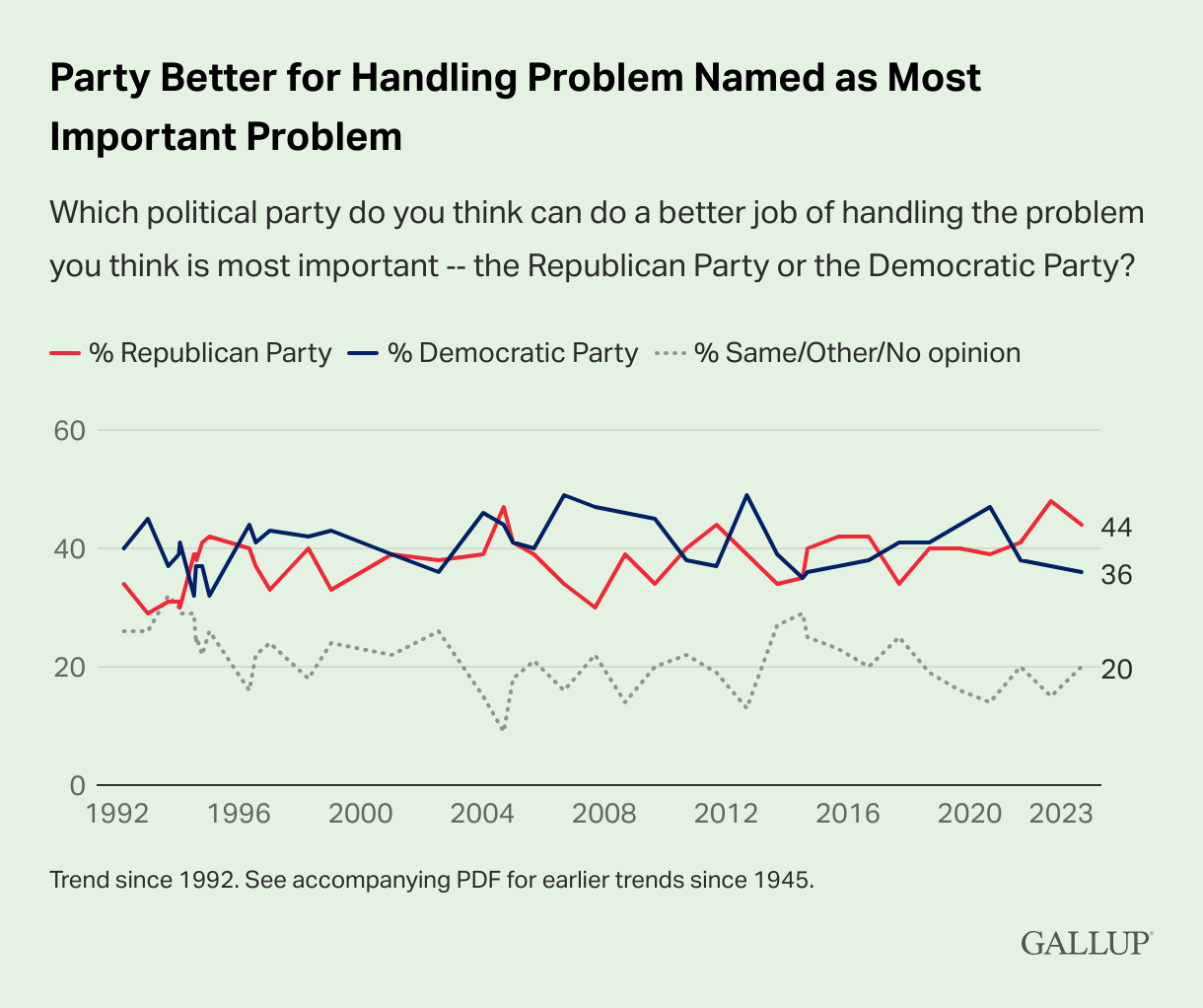
Recent polling indicates that defense of democracy or opposition to authoritarianism is not a major concern for most Americans. The economy and national security are bigger concerns. Gallup reported
  • Fifty-three percent of Americans believe the Republican Party will do a better job of keeping the country prosperous over the next few years, whereas 39% choose the Democratic Party.
  • A slightly larger majority, 57%, have greater faith in the Republican Party to protect the country from international terrorism and military threats, while 35% favor the Democrats.


Q: Are Americans as a whole sufficiently alarmed about the threat radical right to democracy? 

YEAH BUT..................................................... WHAT IS THE ANSWER??

 Not an enjoyable read. Long too. For the enquiring mind:

Large and sustained federal budget deficits are harmful to the fiscal health of the United States, yet policymakers struggle with reining in the red ink. Even during the years of economic growth immediately predating the COVID-19 pandemic, the federal government ran large and growing budget deficits, near $1 trillion per year. As policymakers enacted emergency measures to combat the COVID-19 crisis, federal budget deficits ballooned to levels not seen since World War II. Although the deficit has reverted to pre-pandemic levels as the United States winds down pandemic spending, deficits are projected to grow significantly over the coming decades—an ominous trend that will put increased strain on the federal budget. BPC’s economic policy team analyzes the government’s running budget deficit and updates the Deficit Tracker monthly.

For the rest of the details:

https://bipartisanpolicy.org/report/deficit-tracker/


Damn, that IS nasty. But what to do about it? What are the solutions? What is the answer?

I seldom read anything about making those spending cuts to the military. Or reversing tax cuts to the rich. I do hear a LOT about Medicare and Medicaid, school lunch programs and such.

How about money for research and development?

How about money for infrastructure programs?

How about money for the disabled, and disabled veterans?

How about cutting back on food inspections or safe drinking monitoring?

I mean, we NEED to cut somewhere, right? 

What would YOUR priorities be? Your solutions?

Reverse tax cuts to the rich? Deep cuts to the military? Cut entitlement programs? Cuts to research and development? Cuts to foreign aid - including Ukraine? Close the border so we aren't spending so much on supporting immigrants?

EVERYONE knocks the other side for THEIR suggestions. But there has to be some way to cut the deficit spending. 

Fitch Ratings downgraded U.S. debt from AAA to AA+ on August 1, citing rising deficits, a broken budgeting process, and political brinksmanship—echoing Standard & Poor’s downgrade after the 2011 debt limit episode.