There you have it, folks: an example of a “not perfect, just
forgiven” role model for the Christians (met with laughter).
IDGI. [SMH]
Want to try to explain it to me? Again.
(by PrimalSoup)

There you have it, folks: an example of a “not perfect, just
forgiven” role model for the Christians (met with laughter).
IDGI. [SMH]
Want to try to explain it to me? Again.
(by PrimalSoup)
Today, some prominent thinkers are telling a different story: Capitalism is dead. It’s a contention that’s explicit in the subtitle of Yanis Varoufakis’s bold new book, “Technofeudalism: What Killed Capitalism.” He joins a chorus of observers arguing that the scales have tipped in the direction of a new form of feudalism that strips capitalism of its best features. The former finance minister of Greece (and the negotiator of its debt crisis with the European Union) argues that capitalism has not been overthrown but has instead become something else. .... Blending intellectual memoir, history, and economic and technological history, Varoufakis creates an intimate atmosphere that is a genuine pleasure to read. But its message is grim.The drumbeat of eulogies for capitalism — such as the media theorist Mckenzie Wark’s “Capital Is Dead: Is This Something Worse?,” an important interlocutor for Varoufakis — all point to the emergence of Big Tech as a breaking point in the story that goes back to the Industrial Revolution. The big tech companies — Amazon, Apple, Meta, Alphabet and Microsoft — along with Baidu, Tencent and Alibaba are not participants in markets so much as they are markets themselves. (Amazon founder Jeff Bezos owns The Washington Post.) These platforms only sell goods or host ads as a secondary feature. Their primary function, according to a growing chorus that includes Varoufakis, is to extract rent.Rent is not profit. The distinction is subtle but crucial: .... Apple has been known to take a cut as large as a third from those selling apps in the App Store, effectively charging rent for being in one of two spaces — the other is Google Play — that all but dominate the mobile market. .... Apple has contributed nothing to the effort of actually producing the program I sell, yet they will receive a significant portion of every dollar that my consumers pay. As thinkers of the Industrial Revolution like Adam Smith and David Ricardo might put it, Apple’s revenue on the platform is merely passive, which is what makes it rent, unlike profit, which has to be actively earned. The problem is that, if the balance shifts away from genuine profit, no growth can occur. Rent is finite: The value that labor puts into commodities is added to the economy and becomes profit. If the economy starts to run on rent, it will stall.But stagnation, for Varoufakis, would be the least of our problems. He describes the replacement of traditional capital by what he calls “cloud capital,” which no longer focuses on growth, value and profit, but instead on rent extraction and control. The “cloudalists” are the new capitalist bosses, and their influence extends far beyond the workplace to nearly every facet of your app-powered daily life. According to Varoufakis’s narrative, when we are the product — as we are when our clicks and searches generate profit for massive corporations, when our data is bought and sold — we’ve gone over from the relative freedoms of capitalism to technofeudalism, in which those who control the platforms have direct control over the rest of us, reducing us to the station of “cloud serfs.”In other words, the rise of Big Tech is not just, some have called it, the “Fourth Industrial Revolution.” It is the end of the agreement that dissolved feudalism, from which grew both capitalism and democracy. Capitalism, as Marx pointed out, freed workers by dissolving the bonds of feudalism. The vassal who labored for a lord was bound to that lord and his land. By contrast, capitalist workers were free to exchange work for money, and “free” to starve if they did not. Contrast this to the positive freedoms of democracy: Varoufakis suggests that our digital world effectively destroys these, and wipes away the beating heart of capitalism with them. Cloud capital [] creates a mirage that looks like capitalism. But what seems like profit, and what seems like work, in the cloud, is really rent, and a new, high-tech form of serfdom.This problem is worse than ever, and to the extent that it is a crucial part of capitalism, we still very much live under the umbrella of that label. The main virtue of Varoufakis’s book is that it poses the problem of global digitally mediated value. This by itself is illuminating, whether we adopt the term of art “technofeudalism” or not.
Donald Trump once again defamed his rape victim, E. Jean Carroll, this time during a rally in Rome, Georgia on Saturday. .... During the dark, rambling and often incoherent speech, Trump complained that “sometimes it’s not good to be rich” before adding:
“I just posted a $91 million bond – 91 million – on a fake story, totally made up story. Think of it – 91 million! I could say things about what it would cost normally. $91 million! Based on false accusations made about me by a woman I know nothing about, didn’t know, never heard of. I know nothing about her. She wrote a book. She said things. And when I denied it, I said, ‘It’s so crazy. It’s false.’ I got sued for defamation.”
Trump then called Carroll “not a believable person” and called Judge Kaplan a “highly corrupt judge.”
The Supreme Court has broken long-standing rules and practices to force desired results on the American people. One such violation has been its excursion into fact-finding, based not on the record before it, nor on factual findings of Congress, but on imagined or confected findings that served ulterior purposes of the justices. The Court’s persistent refusal to confront these errors in the face of overwhelming evidence only makes the Court’s conduct more egregious. The Court’s new emphasis on “history and tradition” threatens even more wanton and arbitrary fact-finding, and Bremerton foreshadows deliberate disregard by justices of even adjudicatory facts plain in the record before them.The Supreme Court’s claim to supremacy in constitutional interpretation is at its weakest when the interpretation is premised on bogus facts. Even the power to “say what the law is” enjoys no textual support in the Constitution. Asserting that the Court has ultimate authority to say what the facts are leaps into constitutional fantasy, and endangers the balance between the Supreme Court and its coequal branches. The Court has no special competency to find facts. When fact-finding is done in an unconstrained manner, when the facts arrived at are indefensible, and when they are used to reach a preferred outcome, this signals wrongful trespass into the policymaking function the Constitution assigns to the political branches.
The American people deserve a Court that plays by the rules. If the Court continues to play fast and loose with the facts to suit the outcome its Republican supermajority wants, Congress has tools to remedy the abuse. Something needs to be done. That something should start in the halls of Congress, and it should start now.
Mike Johnson’s eye rolls are a reminder of what Biden is really running against this fall
Republican control of the House of Representatives is a sickness that ought to be excised from the body politicWe can now count “keeping a poker face” among the skills Speaker of the House Mike Johnson is notably lacking, alongside “vote counting” and “swaying his own caucus.” .... Johnson’s eye-rolling and head-shaking turned him into an instant meme across social media, his barely contained discontent providing some comic relief at an otherwise somber moment.
Elon Musk Has a Giant Charity. Its Money Stays Close to Home.
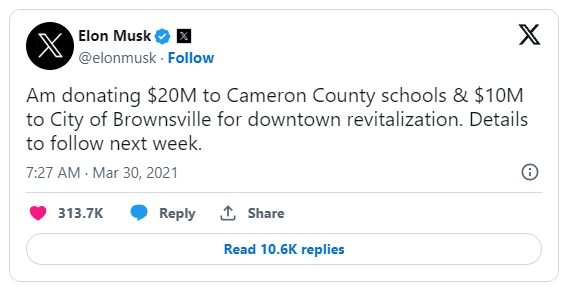
After making billions in tax-deductible donations to his philanthropy, the owner of Tesla and SpaceX gave away far less than required in some years — and what he did give often supported his own interestsBefore March 2021, Elon Musk’s charitable foundation had never announced any donations to Cameron County, an impoverished region at the southern tip of Texas that is home to his SpaceX launch site and local officials who help regulate it.
Then, at 8:05 one morning that month, a SpaceX rocket blew up, showering the area with a rain of twisted metal.The Musk Foundation began giving at 9:27 a.m. local time.
Musk runs a charity with billions of dollars, the kind of resources that could make a global impact. But unlike Bill Gates, who has deployed his fortune in an effort to improve health care across Africa, or Walmart’s Walton family, which has spurred change in the American education system, Mr. Musk’s philanthropy has been haphazard and largely self-serving — making him eligible for enormous tax breaks and helping his businesses.
Income tax strategies — Donations to 501(c)(3) public charities qualify for an itemized deduction from income. Because the tax rate is then applied to a reduced income, this can minimize your overall tax liability. Many donors don’t realize that there are many ways to maximize this seemingly straightforward deduction. For instance, you can “bunch” your charitable contributions in a single tax year, using a donor-advised fund, to increase the amount you donate in a high-income year, and then the funds can be used to support charities over time. Or you can make a combined gift of appreciated assets and cash to maximize your benefits.
Capital gains tax strategies — You can use charitable contributions to reduce your capital gains tax liability by donating long-term appreciated assets. Not only can you deduct the fair market value of what you give from your income taxes, you can also minimize capital gains tax of up to 20 percent.
Estate tax strategies — The federal estate tax is a tax on the transfer of your property at your death. In 2024 the estate and gift tax exemption is $13.61M per individual, so fewer estates will be subject to this tax. By making properly structured gifts and donations, you can remove assets from your estate before the total is tallied and taxed. In fact, you have an unlimited charitable deduction if your estate plan makes gifts to charities.
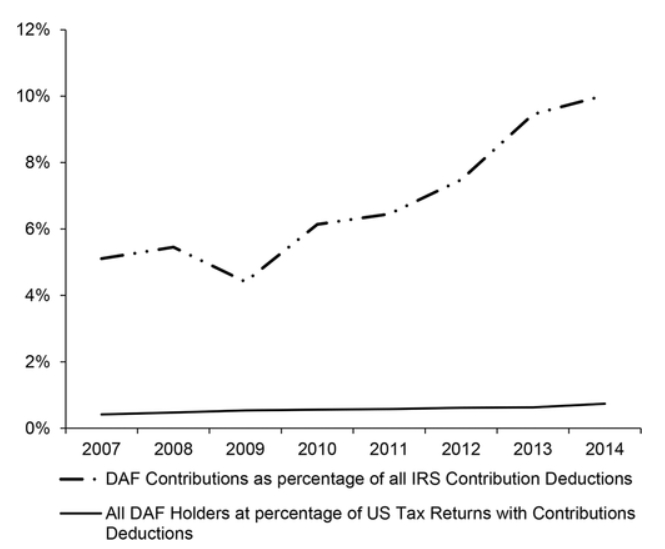
Donor Advised Funds (DAFs) are now a major source of charitable do nations in the United States, responsible for 1 in 10 dollars donated to charity in 2015. In 2016, Fidelity Charitable, whose only mission is to provide DAFs, became the largest charity in the United States. Paradoxically, most people have never heard of DAFs or Fidelity Charitable. This leads us to ask, who uses DAFs and why, what is the impact of government tax policy toward DAFs, and could the extra fiscal cost of subsidizing DAFs be balanced out by an extra public gain of new charity resulting from tax policy toward DAFs?Do DAFs involve enough money for policymakers to really worry about? Perhaps surprisingly, the answer is a resounding yes. Figure 1 illustrates recent trends in DAFs. From 2007 to 2015, contributions to DAFs rose by 240% to a total of $22.26 billion per year. Grants from DAFs to charities rose by a similar percent, to $14.5 billion. Year-end assets—the unspent contributions—climbed to $78.64 billion, a 255% increase. Over the same period, the number of DAF accounts grew as well, but at a relatively slower pace of 178% to almost 270,000 accounts.
Most of us political junkies here watched the State of the Union address this last Thursday night. Usually, a sitting president gets a boost in the polls after a SOTU. For what they’re worth, early flash polling seems to bear that out.
They’re also saying it was Biden’s biggest fund raising day so far.
Now, granted, it’s long time until election day. How long?
Long enough to “conceive and birth a baby” long (9-ish months)! So, we all should be taking my questions with
a grain chunk of salt. Nothing is in
cement… yet. I won’t hold you to your current
answers. There are way too many
variables still in the mix (jail time, heart attack and/or stroke time, dead
time, … well, you see where I’m going here).
What a build-up! 😁 Now for the questions.
At this point, and assuming no one suffers any of those dreaded
variables I just listed:
No “I don’t knows” or “could be a tossup” answers
please. We all already know that. Rather, I want a hard “Biden” or “Trump” on
this one. Bite your lip, close your
eyes, think of the flag, and blurt/keypunch it out, as painful as it might be! Then, if you feel you must, go ahead and
bloviate to your little heart’s content.
BTW, I’m not trying to jinx it, for the superstitious among
us! I’m trying to determine where the
prevailing wind is blowing. Be honest,
not emotional in your answers.
Thanks!
P.S. I may do this poll again, a week or so before the November
election, to see if minds have changed.
(by PrimalSoup)
