Etiquette


DP Etiquette

First rule: Don't be a jackass. Most people are good.

Other rules: Do not attack or insult people you disagree with. Engage with facts, logic and beliefs. Out of respect for others, please provide some sources for the facts and truths you rely on if you are asked for that. If emotion is getting out of hand, get it back in hand. To limit dehumanizing people, don't call people or whole groups of people disrespectful names, e.g., stupid, dumb or liar. Insulting people is counterproductive to rational discussion. Insult makes people angry and defensive. All points of view are welcome, right, center, left and elsewhere. Just disagree, but don't be belligerent or reject inconvenient facts, truths or defensible reasoning.

Friday, May 10, 2024

News bits: Petition to remove judge; Ukraine war update; Brain mapping update

MoveOn is gathering signatures to asking Trump judge Aileen Cannon to be removed from the Mar-a-Lago stolen documents case, Trump v. U.S. As discussed here yesterday, Cannon halted the case, claiming she has too much work to do. Cannon's decision protects DJT from prosecution until after the 2024 elections. And if he wins, it protects him forever.

I signed the petition. If you are interested, you can sign at this link. I recommend signing, even if it has no impact.
_________________________________________________________________
_________________________________________________________________

The Ukraine military has started using an ancient war device called caltrops (crow's feet) to stop Russian military convoys.

The caltrops are scattered in the path of a Russian convoy, blowing out their tires and leaving them more vulnerable. Once disabled, the vehicles are finished off using low-cost quadcopter explosive-laden drones or artillery.

However, unlike in the past, specialist drones were used to deploy the caltrops under the cover of the night—a simple yet very effective tactic. Once scattered, wheeled vehicles have their tires blown out, making them sitting ducks.

Even if not destroyed outright, the loss of multiple, or all, tires seriously hampers the movement of Russian personnel and materiel until recovery or repairs are carried out.
This 1 minute video shows the kind of damage that caltrops are inflicting on Russian vehicles. Maybe the Russians will start dropping their own caltrops to stop Ukrainian vehicles. 
_________________________________________________________________
_________________________________________________________________

Nature News reports that scientists using artificial intelligence for data analysis have mapped 1 cubic millimeter (0.000061 cubic inch) of human cerebral cortex tissue at nanometer scale resolution (1 nm = 0.000000094 inch) (neuron cell body size is ~4-100 micrometers in diameter, 0.00016 to 0.0039 inch). The research paper is entitled, A petavoxel fragment of human cerebral cortex reconstructed at nanoscale resolution (peta = 1 x 10^15):
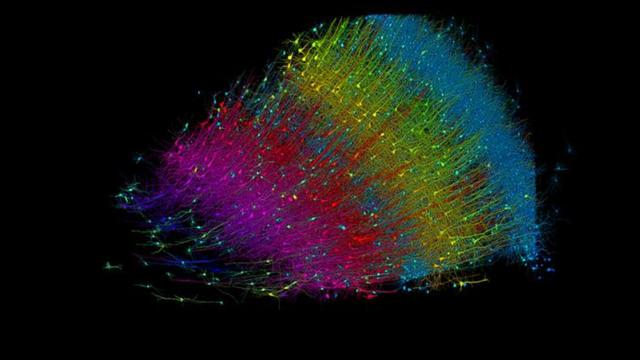
Rendering based on electron-microscope data, showing 
the positions of neurons in a fragment of the brain cortex --
neuron color indicates cell body size

Researchers have mapped a tiny piece of the human brain in astonishing detail. The resulting cell atlas, which was described today in Science and is available online, reveals new patterns of connections between brain cells called neurons, as well as cells that wrap around themselves to form knots, and pairs of neurons that are almost mirror images of each other.

The 3D map covers a volume of about one cubic millimeter, one-millionth of a whole brain, and contains roughly 57,000 cells and 150 million synapses — the connections between neurons. It incorporates a colossal 1.4 petabytes (1,400 terabytes) of image data. “It’s a little bit humbling,” says Viren Jain, a neuroscientist at Google in Mountain View, California, and a co-author of the paper. “How are we ever going to really come to terms with all this complexity?”

The brain fragment was taken from a 45-year-old woman when she underwent surgery to treat her epilepsy. It came from the cortex, a part of the brain involved in learning, problem-solving and processing sensory signals. The sample was immersed in preservatives and stained with heavy metals to make the cells easier to see. Neuroscientist Jeff Lichtman at Harvard University in Cambridge, Massachusetts, and his colleagues then cut the sample into around 5,000 slices — each just 34 nanometers thick (0.0000013 inch) — that could be imaged using electron microscopes. 

Jain’s team then built artificial-intelligence models that were able to stitch the microscope images together to reconstruct the whole sample in 3D. “I remember this moment, going into the map and looking at one individual synapse from this woman’s brain, and then zooming out into these other millions of pixels,” says Jain. “It felt sort of spiritual.”

A single neuron (white) shown with 5,600 of the axons (blue) that connect to it 
The synapses that make these connections are shown in green


A range of histological features in 1 mm3 of human brain were rendered, including neuropil (A) and its segmentation (B) at nanometer resolution, annotated synapses (C), excitatory neurons (D), inhibitory neurons (E), astrocytes (F), oligodendrocytes (G), myelin (H), and blood vessels (I). A previously unrecognized neuronal class (J) and multisynaptic connections (K) were also identified.


Rendering showing cortex neuron layers

When examining the model in detail, the researchers discovered unconventional neurons, including some that made up to 50 connections with each other. “In general, you would find a couple of connections at most between two neurons,” says Jain. Elsewhere, the model showed neurons with tendrils that formed knots around themselves. “Nobody had seen anything like this before,” Jain adds.

The team also found pairs of neurons that were near-perfect mirror images of each other. “We found two groups that would send their dendrites in two different directions, and sometimes there was a kind of mirror symmetry,” Jain says. It is unclear what role these features have in the brain.  

Proofreaders needed

The map is so large that most of it has yet to be manually checked, and it could still contain errors created by the process of stitching so many images together. “Hundreds of cells have been ‘proofread’, but that’s obviously a few per cent of the 50,000 cells in there,” says Jain. He hopes that others will help to proofread parts of the map they are interested in. The team plans to produce similar maps of brain samples from other people — but a map of the entire brain is unlikely in the next few decades, he says.
This is a truly amazing accomplishment. Other groups are working to map an entire mouse brain, but that will probably take several years. As time passes, maybe some improvements in data gathering protocols will speed up the mapping process. 

Thursday, May 9, 2024

News bits: DJT's pay-to-play politics; DJT's nepotism politics; GOP prepares for insurrection

Warning, the news bits are toxic today.

The WaPo writes about blatant political corruption right out in the open:

What Trump promised oil CEOs as he asked 
them to steer $1 billion to his campaign

As Donald Trump sat with some of the country’s top oil executives at his Mar-a-Lago Club last month, one executive complained about how they continued to face burdensome environmental regulations despite spending $400 million to lobby the Biden administration in the last year.

Trump’s response stunned several of the executives in the room overlooking the ocean: You all are wealthy enough, he said, that you should raise $1 billion to return me to the White House. At the dinner, he vowed to immediately reverse dozens of President Biden’s environmental rules and policies and stop new ones from being enacted, according to people with knowledge of the meeting, who spoke on the condition of anonymity to describe a private conversation.

Giving $1 billion would be a “deal,” Trump said, because of the taxation and regulation they would avoid thanks to him, according to the people.  
Despite the oil industry’s complaints about Biden’s policies, the United States is now producing more oil than any country ever has, pumping nearly 13 million barrels per day on average last year. ExxonMobil and Chevron, the largest U.S. energy companies, reported their biggest annual profits in a decade last year.

Yet oil giants will see an even greater windfall — helped by new offshore drilling, speedier permits and other relaxed regulations — in a second Trump administration, the former president told the executives over the dinner of chopped steak at Mar-a-Lago.
There it is, right out in the open. Pay Trump $1 billion and he will pay them back in spades, the environment and public opinion be damned. Trump kleptocracy cannot be denied or justified. This is what the pro-corruption, anti-environment Citizens United USSC decision has led us to.
______________________________________________________________
______________________________________________________________

The WaPo reports that Barron Trump is going to play hardball politics, making him fair game for criticism:
Barron Trump makes political debut as 
Florida delegate for GOP convention

Donald Trump’s son Barron, 18 and about to graduate high school, was named as a delegate at large for the GOP national convention in Milwaukee

Former president Donald Trump’s youngest son, Barron Trump, is making his political debut: The 18-year-old has been named to the slate of Republican Party delegates that will represent Florida at the party’s national convention this summer.

Barron Trump, who was only 10 when his father was inaugurated as president in 2017, has largely been shielded from the political limelight. His selection — along with three of Trump’s other children — reflects the latest expansion of the clan’s takeover of the party.
Barron asked for it
He is gonna get it because he deserves it
______________________________________________________________
______________________________________________________________

The WaPo reports that some senior Republican Party leaders will refuse to accept the outcome of the 2024 election: Top Republicans, led by Trump, refuse to commit to accept 2024 election results -- One possible vice-presidential candidate, Sen. Tim Scott (R-S.C.), repeatedly declined to say whether he will accept the outcome -- The question has become something of a litmus test, particularly among the long list of possible running mates for Trump, whose relationship with his first vice president, Mike Pence, ruptured because Pence resisted Trump’s pressure to overturn the 2020 election. In a vivid recent example, Sen. Tim Scott (R-S.C.) was pressed at least six times in a TV interview Sunday on whether he would accept this November’s results. He repeatedly declined to do so, only saying he was looking forward to Trump being president again.

In my opinion, those Republicans are traitors. 
______________________________________________________________
______________________________________________________________

The Hill reports that judge Aileen Cannon has gone all-in on stopping the Mar-a-Lago case against DJT to protect him:
Senate Democrats are venting their fury over Judge Aileen Cannon’s decision to cancel the start date of former President Trump’s federal trial in Florida for mishandling classified documents, accusing the Trump appointee of “deliberately slow-walking” the case.

Cannon, who serves on the U.S. District Court for the Southern District of Florida, asserted in a five-page order that too many pretrial issues remain unresolved to schedule a later date to hear arguments from federal prosecutors and Trump’s defense.

The judge’s decision cancels Trump’s May 20 trial date, postponing it indefinitely.  
Democrats are close to giving up hope that the 40 felony charges accusing Trump of mishandling classified documents, obstructing justice and making false statements will reach a verdict before Election Day.

And they fear he will immediately kill the case if he defeats President Biden in November and returns to the Oval Office.

“Justice deferred is often justice denied. It is profoundly frustrating that the judge is managing this case in a way that is making it highly unlikely that it will be resolved in a timely fashion,” said Sen. Chris Coons (D-Del.), a member of the Judiciary Committee.
Well, that kills one of the four cases against DJT. Trump's strategy to stop the prosecution here  was brilliant. His attorneys filed lots of motions and complaints, many of them frivolous, giving loose cannon Aileen an excuse to stop the case so she has time to deeply consider all the lunacy that Trump has loaded the case with.

The USSC will probably effectively kill prosecution in DJT's immunity case by forcing the lower courts to reconsider everything. That pushes that case out far past the Nov. elections. Meanwhile, in Georgia, Republican legislators are moving to fire Fani Willis in the Georgia state election racketeering and fraud trial against DJT. It is starting to look like that case will either die forever, or be pushed back until after the Nov. elections.

Things are looking grim for democracy and the rule of law. Only the New York fraud case is viable at this point. Trump and authoritarianism are winning. The democracy and the rule of law are losing. We and our democracy just might be royally screwed.

Once again, the ramifications of of Merrick Garland's staggering incompetence for failure to act are coming into focus. If things turn out horribly, Garland arguably will have been the key factor that killed our democracy and the rule of law. 

Wednesday, May 8, 2024

Is there such a thing as moral superiority in politics?

This question has been on my mind for ~20 years. I don't recall writing about it, but it usually lurks in the background of my conscious mind. This question and what I found over many years directly led me to the idea of an anti-ideology ideology for politics. I call it pragmatic rationalism, (PR) which I usually referred to in blog posts as being grounded in morals. Others have come to a similar mindset, so I'm not unique.

The big problem with PR that probably forever dooms it to political insignificance is the vast differences that people have when it comes to most moral values or principles. Reality is often at odds with professed beliefs and values. My search for an ideology that seemed reasonable at least in theory had to deal with the constant plague on mankind called essentially contested concepts (ECCs). In short, ECCs refer to concepts that people agree about in general, but can never agree on in particulars. Wikipedia describes the ECC plague like this:
Essentially contested concepts involve widespread agreement on a concept (e.g., "fairness"), but not on the best realization thereof. They are "concepts the proper use of which inevitably involves endless disputes about their proper uses on the part of their users", and these disputes "cannot be settled by appeal to empirical evidence, linguistic usage, or the canons of logic alone."
Conceptual confusion in the social sciences—and certainly in political science—is a major source of difficulty in both theory and empirical analysis. The literature is replete with concepts that are applied inconsistently. This in turn influences the coherence of research and the cumulation of findings in the study of politics. .... On one level, these problems may be seen as deriving from a straightforward failure to specify the relationship between ‘term’ and ‘meaning’, involving confusion about concepts. Scholars are sometimes inconsistent in their own usage, or they simply fail to grasp the definitions employed by other researchers.
ECCs include most or nearly all moral values or principles. Most key morals or principles in politics appear to be ECCs. Examples include democracy, justice, rule of law, citizenship, war, genocide, abortion, freedom, equality, free speech, hate speech, honesty, dishonesty, ethical, unethical, constitutional, transparency, opacity, truth, lies, rationality, the public interest (or general welfare) and so on. Although moral values are generally internally consistent, political values are often inconsistent (hypocritical?) because politicians adjust their positions for strategic or self-interested reasons. In my mind, moral values are more important than political values, but our corrupted pay-to-play two party political system does not operate that way.

All of that suggests that moral superiority in politics is an ECC or a meaningless concept. From that point of view, one simply stops thinking about political morals or principles. One just fights it out, regardless of hypocrisy or irrationality in words and deeds used in the fight. Most political advocates and pundits, especially radicals, ideologues, kleptocrats and authoritarians usually (~97% of the time?) claim moral superiority, but that is just a smoke screen for their agendas. The main agendas are usually (~95% of the time?) getting more wealth and/or power, usually more of both. They usually do not care much about moral vales when they are inconvenient. 

Despite the plague of ECCs and how our political system really works, one can argue that there is an at least partly objective basis to assign moral superiority to words and deeds. Morally superior is basically what PR is designed to be. How can moral superiority be possible in the face of ECCs and corrupted politics? It is possible to see moral differences in individuals and groups by looking at what people say they believe in and how they act. 

For example, most American radical right authoritarian elites and rank and file say they are fighting for democracy, truth, the rule of law and equal justice, based on facts and sound reasoning. Every one of those moral values is an ECC, including the concept of a fact. But how well do their actions accord with their self-professed political principles or moral values? When Republican Party elites and most of the rank and file claim the 2020 election was stolen and the 1/6 coup attempt was "legitimate political discourse", how well does that synch up with defending democracy, truth, the rule of law and equal justice, based on facts and sound reasoning? In my opinion, not very well. In fact, not at all.

Is it fair and rational to look at disconnects between openly professed moral values and how well actions align with those morals? It seems fair to me. After all, those who claim to support democracy and the rule of law but actually intend to destroy it are far from consistent. Why can't one judge them? They exert power over everyone based on their self-professed moral values. They claim what they want and do is in the best interest of everyone. But what they do usually directly contradicts the moral values they claim authority to stand on.

And what about those deceived among the rank and file? They sincerely believe that they are fighting for democracy, truth, the rule of law and equal justice, based on facts and sound reasoning. In fact, they fight for the opposite based mostly on lies and crackpottery. They are sucked in by irrational crackpottery like "you have to destroy it before you can fix it", and lies like "the 2020 election was stolen" and other authoritarian propaganda. Are they morally blameless in this? Does being deceived absolve one of moral sin? Do adults have no responsibility for their political actions because they are deceived? If not, then exactly what absolves the millions of the deceived that drives the authoritarian wealth and power movement? Fear or bigotry fomented by propaganda? 

In my opinion, there is such a thing as moral superiority in politics. There is moral culpability for political actions, whether they are grounded in deceit and/or ignorance. Essentially all of the authoritarian elites know exactly what they are doing. There are very few deceived in that group. They want some form of kleptocratic authoritarianism, but they rely heavily on false claims of love and respect for democracy, the rule of law and etc. 

Qs: Is moral superiority[1] in politics a meaningful concept, if one puts heavy weight on respect for facts, true truths and sound reasoning, convenient or not? What if one puts heavy weight on respect for facts, true truths, sound reasoning and belief in democracy (e.g., reasonable compromise) over authoritarianism (e.g., no compromise)?  


Footnote: 
1. Some researchers believe that belief in personal moral superiority, which most people have, is a powerful illusion. A 2016 research paper comments:
Most people strongly believe they are just, virtuous, and moral; yet regard the average person as distinctly less so. This invites accusations of irrationality in moral judgment and perception—but direct evidence of irrationality is absent. Here, we quantify this irrationality and compare it against the irrationality in other domains of positive self-evaluation. Participants (N = 270) judged themselves and the average person on traits reflecting the core dimensions of social perception: morality, agency, and sociability. Adapting new methods, we reveal that virtually all individuals irrationally inflated their moral qualities, and the absolute and relative magnitude of this irrationality was greater than that in the other domains of positive self-evaluation. Inconsistent with prevailing theories of overly positive self-belief, irrational moral superiority was not associated with self-esteem. Taken together, these findings suggest that moral superiority is a uniquely strong and prevalent form of “positive illusion,” but the underlying function remains unknown.  
Most people believe they are just, virtuous, and moral. These beliefs demand scientific attention for several reasons. For one, in contrast to other domains of positive self-belief, they likely contribute to the severity of human conflict. When opposing sides are convinced of their own righteousness, escalation of violence is more probable, and the odds of resolution are ominously low (Pinker, 2011; Skitka, Bauman, & Sargis, 2005). .... Such is the extent of this phenomenon that violent criminals consider themselves more moral than law-abiding citizens living in the community (Sedikides, Meek, Alicke, & Taylor, 2014).
The point being that the concept of belief in moral superiority is accepted in science, but it is plagued by subjectivity and ECCs. The question I pose here asks if persons and groups in politics can be reasonably judged from an at least partly objective point of view, i.e., respect for facts, true truths, sound reasoning and belief in democracy over authoritarianism.

Regarding the failure of institutions and constitutions

From what I can tell, a small but maybe growing number of reasonable people are starting to question the failure of key democratic institutions and/or the constitution itself. Most elite authoritarian radical right activists are doing the same, but with intent to destroy democracy and the institutions and laws that support it. The questioning on the other side looks to support democracy and its implementing institutions. 

One commentator, Alex Pareene, is a pro-democracy advocate who writes about this issue, which I consider to be critically important:
The Institutionalist's Dilemma

On trusting the process after it's openly failed

Nothing has fundamentally changed about how the Senate “works” since George Packer wrote the damning portrait of a dysfunctional institution that I reference in that old Salon piece. More than a decade later, Senate institutionalists still make up the majority of the Democratic caucus, and they still believe the way to make the institution work is not to change its rules but to somehow change the nature of the opposition.

So, in some sense, I gave up on the Senate. I spend less time carefully making the arguments for reforming it.

When we all learned that the far-right majority on the Supreme Court plans to gut the right to privacy that undergirds legal abortion access in the United States, a few patterns emerged in people’s responses. Most liberals were furious. Others in the media were outraged—on behalf of the Supreme Court, because they feared the leaking of a draft opinion could undermine the public’s faith in the “legitimacy” of the institution.

Many of those takes were bad faith from conservatives sort of desperately reaching for a talking point, but some of them were quite sincere. This is the mindset of the institutionalist. It is important that people retain faith in our institutions, which does not mean that our institutions should work to earn people’s faith, but instead that people shouldn’t hear about it when they don’t. This attitude is especially common in lawyers, who, as a profession, turned “nothing is true, everything is permitted” into a professional ethic. And of course, many elected officials, and especially many Democrats, are lawyers.

One of the more consequential contradictions of the Democratic Party is that the vast majority of its staffers, consultants, electeds, and media avatars, along with a substantial portion of its electoral base, are institutionalists. They believe, broadly, in The System. The System worked for them, and if The System’s outputs are bad, it is because we need more of the right sort of people to join or be elected to enter The System. But when the party does manage to win majorities, it depends on support from a substantial number of anti-system people. Barack Obama defeated the Clintons with this sacred knowledge, before he started reading David Brooks. (emphasis added)

Institutionalists, in my experience, have trouble reaching an anti-system person, because they think being against The System is an inherently adolescent and silly mindset. But believing in things like “the integrity of the Supreme Court” has proven to be, I think, much sillier, and much more childish. (emphasis added)

In the beginning of Joe Biden’s presidency a lot of very intelligent people tried to come up with ideas for how to change the Supreme Court, which is poised to spend years eroding the regulatory state and chipping away at civil rights. Expand it, perhaps. Or marginalize it. President Joe Biden, a committed institutionalist, formed a commission of legal scholars—from across the ideological spectrum, of course—to investigate what ought to be done about it. They failed to come up with any answers. “Lawmakers,” the commission wrote, “should be cautious about any reform that seems aimed at the substance of Court decisions or grounded in interpretations of the Constitution over which there is great disagreement in our political life.” You might be mad at the Court because of the decisions it produces, but it’s essential that everyone still trusts the processes that led to them.
 
This was a white flag. I think some people in the White House have some sick hope that the end of Roe will galvanize the midterm electorate. Something like that may indeed happen. But if they wish to understand why the president has been bleeding youth support for the last year they should try to imagine these young people (and “young”, at this point, has expanded to like 45) not as the annoying and hyper-engaged freaks they see on Twitter every day, but as ones they don’t see anywhere, because, having been urged to pay furious attention by people in the party, they discovered that those people had absolutely no realistic plans to overcome entrenched, systemic obstacles to progress.

The legitimacy crisis is that our institutions are illegitimate. For my entire adult life, beginning with Bush v. Gore, our governing institutions have been avowedly antidemocratic and the left-of-center party has had no answer for that plain fact; no strategy, no plan, except to beg the electorate to give them governing majorities, which they then fail to use to reform the antidemocratic governing institutions. They often have perfectly plausible excuses for why they couldn’t do better. But that commitment to our existing institutions means they can’t credibly claim to have an answer to this moment. “Give us (another) majority and hope Clarence Thomas dies” is a best-case scenario, but not exactly a sales pitch. (emphasis added)
This line of reasoning resonates strongly with me. I see this core problem the about the same way that Pareene sees it. He saw the problem with the system years before I independently came to about the same beliefs. He sees the whole picture more clearly than my still incomplete thinking on this issue.