Etiquette


DP Etiquette

First rule: Don't be a jackass. Most people are good.

Other rules: Do not attack or insult people you disagree with. Engage with facts, logic and beliefs. Out of respect for others, please provide some sources for the facts and truths you rely on if you are asked for that. If emotion is getting out of hand, get it back in hand. To limit dehumanizing people, don't call people or whole groups of people disrespectful names, e.g., stupid, dumb or liar. Insulting people is counterproductive to rational discussion. Insult makes people angry and defensive. All points of view are welcome, right, center, left and elsewhere. Just disagree, but don't be belligerent or reject inconvenient facts, truths or defensible reasoning.

Tuesday, June 23, 2020

The Psychology of Men and Facemasks


I'm a manstud!


Context
1. I've now progressed in my thinking about politics that, assuming I can do it and there is some supporting data, most every politics OP I post should be linked to cognitive or social science in some way. The reason is simple: Cognitive and social science describe politics and the human condition better than any political partisan, special interest, blowhard, crook, liar, demagogue, political or religious ideologue or murderer ever would. I am sure there are a few or some major business people, politicians, etc., who are significantly, mostly or completely exceptions to that blanket condemnation. Well, pretty sure. I hope.

2. Over my lifetime to date, I've come to believe that for modern times, men in power have been and still are probably (~85% personal confidence) significantly worse than women in power would be in terms of acceptance of facts and true truths, rational reasoning, governing, reasonable empathy and civility, honesty** and exercise of soft power (non-war and /or mass slaughter) effectiveness. Exercise of hard power, i.e., the military and kinetic force, seems to come way too easy to men. The caveat on that belief is that I am not a historian and thus no expert.

3. Is there a historian in the house? I really need one right now.

** No, reasonable empathy, civility or honesty does not mean anything close to gullibility, stupidity or any other weakness. IMO, reasonable (not stupid) empathy, civility and honesty are strengths, not weaknesses and when circumstances merit, they need to be mostly or completely withdrawn.


Bad boys
An article my home town newspaper the San Diego Union Tribune published today was interesting. The article, Why more men aren't wearing masks -- and how to change that, reported data indicating that men are less prone to wear face masks than women. Duh. Observing unmasked men in public compared to women and children with their moms inspired Hélène Barcelo of the Mathematical Science Research Institute in Berkeley, to look closely. A study by Barcelo and Valerio Capraro of London’s Middlesex University generated data indicating that men are less likely than women to wear face covering.

The SDUT writes:

“Posted online in mid-May, the resulting study of 2,459 U.S. participants, “The Effect of Messaging and Gender on Intentions to Wear a Face Covering to Slow Down COVID-19 Transmission,” offers an interesting glimpse into why some men resist the call to cover up — and provides some clues as to how to influence that behavior. In addition to finding that men are less inclined to wear a face mask, the study found that men are less likely than women to believe they will be seriously affected by the coronavirus. 
Further, it found a big difference between men and women when it came to the self-reported negative emotions that come with that simple strip of fabric across the face. 
As study co-author Capraro explained, “We asked [participants to rank] on a scale of one to 10 how much they agreed with five different statements: ‘Wearing a face covering is cool,’ ‘Wearing a face covering is not cool,’ ‘Wearing a face covering is shameful,’ ‘Wearing a face covering is a sign of weakness’ and ‘The stigma attached to wearing a face covering is preventing me from wearing one as often as I should.’ 
“The two statements that showed the biggest difference between men and women,” Capraro said, “were, ‘Wearing a face covering is a sign of weakness’ and ‘The stigma attached to wearing a face covering is preventing me from wearing one as often as I should.’”
To reorient the male mind on this point, the researchers suggest these:

1. Emphasize the benefit to community over than family, country or self. That tactic appeared to be the biggest motivator for men. (Germaine: Wot? Over family? No wonder we're on the road to hell. -- See, that exemplifies why I think women are better suited for rule than men.)

SDUT quotes a researcher o this point: “One of my areas of research is in benevolent sexism. So one way to rebrand this is instead of [making it about] protecting yourself, make it about protecting other people. [Make it about being] paternalistic and chivalrous. You’re saying, ‘I’m protecting the weak, the elderly, [and] I’m being a hero.”

I don't know how anyone else reads that, but I read it like this: (whining voice) I'm a big stud. You've gotta listen to and obey me. 

I'm not impressed with that. The only question in my mind is how accurate it is or is not. (I need to do more research on this point, so CAVEAT)

2. “According to Alex Navarro, assistant director of the Center for the History of Medicine at the University of Michigan and one of the editors-in-chief of the American Influenza Epidemic of 1918-1919: A Digital Encyclopedia, an overt appeal to patriotism was used to encourage mask-wearing in the early stages of the Spanish flu epidemic as the country was still fighting World War I.”

Apparently, this appeals to most men more than facts and reason 
-- what a stud!


3. SDUT writes:
“If stereotypical masculine behavior is part of the problem, might it be part of the solution? Could some of the traits traditionally associated with manliness be Trojan Horsed to increase the number of masked men? Glick, who back in April penned a piece for Scientific American titled “Masks and Emasculation: Why Some Men Refuse to Take Safety Precautions,” thinks the approach might work. 
‘Of course you’d be playing into this kind of masculinity,’ Glick said, ‘but I think tough-looking masks — MAGA masks, camouflage[-print masks], [masks printed with] shark teeth — might. They wear masks in wrestling, right? And what about superheroes and villains?’”
That speaks for itself. 

4. And there's this about the power of humor with men:
“‘I think [humor] definitely could work,’ he said. ‘A lot of men communicate this way. They have serious conversations but in humorous ways because [they] can’t fully own it so [they] joke about it. For example, guys in the locker room might be talking about the difficulties in [their] marriages but by joking about it. It’s kind of a code they use to communicate, to admit they’re having a hard time.’ 
Englar-Carlson said he wasn’t exactly sure what a humorous messaging campaign around mask-wearing might look like, but with Glick’s comment about wrestlers, superheroes and villains echoing in my ears, I floated one possibility: a PSA featuring Darth Vader, Bane from “The Dark Knight Rises” and a cadre of Lucha Libre wrestlers playing it tough while urging guys to put on their own masks.”
Is it me, or do many or most men look mentally weak? You can't present them with reality so you have to deflect, cajole, pull rabbits out of hats and otherwise massage fragile egos.

The SDUT article continues in this vein.

Questions: 
1. Does this reasonably indicate that men as leaders are too wuss in terms of self-confidence or mental power and compensate with unjustified violence, including not wearing a facemask in the face of COVID-19, and war too often? Or is just one thing insufficient to draw such a sweeping conclusion?

2. Are men’s egos really as fragile as I think this article reasonably conveys?
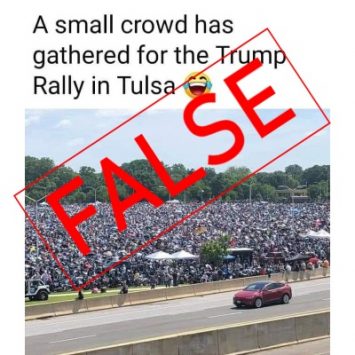
Viral Photo Misidentified as Trump Tulsa Crowd

Quick Take
Social media accounts supportive of President Donald Trump have been sharing a photo of a large outdoor crowd with the false claim that it shows the scene outside of Trump’s Tulsa rally. It actually shows the Rolling Thunder event near Washington, D.C. in 2019.
Full Story
Although President Donald Trump had expected to fill the 19,000-seat arena for his rally in Tulsa, Oklahoma — with overflow crowds next door — there were whole sections of empty seats at the June 20 event.
The Tulsa Fire Department reported that about 6,200 tickets were scanned for the event. The Trump campaign has disputed that number, saying that the attendance figure was actually closer to 12,000.
What’s not in dispute, though, is that the campaign cancelled speeches that were planned for an outdoor overflow crowd when that crowd didn’t materialize.
But you wouldn’t know that by looking at Trump fan accounts on social media, which have been posting a picture of an outdoor crowd near Washington, D.C. in 2019 with the bogus claim that it shows the overflow crowd in Tulsa.
Many of the pictures were shared with a caption attached that claimed: “A small crowd has gathered for the Trump Rally in Tulsa 😂


The Berks County Republican Committee’s Facebook page posted the picture the day after Trump’s rally with this claim: “SHARE THIS FAR AND WIDE AS THE LEFT IS TRYING TO MAKE IT LOOK LIKE TRUMP SUPPORTERS DIDN’T SHOW UP FOR TRUMP!”
But the picture actually shows the start of an annual motorcycle ride through Washington, D.C. that highlights veterans’ issues and honors prisoners of war. It’s hosted by an organization called Rolling Thunder. The picture shows a crowd of participants gathered in the north parking lot of the Pentagon, where the ride began on May 26, 2019.
Other photos from that day, some of which were featured on the Facebook page for Rolling Thunder Washington, D.C., show a similar angle of the scene as is featured in the picture now being shared with the false information. The same white Jeep is visible in the foreground as is the black truck in the crowd and the white-topped tents.
Artie Muller, executive director of Rolling Thunder confirmed to FactCheck.org that the photo being shared on social media shows the event. “That’s how it always looks,” he said.

So, the picture shows a crowd near Washington, D.C. in 2019, not the crowd for Trump’s Tulsa rally.


Monday, June 22, 2020

Measuring Burdens on Personal Liberty: Facemasks


It's analysis time, analysis fans

Liberty: roughly, what one is allowed to do by law

Freedom: roughly, what one actually can do, legal or not


Context
Back in 2015 after the Supreme Court Obergefell v Hodges decision legalizing same-sex marriage, there was a huge outcry from people who opposed it. The arguments against Obergefell tended to speak in terms of an impending apocalypse. Religious liberties would be crushed and so would free speech. Those claims seemed to be overblown and usually irrational or incoherent. But when I searched, there was no published analysis I could find that did a cold, neutral analysis of what exactly burdens and benefits would come from legalized same-sex marriage and what groups of people would be affected.

In frustration, I decided to do my own analysis. After about 100 hours of searching, thinking about how to do the analysis and then doing it, I concluded that for the most part there was no impending apocalypse. The burdens on most people were low to trivial to non-existent. The people who got whacked hardest were business owners in the 22 or 23 states that had laws prohibiting discrimination in commerce. Those people and their businesses could be fined into bankruptcy for refusing to provide goods or services to same sex couples. You know, wedding cakes and wedding photos. But in terms of actual religious practice or speech, Obergefell imposed little or no burden on most people. And, Obergefell forced no couple to get married against their will, and it prevented no couple who wanted to marry from getting married.[1] Before Obergefell, in some states same-sex couples who wanted to marry could not get married. That was truly liberty crushing for those people.

The other thing that was problematic, was the almost total silence of the anti-same sex marriage argument about the benefits to same-sex couples. That was rarely or never mentioned. Most people who engaged in this complaint were almost totally self-centered. They could not care less what benefits others might enjoy from the new legal landscape. They mostly cared only about themselves based on their usually grossly exaggerated fears.


Facemasks & COVID-19: A quick seat of the pants analysis
Today, some people are refusing to wear face masks in public because they argue it is a large burden on their liberty. Some claim health regulations that require wearing facemasks in public is outright tyranny. Some state governors have compared it to living in China. As was the case with same-sex marriage, the complaints about facemasks imposing tyranny-level burdens on personal liberty (i) seem grossly exaggerated, and (ii) conveniently ignore the benefits to other people and society as a whole.

So, what might a cost-benefit analysis look like? Just collect some data, make some reasonable assumptions and think it through.

Current data indicates that the COVID-19 death rate is about 2.25% by dcleve's estimate. Assume it is 2% to keep things simple and not exaggerated. The benefits of not wearing a face mask vary from person to person. People like me who wear glasses are arguably higher because without a mask, my glasses aren't fogged most of the time. I find foggy glasses to be annoying and occasionally interfering with something I want to do, e.g., read the label on a product in the grocery store, which I often do for various reasons. I sometimes need to take my foggy glasses off to see or read. For people who do not wear glasses, this is a non-existent burden on their liberty to see freely without fog. The other burden that facemasks impose on some people is simply psychological discomfort. Some folks don't like facemasks for one or more of various reasons including:

1. they don't like the way they look and are inconvenient to wear
2. they are socially and/or psychologically uncomfortable with how face masks impair human social or interpersonal interactions, e.g., by hiding facial expressions thereby creating uncertainty and social or psychological discomfort
3. they feel they are not loyal enough to Trump or their own tribe when they wear a face mask
4. they feel that wearing a face mask supports democrats too much
5. buying a face mask usually costs money
6. they believe that COVID-19 is a hoax or the pandemic has passed and it is time to move on

For people who are not yet infected with COVID-19, the benefits of facemasks are that the odds of them becoming become infected are reduced. Existing data indicates that facemasks reduce the spread of virus from infected people to others and they reduce the odds that an uninfected person will get infected. Thus, masks work two ways to reduce the infection rate. That should allow some people who want to ride this pandemic out until a drug and/or vaccine is developed.

Simple logic and existing data indicates that people who do not wear face masks will spread virus to others and kill about 2% of them. If we stop trying to slow the virus spread and take no measures, one can assume that we will develop herd immunity the old fashioned way, e.g., by all out plague. Herd immunity is estimated to require about 80% of all people to have been infected. If one assumes that the American population is 320 million and 80% get infected and 2% of them die, then about 5.12 million Americans will die. Obviously, not wearing a facemask imposes the greatest possible burden there could be on that many people, i.e., it kills them. And, as dcleve's analysis indicated, it is reasonable to expect that at least another ~5 million will suffer serious long-term injury.

I will just assume that if we go into full blown plague mode, the cost to the economy will be ~$3 trillion the first year and another ~$2 trillion the next year. That is in addition to the trillions it has already cost (~ $5 trillion?). The costs could be, and probably would be, much higher. But, it is best to be conservative to avoid being called an effing liar.

Thus, wearing a face imposes what I consider to be a low liberty burden on individuals. People who oppose wearing a facemask and call it tyranny are grossly exaggerating. Probably most more rational people who oppose wearing facemasks will claim the liberty burden is moderate to high. Few or no people who oppose mandatory facemask wearing will even acknowledge that refusal to wear  a facemask will cause many deaths, certainly nothing remotely close to 5 million.

If one assumes the foregoing quick, informal analysis reasonably describes the cost-benefit situation, is the benefit of wearing facemasks much greater than the costs, somewhat greater, about the same, less, or much less? For individuals and their situation? For American society and its economy?

I suspect that most people who looks at it like this will conclude the benefits outweigh the costs for society and maybe also for individuals. I suspect that most Trump supporters will conclude the costs outweigh the benefits.


Footnote:
1. The anaylses are here for burden on liberty in commerce and here for burden on religious practice and speech for people who may be interested in the concept of one way to measure burdens and benefits when liberties are in conflict, or at least alleged to be. This way of thinking about liberties in conflict cuts through a lot of bullshit and lies very effectively.

That is probably why one doesn't see such analyses very often if ever. I do not know how many, if any, analyses like these are being done by experts or professionals. IMO, this sort of cost-benefit analysis and thinking should be front and center every single time people whine about how badly they are being oppressed. My guess is that most of the complaints (~80% ?) are either exaggerated or grossly exaggerated. The complainers rarely or never even mention benefits -- they only howl about the costs to them and/or their tribe. IMO, that tactic is a form of dark free speech called lying by omission.

Sunday, June 21, 2020

Trust is the Normal Default Mindset


A 2009 article by social psychologist Roderick Kramer summarized the state of the human mind in many situations is trusting. That usually works well, but when a person is deceived and extends misplaced trust, it can cause serious personal damage. When millions of people are deceived, it can be catastrophic, even lethal. The article published in the Harvard Business Review. It addressed the matter of how Bernard Madoff managed to pull off a $65 billion Ponzi scheme and bilk many sophisticated wealthy people out of their money. 

Kramer's description is good to keep in mind when considering how propagandists and demagogues deceive and mislead people, sometimes with lethal consequences for people and whole societies. This OP is to compliment the review of the book, The Misinformation Age: How False Beliefs Spread, that I posted a couple of days ago. One reason to focus on trust is that propagandists are well aware of the fact that if they can win people's trust via one of various tactics, their deceit is much more powerful and people are easier to polarize, leading to loss of trust.

Kramer writes:
“Madoff is hardly the first to pull the wool over so many eyes. What about Enron, WorldCom, Tyco, and all the other corporate scandals of the past decade? Is there perhaps a problem with how we trust? 
I think it’s worth taking another look at why we trust so readily, why we sometimes trust poorly, and what we can do about it. 
In the following pages, I present the thesis that human beings are naturally predisposed to trust—it’s in our genes and our childhood learning—and by and large it’s a survival mechanism that has served our species well. That said, our willingness to trust often gets us into trouble. Moreover, we sometimes have difficulty distinguishing trustworthy people from untrustworthy ones. At a species level, that doesn’t matter very much so long as more people are trustworthy than not. At the individual level, though, it can be a real problem. To survive as individuals, we’ll have to learn to trust wisely and well. That kind of trust—I call it tempered trust—doesn’t come easily, but if you diligently ask yourself the right questions, you can develop it. 
In short, we’re social beings from the get-go: We’re born to be engaged and to engage others, which is what trust is largely about. That has been an advantage in our struggle for survival. 
Trust kicks in on remarkably simple cues. We’re far more likely, for example, to trust people who are similar to us in some dimension. Perhaps the most compelling evidence of this comes from a study by researcher Lisa DeBruine. She developed a clever technique for creating an image of another person that could be morphed to look more and more (or less and less) like a study participant’s face. The greater the similarity, DeBruine found, the more the participant trusted the person in the image. This tendency to trust people who resemble us may be rooted in the possibility that such people might be related to us. Other studies have shown that we like and trust people who are members of our own social group more than we like outsiders or strangers. This in-group effect is so powerful that even random assignment into small groups is sufficient to create a sense of solidarity. 
So what does all this research add up to? It shows that it often doesn’t take much to tip us toward trust. People may say they don’t have a lot of trust in others, but their behavior tells a very different story. In fact, in many ways, trust is our default position; we trust routinely, reflexively, and somewhat mindlessly across a broad range of social situations. As clinical psychologist Doris Brothers succinctly put it, “Trust rarely occupies the foreground of conscious awareness. We are no more likely to ask ourselves how trusting we are at any given moment than to inquire if gravity is still keeping the planets in orbit.” I call this tendency presumptive trust to capture the idea that we approach many situations without any suspicion. 
If it’s human to trust, perhaps it’s just as human to err. Indeed, a lot of research confirms it. Our exquisitely adapted, cue-driven brains may help us forge trust connections in the first place, but they also make us vulnerable to exploitation. In particular, our tendency to judge trustworthiness on the basis of physical similarities and other surface cues can prove disastrous when combined with the way we process information. 
One tendency that skews our judgment is our proclivity to see what we want to see. Psychologists call this the confirmation bias. Because of it we pay more attention to, and overweight in importance, evidence supporting our hypotheses about the world, while downplaying or discounting discrepancies or evidence to the contrary. 
A confirmation bias wouldn’t be so bad if we weren’t heavily influenced by the social stereotypes that most of us carry around in our heads. These stereotypes reflect (often false) beliefs that correlate observable cues (facial characteristics, age, gender, race, and so on) with underlying psychological traits (honesty, reliability, likability, or trustworthiness). Psychologists call these beliefs implicit theories, and the evidence is overwhelming that we aren’t conscious of how they affect our judgment. .... But they can cause us to overestimate someone’s trustworthiness in situations where a lot is at stake (for instance, our physical safety or financial security). 
....researchers have identified two cognitive illusions that increase our propensity to trust too readily, too much, and for too long. The first illusion causes us to underestimate the likelihood that bad things will happen to us. Research on this illusion of personal invulnerability has demonstrated that we think we’re not very likely to experience some of life’s misfortunes, even though we realize objectively that such risk exists. .... The second and closely related illusion is unrealistic optimism.

As if all these biases and illusions weren’t enough, we also have to contend with the fact that the very simplicity of our trust cues leaves us vulnerable to abuse. Unfortunately for us, virtually any indicator of trustworthiness can be manipulated or faked. A number of studies indicate that detecting the cheaters among us is not as easy as one might think.”