Etiquette


DP Etiquette

First rule: Don't be a jackass. Most people are good.

Other rules: Do not attack or insult people you disagree with. Engage with facts, logic and beliefs. Out of respect for others, please provide some sources for the facts and truths you rely on if you are asked for that. If emotion is getting out of hand, get it back in hand. To limit dehumanizing people, don't call people or whole groups of people disrespectful names, e.g., stupid, dumb or liar. Insulting people is counterproductive to rational discussion. Insult makes people angry and defensive. All points of view are welcome, right, center, left and elsewhere. Just disagree, but don't be belligerent or reject inconvenient facts, truths or defensible reasoning.

Sunday, May 8, 2022

The Republican Party’s slide into anti-democratic authoritarianism

An article The Hill posted, Republican Party’s fear of debate highlights our slide toward authoritarianism, reflects the apparently growing recognition of what the Republican Party has clearly become, American fascist or neo-fascist (as I define the concept). 

Last week, the Republic National Committee voted to withdraw from the Commission on Presidential Debates (CPD) and will require candidates to pledge they will not participate. My immediate thought was, what are they afraid of? Then a more discouraging realization seeped in — this is another sign the U.S. is moving backwards. The U.S. has supported candidate debates through our foreign aid as an important benchmark in democracy. Debates signal maturity, transparency, and competition. Sparring over policy differences and making a case to voters are signs of democratic advancement. And now the U.S. itself may not be able to meet that challenge.

Everywhere I’ve worked, a key sticking point in debate organization is moderation. In weak and new democracies, the hangover of distrust is strong. There is no history of referees — neutral arbiters calling balls and strikes. One of the more difficult tasks for countries transitioning to democracy is building out independent bodies, whether an election management body, auditor general, anti-corruption commission, or ombudsperson. Media proves the most difficult, with journalists and outlets labeled partisan. Thus, the question of who will moderate a debate is fraught. I have had parties refuse to participate, rejecting every proposed moderator and insisting they would only join if they alone could choose. In Cambodia, finding a neutral moderator was difficult, but we managed to identify someone all parties could live with.

One of the RNC’s complaints about debates is unfair and biased moderation selected by the CPD. The committee argues that moderation in 2020 gave Joe Biden an advantage. The CPD is actually nonpartisan, with a board of former Republican and Democratic leaders. Furthermore, selected moderators have included a diverse array of journalists, including from conservative-leaning outlet Fox News, such as Chris Wallace. No matter, as Donald Trump declared them all “against him” or “terrible and unfair.” As in the newer democracies where the U.S. provides aid, it appears we also are too polarized to agree upon neutral referees, and immaturely insistent that only our choices are the fair ones.

Agreeing on debate rules is also a challenge. My experience has shown that candidates only like the rules applied to their opponent.  
Like elsewhere, the RNC is also complaining about debate rules, and the behavior they try to enforce. In 2020, the Trump campaign was furious that the commission determined that mics would be controlled in future debates to keep order because in the previous debate Trump refused to follow the time limits, constantly interrupted, and ignored the moderator. The Trump campaign also wanted control over the topics for debate, particularly when learning questioning would focus on his COVID response, though the campaigns had already agreed the issues for debate would be up to the moderators. The campaign also complained about live fact-checking by the moderator, accusing the commission of being “stacked with Trump Haters and Never Trumpers.” Trump said the quiet part out loud: “As President, the debates are up to me… avoiding the nasty politics of this very biased Commission.” As I’ve experienced elsewhere, the Trump campaign had an inconsistent relationship with rules (he certainly wanted Biden’s speaking time limited), depending on to whom it applied, and a sense of entitlement.

The RNC should consider carefully the company they are in — following the path of Putin, Orban, Mugabe, and other authoritarians. Refusing to debate is a trait of strongmen and dictators, not confident democrats. In a free society, as I have told parties everywhere, opting out of debates is not a good look.
 Yes indeed, the Republican Party and its morally rotted ex-president leader are following the path of democracy- and liberty hating authoritarians, including Putin. 

Regarding the origins of Christian nationalism and some of its moral mindset

This 18 minute interview by NPR's Michele Martin with American Christianity historian Kristin Du Mez (do may) discusses the Evangelical movement, its origins and one aspect of its moral mindset. Du Mez argues that the American Christian right is undermining democracy and fracturing the country. 

One of the points that Du Mez asserts is that the modern White Evangelical way of thinking is so innate and natural that they sincerely believe that their Church and Evangelism is not political. To them, it's just ordinary day to day life. They fully engulfed by this religious culture and society. In their prayers they thank God for anointing Brett Kavanaugh to be on the Supreme Court and they vilify big government, but they see no politics in any of that. Instead, they see these things as merely being Christian. They have lost sight of most or all differences between politics and religion. In their minds, religion has swallowed politics.


Regarding Evangelical values, Du Mez asserts that most people did not understand them. Support for the ex-president was not a betrayal of those values. Instead, he was the embodiment of them. One needs to puts White patriarchal authority at the center of the Evangelical morality, to see that the ex-president embodied their moral beliefs and values. The vulgarity, disrespect, mendacity, infidelity, bigotry and so on were all beside the point. The core value is a strong, even ruthless White man capable of defending Christianity, the nation, the women and the children. She argues that is what many Evangelicals, men and women, saw and liked about him.

Along with white unease over the rise in minority populations and various social changes, White patriarchal moral authority is another factor in what Christian nationalism and the Republican Party are today.

Du Mez notes that prominent Evangelicals in leadership positions who opposed the ex-president as being to radical or otherwise not acceptable or Christian turned out to be wrong. Now they have either lost their power in a populist American Evangelical Christianity by being pushed out or by leaving after realizing that their leadership position has simply vanished in the face of a a populist insurgency and the White patriarchal moral authority the ex-president represents in the insurgents' minds. 


The purity/sanctity moral frame[1]: Wife beating, rape and uncontrolled lust --
It's the woman's fault, men just can't help it 
In a fascinating segment beginning at ~10 minutes in the interview, Du Mez describes why Evangelical women do not find the ex-president's marital infidelities or sexual vulgarities strongly offensive or objectionable. Evangelism teaches that men are aggressively sexual, while women are not. Because of that, it is the woman's duty to defend purity. When men do bad things related to sex, the woman has tempted the man or has failed him sexually. That is the woman's fault. For example when a man has sex with his young daughter, it is the wife's fault for not properly satisfying her man's sex urges. According to Du Mez, this strain of belief dates back to Evangelical teachings from the 1960s and 1970s. It is a central theme in Evangelical moral belief today.

If what Du Mez argues is mostly true, that would help explain some or most of why supposedly moral Evangelical women accept and support people like T****. That is a manifestation of their moral purity belief that the woman is responsible for taming men's uncontrollable sex urges. That may seem counter intuitive, but it does make moral sense to me. I think I get it.


Christian nationalists are happy campers today: They got what they wanted, Roe overturned: The sacred ends justified the dirty means
Finally, the interview ends with a segment on how Evangelicals see the situation today. They are overjoyed at the impending reversal of Roe v. Wade. They also see that, unpleasant as the means may have been, the sacred ends morally justified what the ex-president and the Republican Party have done.

These people are scary. They will accept the fall and loss of democracy, the secular rule of law and civil liberties if those things are demagogued into truth as the will of God. These anti-democratic impulses to obey God are deeply embedded in Evangelical minds. Contrary facts and reasoning are not persuasive or even relevant. One just cannot question God's will. God is first. Democracy and all the rest is arguably not even a close second.


Footnote: 
1. Purity is one of the moral values hypothesized to be important in Moral Foundations Theory. MFT was mentioned here a couple weeks ago. That post discussed what happens when the loyalty moral value clashes with the honesty moral value. Propagandists and demagogues intentionally create artificial moral conflicts to divide, distract, foment distrust and subjugate the masses. 

The core moral values hypothesized in Moral Foundations Theory are Care/Harm, Fairness/Cheating, Loyalty/Betrayal, Authority/Subversion, Sanctity/Degradation, and Liberty/Oppression. The purity that Du Mez mentions refers to the sanctity/degradation moral.

Saturday, May 7, 2022

Recent origins of the Christian nationalist anti-abortion movement

This fascinating 18 minute interview by Christiane Amanpour with a former Christian nationalist propagandist, Frank Schaeffer. Schaeffer now says he regrets his role in helping to convert Evangelical Christians from mostly positive or neutral about abortion to rigidly anti-abortion. He claims that he and his father were important players in the demagoguery and the conversion.[1] The one group that was the most anti-abortion was Catholics. They did not need to be convinced to oppose Roe v. Wade. The Evangelicals needed to be convinced.  

Schaeffer made propaganda films that demagogued abortion for maximal emotional impact, especially to foment moral outrage and hate. A key point was that this was an effective way to raise money and trap votes for Republicans. Republican politicians and activists, e.g., Paul Weyrich[2], noticed this and started pandering to the anti-abortionists in the Republican Party quest for money and power. 

In all of what is going on in American neo-fascist conservative politics, lust for money and power among the elites is a constant central theme. The minds of most rank and file supporters (~95% ?) are quite different.


Footnotes: 
1. I don't know the history of this well enough to know how important Schaeffer was in the conversion of Evangelicals to rabid anti-abortionists. If what he claims is true, he was arguably a significant player in both the anti-abortion movement and in crystallizing (maybe inadvertently) Christian nationalism into the toxic, powerful neo-fascist political and social movement it is today.

2. Apologies for posting this short video so many times. It just strikes me as important to know. This 40 second video is Weyrich stating the fringe of the Republican Party view on free and fair elections in 1980. Today in 2022, that old fringe opinion is now dominant mainstream Republican Party dogma. The Republican concern Weyrich stated in 1980 is still true today.  


Public opinion on abortion

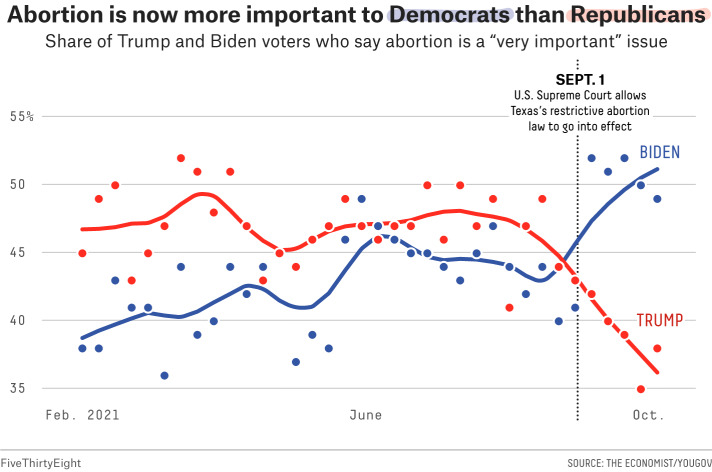
The polling experts at FiveThirtyEight posted some data on public opinion.


The last graph shows that relentless, ruthless Republican demagoguery on abortion is swaying public opinion. 

Once again, the power of dark free speech is on display. If that can happen with opinions on abortion, it can happen on opinions with most anything, including support for democracy and respect for truth, a secular basis for the rule of law, and civil liberties. That's the threat, right out in the open.