Etiquette


DP Etiquette

First rule: Don't be a jackass. Most people are good.

Other rules: Do not attack or insult people you disagree with. Engage with facts, logic and beliefs. Out of respect for others, please provide some sources for the facts and truths you rely on if you are asked for that. If emotion is getting out of hand, get it back in hand. To limit dehumanizing people, don't call people or whole groups of people disrespectful names, e.g., stupid, dumb or liar. Insulting people is counterproductive to rational discussion. Insult makes people angry and defensive. All points of view are welcome, right, center, left and elsewhere. Just disagree, but don't be belligerent or reject inconvenient facts, truths or defensible reasoning.

Sunday, November 26, 2023

Dutch election shows far right rising and reshaping Europe

 Snippets:

When Austria two decades ago became the first nation in Western Europe to lurch to the far right since World War II, the rest of the continent roared in outrage. Protesters haunted its politicians. Diplomats shunned them. One Belgian delegate skipped a lunch with Austria’s then-defense minister, telling reporters: “I don’t eat with fascists.”
Fast forward to 2023, when historic political momentum has given the far right a seat at Europe’s table and a chance to reshape the region’s politics and policies.
The latest victory came in the socially liberal Netherlands, where hard-right icon Geert Wilders and his anti-European Union, anti-Muslim and anti-immigration Party for Freedom landed a shocking first place finish this week in parliamentary elections.
But the unexpectedly strong showing by the “Dutch Donald Trump,” who has long pledged to ban the Quran and halt acceptance of asylum seekers, amounted to a powerful warning to mainstream Europe.
Wilders’s success, while shaped in part by domestic conditions, has further buoyed the global hard right, days after Javier Milei, a far-right economist and former television pundit, was elected president in Argentina.
Ahead of next year’s elections in the United States — where Trump is seen as a close ally of Europe’s anti-migrant, right-wing nationalists — the ascendancy of the far right in Europe is being closely watched as a bellwether of voter rage against traditional politicians in the West.
Far-right parties have taken power in Italy, extended their rule in Hungary, earned a coalition role in Finland, become de facto government partners in Sweden, entered Parliament in Greece and made striking gains in regional elections in Austria and Germany. Slovakia is also something of a far-right success story, with the far-right Slovak National Party among the coalition partners supporting populist Robert Fico — who hails from the far left but opposes migration and LGBTQ rights.
Wilders’s victory in Europe’s last big election of the year has renewed concern — or hope, depending on your perspective — that the far right could gain clout or become kingmakers in next spring’s European Parliament elections, with ramifications for the E.U.’s stance on migration, LGBTQ and reproductive rights, climate action and support for Ukraine.
Meanwhile, hard-right leaders across Europe have emerged as some of the strongest backers of Israel in the current conflict in Gaza.
The number of migrants entering Europe this year soared to levels not seen since 2016, amplifying the far right’s rallying cry against migrants and prodding mainstream politicians toward harder lines. After extended debate, E.U. nations have backed changes to the bloc’s migration rules that could get final approval as soon as early next year. Front-line countries such as Italy and Greece could send more migrants to other countries — or be paid by those that refuse. Importantly, deportations could be sped up and detention times extended.
The rest: 
The first question that enters my mind, is this:
While we liberals believe in immigration, have we ignored for too long the anxieties of those people who see too many immigrants as a threat? Do we simply dismiss them as "racist" and they counter our labeling of them by using their vote to get the government they want?
Are we about to make the same mistake in the US?
Americans have previously reacted with resignation. But not this time. A national poll conducted this month by CBS News found that only 34 per cent of Americans approve of Joe Biden’s handling of the issue, with lower marks only on inflation. Among Hispanics that figure fell to 29 per cent, and among independents to 26 per cent.


Saturday, November 25, 2023

Regarding wealth inequality: The buy-don't-built route to gigantic personal and corporate wealth & power

Larry Motuz pointed this gem out as something of interest. It’s about wealth inequality, ownership of corporations and how wealth and power flows and accumulates:
Stocking Up on Wealth … Concentration

Speaking of competition and losers, Ronald Reagan set the tone of the neoliberal era when, in 1981, he fired 11,000 striking air-traffic controllers. The message? Workers were losers who would be subjected to the discipline of competition. Reagan called it ‘morning in America’. But really, it was ‘morning for American big business’.

Today, we are well into the next-day’s hangover, and we know how the party played out. For workers, it was a disaster. But for the rich, it was an incredible boon. Wealth didn’t trickle down so much as it got catapulted up. The result, as Figure 1A shows, was a relentless rise in the concentration of American wealth.

Gini index of wealth concentration 
among all Americans


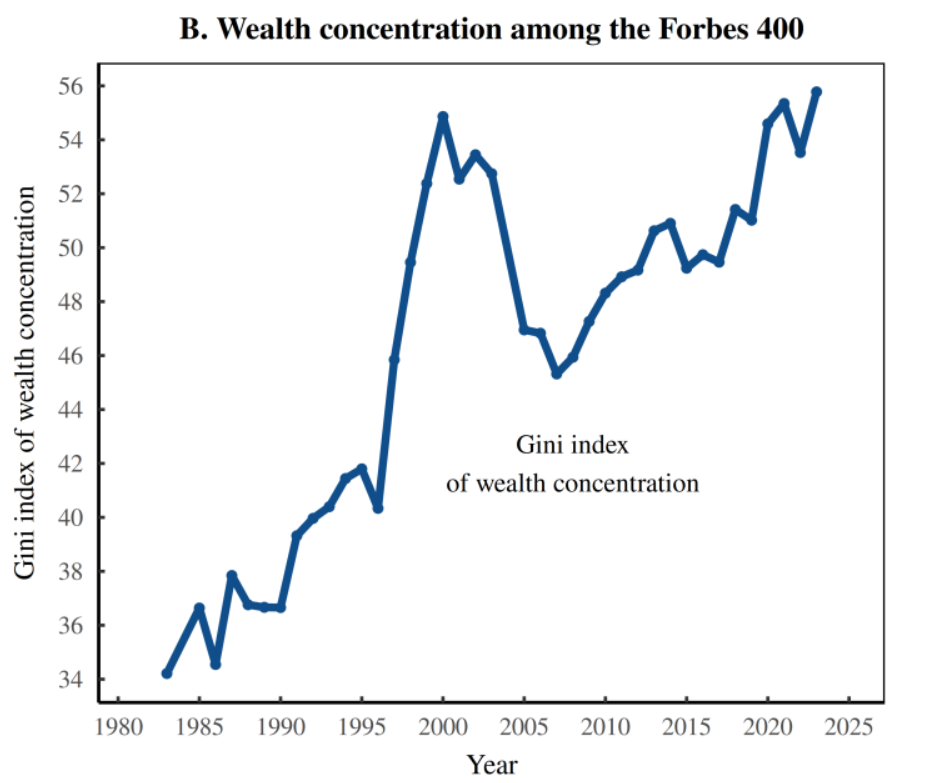
Interestingly, as wealth got catapulted from the poor to the rich, it also got transported from the mega rich to the supremely rich. This is the story told by Figure 1B. Here, I’ve focused on the richest Americans — the folks who grace the Forbes 400 list. Even here, among the upper crust of elites, wealth has grown more concentrated. Why?

As you’ll see, the culprit seems to be the stock market.

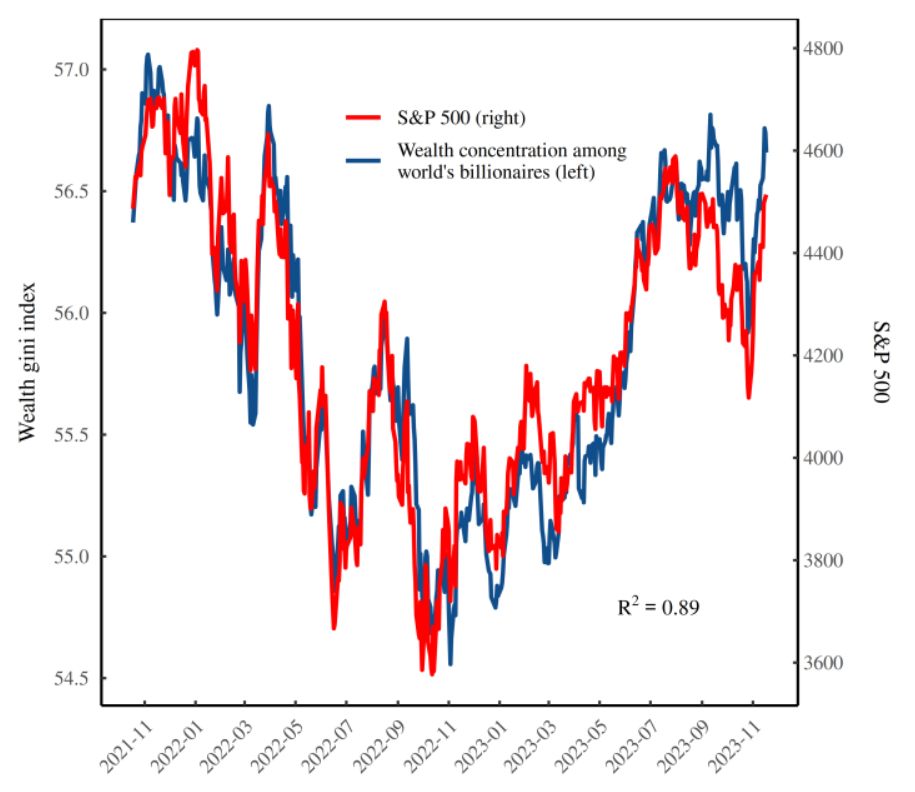
The message is that billionaire wealth is both spectacularly large and spectacularly concentrated. .... Something is driving billionaire wealth concentration up and down. What could it be?


The stock market drives billionaire 
wealth concentration


The stock-market average seems to ‘know’ about something that it shouldn’t. Why?
.... It happens when growth is driven by inequality. .... the S&P 500 index (an average) is connected to levels of elite wealth concentration (a form of spread). But this connection only makes sense if the S&P 500 is an (unwitting) indicator of stock-market inequality..... what I’m calling ‘growth through inequality’ — explains our stock-market results. .... the S&P 500 index (an average) is connected to levels of elite wealth concentration (a form of spread). .... in simple terms, the S&P 500 tracks the total market capitalization of the 500 largest US firms


.... firms that are giant companies like Apple, Microsoft, Google and Amazon — four corporations that have a combined market capitalization of about $5.9 trillion. .... [those huge] firms account for about a sixth of the value of the entire S&P 500. So if their stock rises, it will buoy the whole S&P 500 index. But this buoyancy isn’t really ‘growth’; it’s an artifact of corporate concentration — rich firms getting richer.

.... we’ve got evidence that the S&P 500 is an unwitting indicator of US corporate concentration. And it’s not because S&P analysts tried to make that happen. (They didn’t.) It’s because historically, an important part of (apparent) stock-market growth is simply the richest firms getting richer.
To the owners go the spoils

So what happens as rich firms get richer? Well, the rich owners of these firms also get richer. .... the concentration of corporate wealth should beget the concentration of individual wealth. So does it? At least in the United States, the answers seems to be yes. .... To the richest owners go the spoils of oligopoly.

The concentration of corporate wealth 
begets the concentration of individual wealth.

At this point we’ve got some fairly incendiary evidence. The ‘crime’ of elite wealth concentration seems to be tied directly to corporate oligarchy. But .... let’s consider the testimony of the defense’s expert witnesses. I’m talking, of course, about neoclassical economists.

Ostensibly, neoclassical economists love competitive markets and hate monopoly. But beginning in the 1980s, a weird thing happened; economists at the University of Chicago started to argue that despite lacking competition, monopolies could still be ‘efficient’. Their reasoning was that if monopolists actually behaved badly, they would be undercut by competitors, and their monopoly would be undone. Therefore, if a monopoly exists, it must be because the monopolist is doing what the market wants.

Now the logic here is torturous. We’re positing imaginary competition to justify a lack of real-world competition. But then again, neoclassical economists have never let the real world get in the way of their imaginations. And in this case, the goal of the imaginary theorizing was always obvious: it was designed get government out of the way and allow big corporations to purchase their way to power.

Backing up a bit, politicians are rarely incensed when a big corporation builds more factories. So in that sense, the government is not opposed to big companies getting bigger. But from a corporate vantage point, factory building is a less-than-ideal route to bigness. The problem is simple: if everyone builds more factories, it leads to ‘free run of production’ (Thorstein Veblen’s term) which then collapses profits. So savvy corporations are always looking for a better route to power. And that better route is to buy instead of build.

The buy-not-build tactic is hardly rocket science. As Jonathan Nitzan and Shimshon Bichler observe, when you buy your competitor, you solve two problems at once: you accumulate power and reduce your competition. The difficulty, though, is that this buy-not-build tactic has the appearance of being a blatant power grab. So there’s the risk that an entrepreneurial government might get in the way.

That’s where Chicago-school theorists come in. Starting in the 1980s, they successfully preached an ideology that got the government out of the way. The net result is the modern corporate landscape, forged in large part by a string of government-approved corporate acquisitions.

Tech monopolist Google has been a prime benefactor of this buy-not-build tactic. As Cory Doctorow notes, “Google didn’t invent its way to glory — it bought its way there.” He continues:

Google’s success stories (its ad-tech stack, its mobile platform, its collaborative office suite, its server-management tech, its video platform …) are all acquisitions.

The same strategy holds for most of today’s corporate oligarchies. Their tentacles have largely been bought, not built. On this front, the numbers don’t lie: the consolidated corporate landscape of the 21st century was forged by a massive, neoliberal wave of mergers and acquisitions.

To quantify the scale of mergers and acquisitions, we’ll turn to an index called the buy-to-build ratio. As the name suggests, the buy-to-build ratio measures the corporate proclivity for buying other companies instead of building new capacity. Created by Jonathan Nitzan and Shimshon Bichler (and first published in 2001), the buy-to-build ratio takes the value of corporate mergers and acquisitions and divides them by the value of greenfield investments. The greater this buy-to-build ratio, the more that corporations are buying (and not building) their way to power.

As I’ve alluded, the neoliberal era saw a massive wave of corporate mergers and acquisitions. As a result, from 1980 to 2000, the US buy-to-build ratio jumped nearly tenfold. And guess what accompanied this acquisition wave. That’s right … a sharp rise in corporate concentration. .... over the last forty years, big corporations have been buying their way to consolidated power.

One of the (few) nice things about living in an era of concentrated corporate power is that modern plutocrats are brash enough to speak plainly about their ambitions. Forget the arcane language wielded by Chicago-school economists. Today’s plutes — men like Peter Thiel — say the quiet part out loud. If you want to ‘capture lasting value’, Thiel proclaims, ‘look to build a monopoly’. Or in mantra form, ‘competition is for losers’. (emphasis added)

John D. Rockefeller would be proud.

Speaking of Rockefeller, did you know that he was one of the principle funders of the University of Chicago? Ironic, isn’t it. Rockefeller, like Thiel, spoke openly about his pursuit of power and personal enrichment. So if, during Rockefeller’s life, someone had connected elite wealth concentration to corporate consolidation, the reaction would have been “Well, that’s obvious.”

Fast forward to the 1980s and the connection became not-so obvious, at least to economists. And that’s thanks in large part to Rockefeller’s Chicago-school investment, which pumped out decades worth of pro-oligarch propaganda.

Today, we’ve come full circle. Billionaires like Peter Thiel are so hubristic that they speak brazenly about their pursuit of power, laying bare their inner robber baron. The upshot to this plute bravado is that few people will be surprised by the straight line that connects corporate oligarchy with the concentration of elite wealth.
That's sobering. Buy-don’t build is what got most of America’s major plutocrats much or most of their vast wealth and power. And if you look at it, anti-democracy authoritarianism is inherent in buy-don’t build dogma. Put another way, there is fierce competition for two things that tend to go together, wealth and power. The twin tendencies are (i) with wealth comes power, and (ii) with power comes wealth. What gets in the way of accumulating wealth? Regulations, government and the public interest or general welfare (civil liberties, transparent, honest government, etc.).

This is a very plausible explanation for the tactics and dogma that mostly animates America’s authoritarian radical right brass knuckles capitalist elites. That is just as scary as the tactics and dogma that animate America’s authoritarian radical right Christian nationalist elites. It’s a marriage made in hell for average people, democracy, the rule of law and civil liberties, but it’s made in heaven for the elites.

News Chunks: Capitalism and groundwater wars; Regarding the dangerous enraged one

In a long but excellent article, the NYT writes about how a few wealthy, mostly unaccountable elites control vast amounts of groundwater in Nevada, Kansas and Montana. Long story short, elite capitalists and their business interests are pumping groundwater fast and it will be gone in the coming years. People will simply have to move away from affected areas, including the businesses. The land alone will not sustain much in the way of modern large-scale human activities. 

This is what unregulated, social conscience-free capitalism always or nearly always does. Capitalists do not care about you, me, the public interest, or the environment. They care about themselves and profit. Period. The NYT writes about the Kansas situation (not paywalled off):


From a small brick building in Garden City, Kan., 13 men manage the use of groundwater across five million acres in the southwest corner of the state, some of the most productive farmland in America for corn, wheat and sorghum.

They serve on the board of Groundwater Management District 3, which since 1996 has overseen the pumping of 16.2 trillion gallons of groundwater — enough to fill Lake Mead, the country’s largest reservoir, twice over.

The board is elected, but not by everyone: The only people eligible to vote are large landowners, a group of less than 12,000 people in an area of roughly 130,000. And in some years, fewer than 100 people actually vote. Others — cashiers at Walmart, teachers at the community college, workers at the local St. Catherine Hospital — have no say in the management of the aquifer on which they, too, rely.

The aquifer is running out of water, fast. But the board hasn’t slowed down the pumping.

In a country where the value of land often depends on access to water, powerful interests in agriculture, heavy industry and real estate draw vast amounts of water out of the ground. For generations, that water has been treated as an unlimited resource in much of the United States, freely available to anyone who owns a piece of land and can drill a well. Entire local economies have been built around the assumption that the water will never run out.

Now it is starting to run out, not only in Kansas but across much of the country. From Maryland to Hawaii groundwater levels are falling, often the result of overpumping and underregulation, made worse by climate change. As the planet warms, demand for water is increasing. At the same time, increased evaporation, as well as decreased precipitation in some places, means that less water is refilling the aquifers, accelerating their decline.

“If we don’t make change, we’re not going to have water,” said Lindsay Vaughn, a state lawmaker in Kansas who has tried to curtail pumping in her state. 

But change is being actively resisted by many of the agribusinesses, multinational companies and big landowners who depend on enormous amounts of water. They say that reducing groundwater access strikes at the heart of local and regional economies. It also strikes at their bottom lines.

“You lose land value, you lose tax base, and quite frankly you lose the way of life,” said Joe Newland, president of the Kansas Farm Bureau.

In reporting around the country, The New York Times found that the struggle is intensifying between those who benefit from pumping large amounts of groundwater and those who see it as a looming catastrophe.

Once the water is gone, it’s gone unless humans mount a major, years-long effort to replenish depleted aquafers. This raises a bigger question than just groundwater. When unregulated capitalism runs wild and butt naked until there is nothing left to exploit or to sustain the local human population, the enterprise collapses. The elites just move on, mostly cushioned and protected by accumulated wealth. Regular people are left behind to fend for themselves. That's the typical narrative, with the typical human and/or environmental wreckage. 

Capitalism, it privatizes wealth and trickles most profit (usually ~95% ?) up to the elites, while socializing human and environmental risks and harms to the rest of us. No wonder the plutocrats fight tooth, claw and poison dagger to keep their vast wealth and power. They generally fight in darkness with as much secrecy and plausible deniability as possible. That’s how Trump always operated and still does. They all do it, with few exceptions.

One critically necessary thing needed to keep rural farm operations going is fresh water. Once that is gone, affected areas will in essence be mostly bankrupt wastelands. Natural rainwater will be insufficient to maintain most modern large-scale farm operations. The day is coming when there will be a lot of irate displaced farmers asking pointed questions, but getting no good answers. The plutocrats will quietly slink away in the dead of night, leaving the usual plutocrat wreckage behind them for others to deal with.
___________________________________________________________
___________________________________________________________

A long, detailed NYT opinion by columnist Thomas Edsall considers the race for president and how the MSM is stumbling, fumbling, bumbling and failing (not paywalled off - the article is worth the time to read):
Brian Klaas, a political scientist at University College London, captured the remarkable nature of the 2024 presidential election in an Oct. 1 essay, “The Case for Amplifying Trump’s Insanity.”

Klaas argued that the presidential contest now pits

a 77-year-old racist, misogynist bigot who has been found liable for rape, who incited a deadly, violent insurrection aimed at overturning a democratic election, who has committed mass fraud for personal enrichment, who is facing 91 separate counts of felony criminal charges against him and who has overtly discussed his authoritarian strategies for governing if he returns to power

against “an 80-year-old with mainstream Democratic Party views who sometimes misspeaks or trips.”

“One of those two candidates,” Klaas noted, “faces relentless newspaper columns and TV pundit ‘takes’ arguing that he should drop out of the race. (Spoiler alert: It’s somehow not the racist authoritarian sexual abuse fraudster facing 91 felony charges.)”

Klaas asked:

What is going on? How is it possible that the leading candidate to become president of the United States can float the prospect of executing a general and the media response is … crickets?

How is it possible that it’s not front page news when a man who soon may return to power calls for law enforcement to kill people for minor crimes? And why do so few people question Trump’s mental acuity rather than Biden’s, when Trump proposes delusional, unhinged plans for forest management and warns his supporters that Biden is going to lead us into World War II (which would require a time machine), or wrongly claims that he defeated Barack Obama in 2016?

The media, Klaas argued, has adopted a policy in covering Donald Trump of “Don’t amplify him! You’re just spreading his message.”

In Klaas’s view, newspapers and television have succumbed to what he called the “banality of crazy,” ignoring “even the most dangerous policy proposals by an authoritarian who is on the cusp of once again becoming the most powerful man in the world — precisely because it happens, like clockwork, almost every day.”

This approach, according to Klaas,

has backfired. It’s bad for democracy. The “don’t amplify him” argument is disastrous. We need to amplify Trump’s vile rhetoric more, because it will turn persuadable voters off to his cruel message.

Looking over the eight and a half years during which Trump has been directly engaged in presidential politics, it’s not as if there had been no warning signs.

The warnings that Trump is dangerous and unstable began well before his 2016 election and have become increasingly urgent.

These warnings came during the 2016 primary and general campaigns, continued throughout Trump’s four years in the White House and remain relentless as he gets older and more delusional about the outcome of the 2020 election.

In recent months, Trump has continued to add to the portrait Glass paints of him.

In March he told loyalists in Waco, Texas:

I am your warrior. I am your justice. And for those who have been wronged and betrayed, I am your retribution.

“With you at my side,” Trump went on to say,

we will totally obliterate the deep state, we will banish the warmongers from our government, we will drive out the globalists, and we will cast out the communists and Marxists, we will throw off the corrupt political class, we will beat the Democrats, we will rout the fake news media, we will stand up to the RINOs, and we will defeat Joe Biden and every single Democrat.

At the California Republican Convention on Sept. 29, Trump told the gathering that under his administration, shoplifters would be subject to extrajudicial execution: “We will immediately stop all the pillaging and theft. Very simply, if you rob a store, you can fully expect to be shot as you are leaving that store.”

Trump has continued to forge ahead, pledging to a crowd of supporters in Claremont, N.H., on Nov. 11: “We will root out the communists, Marxist fascists and the radical left thugs that live like vermin within the confines of our country that lie and steal and cheat on elections and will do anything possible — they’ll do anything, whether legally or illegally, to destroy America and to destroy the American dream.”

Trump, the Washington Post noted, dismissed federal criminal indictments as “third-world-country stuff, ‘arrest your opponent,’” then claimed that the indictments gave him license, if re-elected, to do the same thing: “I can do that, too.”

In an earlier story, Haberman, Savage and Swan reported that Trump allies are preparing to reissue an executive order known as Schedule F, which Trump promulgated at the end of his presidency but which never went into effect.

Schedule F, the reporters wrote,

would have empowered his administration to strip job protections from many career federal employees — who are supposed to be hired based on merit and cannot be arbitrarily fired. While the order said agencies should not hire or fire Schedule F employees based on political affiliation, it effectively would have made these employees more like political appointees who can be fired at will.

Schedule F would politicize posts in the senior civil service authorized to oversee the implementation of policy, replacing job security with the empowerment of the administration to hire and fire as it chose, a topic I wrote about in an earlier column.
Edsall’s column is quite long. It goes on at length like this. There is a heck of a lot to write about. What Klass and Edsall are arguing is for the MSM to stop treating DJT nicely. The MSM needs to pretending DJT didn’t say the horrible things he said. A few others in the MSM have recently seem to woken up to the gravity and urgency of the threat and are starting to use words like fascist.
 
Q: Should the MSM do as Klass and Edsall are arguing, or should keep a firm and steady hand on the tiller of the status quo, i.e., will it persuade the few persuadable minds that might still be open to more warnings about DJT?

Friday, November 24, 2023

News bits: Attacking the administrative deep state; Govt. attacking privacy; Christianity attacking secularism


A NYT opinion (not behind a paywall, I think) by law professor Kate Shaw (Cardozo Law School) discusses the current attack on the entire federal government in a case now pending at the USSC:
This USSC term largely revolves around a single blockbuster question: Will our government retain the capacity to address the most pressing issues of our time?

That’s what’s at stake in a group of cases involving the power, capacity and in some instances the very existence of federal agencies, the entities responsible for carrying out so much of the work of government. .... But the administrative power cases pending before the court this term involve issues that touch the lives of every American.

They involve the government’s ability to study and approve the safety and efficacy of the drugs we take; its power to protect consumers, enforce the securities laws and safeguard the nation’s waters; and ultimately to respond in innovative ways to the climate emergency. The outcome in these cases may even affect more obvious hot-button issues like guns and abortion.

It’s been clear for some time that several conservative justices harbor deep skepticism about the administrative state.

Under the court’s current conservative supermajority, the project of dismantling the administrative state is already well underway. This has largely happened through the court’s use of what it terms the major questions doctrine, a novel principle the court has wielded to prevent agencies from taking actions of significant political or economic importance if they cannot point to explicit authorization from Congress.

Using this doctrine, last year the court kneecapped the Environmental Protection Agency by limiting its ability to enforce the Clean Air Act in West Virginia v. E.P.A. It further curtailed agency power this year in Biden v. Nebraska, when it struck down an initiative by the administration’s Department of Education that would have canceled significant quantities of student debt.

Perhaps the most important case this term is Loper Bright Enterprises v. Raimondo, scheduled for oral arguments in early 2024, in which the plaintiffs are asking the court to overrule the best-known case in administrative law, Chevron v. Natural Resources Defense Council. In Chevron, the court announced a rule that directed federal courts to defer to reasonable agency interpretations of statutes they administer. That is, if a statute is silent or ambiguous on a particular question, courts aren’t supposed to write on a blank slate about what the statute means — if an expert agency has already provided an answer to the question, and it’s a reasonable one, the court is supposed to defer to that interpretation.  
In the 1984 Chevron case itself, the court deferred to a Reagan-era E.P.A. rule challenged by environmentalists, and the case once counted conservative stalwarts like Justice Scalia and Justice Clarence Thomas among its defenders. (In his “dull” lecture, Justice Scalia explained that the rule of Chevron “accurately reflects the reality of government” and “adequately serves its needs.”)

But Chevron has become a bĂȘte noire [something hated or strongly disliked] in conservative circles.
I warned about the authoritarian radical right attack on the Chevron Defense before. If that legal doctrine falls, almost all of federal government will grid to a halt. People will feel a lot of pain. Some will be killed as regulations fade away and free markets running wild and butt naked takes care of us instead of the government doing it. Vast power will flow from us to brass knuckles capitalists and enraged, foaming at the mouth Christian nationalist freaks. 

Keep your eyes on the flow of power.

OT: I wrote to Shaw and asked her to stop calling elite Republican politicians, including judges, conservatives. They are not conservative. They are deeply corrupt, pro-dictatorship radical right extremists. I suspect she won’t change her labeling, but at least I did a little by pinging her mind. 


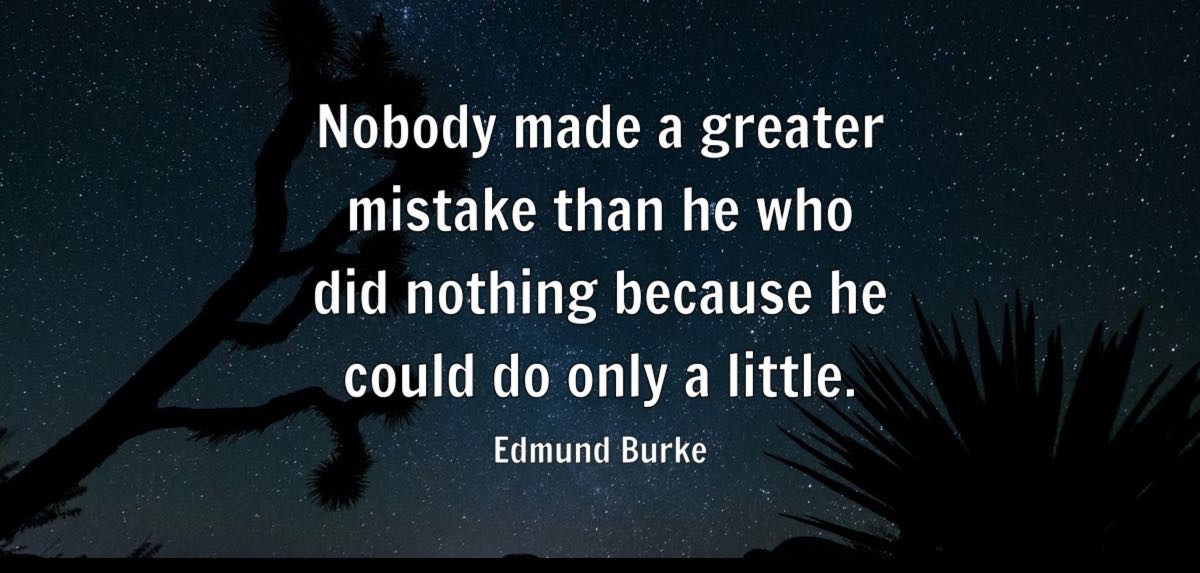
Quote Investigator: Currently, QI has located no substantive evidence that Edmund Burke employed this saying. Burke died in 1797, and he received credit in 1981. The earliest match located by QI appeared in the 1850 book “Elementary Sketches of Moral Philosophy” by Reverend Sydney Smith. This posthumous work was based on lectures delivered by Smith at the Royal Institution of London between 1804 and 1806. Boldface added to excerpts by QI:

It is the greatest of all mistakes, to do nothing because you can only do little: but there are men who are always clamoring for immediate and stupendous effects, ....

Fact check tip: Always check to see if a quote is properly attributed. I've made that mistake several times, but not any more (I hope).
________________________________________________________________________
________________________________________________________________________

The federal government does not take privacy rights seriously:
US govt pays AT&T to let cops search Americans' phone records 
– 'usually' without a warrant

At least get a court order before mining Hemisphere Project data, says Senator

A senator has complained that American law enforcement agencies snoop on US citizens and residents, seemingly without regard for the privacy provisions of the Fourth Amendment, under a secret program called the Hemisphere Project that allows police to conduct searches of trillions of phone records.

According to Senator Ron Wyden (D-OR), these searches "usually" happen without warrants. And after more than a decade of keeping people — lawmakers included — in the dark about Hemisphere, Wyden wants the Justice Department to reveal information about what he called a "long-running dragnet surveillance program."

"I have serious concerns about the legality of this surveillance program, and the materials provided by the DoJ contain troubling information that would justifiably outrage many Americans and other members of Congress," Wyden wrote in a letter [PDF] to US Attorney General Merrick Garland.  
AT&T declined to answer any specific questions about Hemisphere, but a spokesperson told The Register: "To be clear, any information referred to in Senator Wyden's letter would be compelled by subpoena, warrant, or court order."
If AT&T is lying, it's reasonable to believe that nothing will be done about this. Garland is worse than worthless. He does not care much about us, our rights, democracy, or the rule of law.
________________________________________________________________________
________________________________________________________________________

This video discusses Awana (Approved Workmen Are Not Ashamed). The speaker describes Awana as a nationwide Christian nationalist child indoctrination cult. The Wikipedia page for Awana is bland and probably written by Awana to make it seem innocent. It certainly was not written by Ellie, the speaker in the video. She was raised by devout Christian parents and went through various Christian nationalist experiences for children. She has rejected Christian nationalism and posts videos on YouTube about her childhood experiences and other things.


An Awana pledge to the Christian flag

This comment to me at the reddit atheism site
put me onto Ellie, the speaker in the video

I think I've underestimated how broad, deep and intrusive Christian nationalism has been and increasingly is. ☹️