Etiquette


DP Etiquette

First rule: Don't be a jackass. Most people are good.

Other rules: Do not attack or insult people you disagree with. Engage with facts, logic and beliefs. Out of respect for others, please provide some sources for the facts and truths you rely on if you are asked for that. If emotion is getting out of hand, get it back in hand. To limit dehumanizing people, don't call people or whole groups of people disrespectful names, e.g., stupid, dumb or liar. Insulting people is counterproductive to rational discussion. Insult makes people angry and defensive. All points of view are welcome, right, center, left and elsewhere. Just disagree, but don't be belligerent or reject inconvenient facts, truths or defensible reasoning.

Monday, July 22, 2024

What Dems are thinking; What Repubs are saying


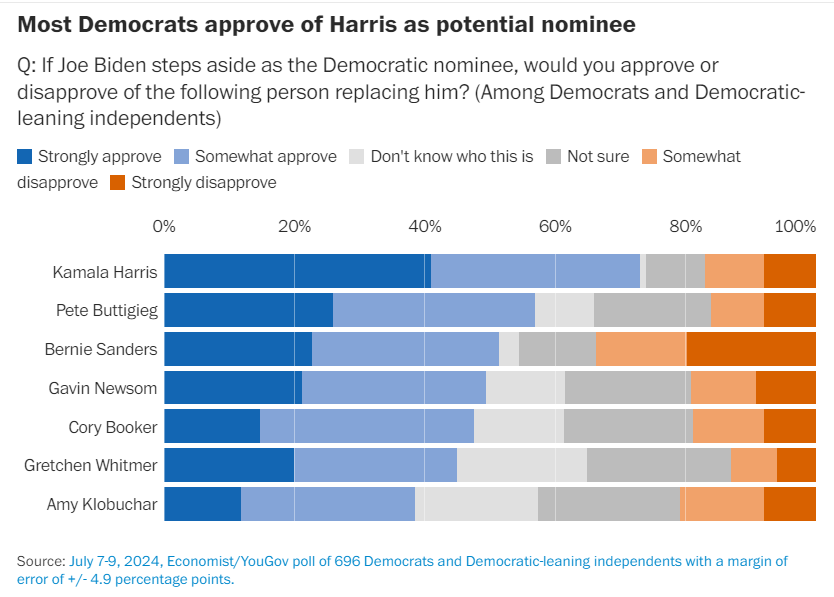
At this point, it is probably too early to give much weight to polls. Some time is needed for the change to sink in. And, polls from the swing states (PA, MI, WI, GA, NC, NV, AZ) are probably the only ones that count, unless a major shift in sentiment from DJT to the nominated Dem candidate occurs.

Reuters reports that all state Democratic party chairs have endorsed Harris. The momentum seems to be in her favor.
__________________________________________________________
__________________________________________________________

As expected, the Repubs have started their brutal dark free speech attacks on Kamala. The degree of lying, slandering and crackpottery is as high and intense as a reasonable pro-democracy person might expect. Given how disgusting the morally rotted attacks are in my opinion, it seems counterproductive to repeat much or any of Repub filth here. I am inclined to mostly or completely ignore it. If there is useful negative information about Harris to be had, it can come from sources other than hyper-biased Repub liars. 

Q: Is it better to know at least something about the Repub attacks and hypocritical sleaze, or to ignore it? 

Sunday, July 21, 2024

Biden drops out of the race; Now what?

Joe drops out of the race and endorses Kamala. Things just keep getting weirder. 

1. This is mostly bad for DJT, mostly good for democracy

2. This is mostly good for DJT, mostly bad for democracy

3. I don't know what this is 

4. Other

Book comments: Autocracy Inc.

One thing that seemed to be real and serious was a personal perception that the world’s authoritarians are banding together to mount a global war against democracy, the rule of law, civil liberties and transparency in government. Apparently, at least a few others see basically the same thing. 


The Hill published commentary on a new book by historian Anne Applebaum (staff writer at The Atlantic), Autocracy, Inc.: The Dictators Who Want To Run The World
Last month, North Korea and Russia signed a pact covering trade, investment and cultural ties, and pledging aid if either nation faces “aggression.” In exchange for economic assistance and technology transfers that bolster its nuclear weapons program, North Korea is continuing to provide Russia with ammunition for its war against Ukraine. President Vladimir Putin praised Supreme Leader Kim Jong Un for supporting “the fight against the imperialistic policies of the United States and its allies.”

This month, soon after he assumed the rotating presidency of the European Union, Hungarian Prime Minister Viktor Orbán — a self-proclaimed champion of “illiberal democracy” who has cracked down on freedom of the press and an independent judiciary — left EU leaders fuming by urging President Volodymyr Zelensky to negotiate an end to the war in Ukraine, and then lavishing praise on Putin and Xi Jinping in Moscow and Beijing. A few days later, Orbán met with Donald Trump, whose reelection he has endorsed. “We discussed ways to make peace,” Orbán said. “The good news of the day: he’s going to solve it.”

These incidents indicate that aspiring autocrats and dictators share the same goals: enrich themselves, remain in power, deprive their own citizens of influence, discredit and destroy democracy and create a new world order. And that they are collaborating to achieve these goals.

Shared grievances and anti-democratic goals motivate autocrats to help one another. Iran traded food and gasoline for Venezuelan gold and sent equipment and personnel to repair oil refineries. In 2016, Xi Jinping endorsed Iran’s role in helping Syria’s Bashar al-Assad, who authorized chemical weapons attacks on his own people, retain power. Iran increased China’s access to its oil, infrastructure, telecommunications and banking markets.

Enemies of democracy have vastly improved their capacity to censor online content. China outlaws posts that “endanger national security, subvert the government, or undermine national unification.” Afraid of losing business in the world’s second most populous nation, American tech companies altered software to protect the “Great Firewall’s protocols.” Pakistan, Brazil, Mexico, Serbia, South Africa, Turkey, Singapore and Zimbabwe have acquired China’s “safe city technology.”

Autocrats have also ramped up the internal and external dissemination of fake news about democracies.
Along with increasing military and financial assistance to Ukraine, Applebaum believes that to regain the initiative a multinational movement must make money laundering and real estate transactions transparent; require internet posts to be more evidence-based and less anonymous, while holding social media companies more accountable for content; and reduce democratic countries’ reliance on minerals, semiconductors and energy supplies sold by Russia, China and other autocracies.

These reforms won’t occur, Applebaum emphasizes, until citizens of democracies “think of themselves as linked to one another and to the people who share their values inside autocracies, too. They need one another, now more than ever, because their democracies are not safe. Nobody’s democracy is safe.”

At a time of increasing isolationist and nationalist sentiments in Western democracies, implementing this agenda won’t be easy.
The NYT comments on Applebaum’s book (not paywalled):
Something new is happening in the world of oppression. Or so says the historian Anne Applebaum.

Whereas the twilight struggle of the 20th century was waged between formal “blocs” of ideologically aligned allies, today’s autocrats are more diverse — a mix of self-described Marxists, illiberal demagogues, kleptocratic mafiosi, old-school tyrants and new-school theocrats.

Of course, they do share ideas if not ideologies, among them that liberal internationalism is an alibi for imperialism, the means by which Washington and Brussels impose their interests and decadent cultural mores (especially L.G.B.T.Q. tolerance) on the rest of the world. But today’s autocrats principally cement their bonds, Applebaum argues, “not through ideals but through deals.” Thanks in large part to the opacity of global finance, they enjoy a vibrant trade in surveillance technologies, weapons and precious minerals, laundering one another’s dirty money and colluding to evade American sanctions. This venal compact of convenience she calls “Autocracy, Inc.” 

To her credit, Applebaum’s new book risks a more sophisticated, and less flattering, answer: Globalization did work, only not how she and her friends assumed it would. Autocracies became more integrated with one another, while American and European trade dependence on the autocratic world — on Chinese manufacturing and Russian oil, for instance — became a weapon to be used against the West. “Everyone assumed that in a more open, interconnected world, democracy and liberal ideas would spread to the autocratic states,” Applebaum writes. Nobody imagined that autocratic and illiberal ideas “would spread to the democratic world instead.”

And not only ideas. Before and after the fall of the Soviet Union, cash robbed from the coffers of the Communist East flowed into bank accounts in London and the Caribbean. More recently, shell companies in Delaware have purchased apartments in New York on behalf of oligarchs in Russia and China, while European and American accountants, real estate agents and lawyers have enjoyed hefty fees for secreting the ill-gotten wealth of the world’s kleptocrats. In short, the world system accommodated the needs of autocracy; the autocrats were not required to change. 

Applebaum is cleareyed about the difficulties of rectifying this situation: “Powerful people benefit from the existing system, want to keep it in place and have deep connections across the political spectrum.” She’s no anticapitalist, but her recommendations for reforms to the financial system — requiring companies to be registered in the name of their actual owners, for example — are concrete and admirable. (emphasis added)

The NYT article goes on to criticize some of Applebaum’s reasoning and conclusions, but I found her reasoning more persuasive and evidence-based than the NYT critic’s subjective evaluations. In essence, she sees even more than what I could see. 

Remembering the radical right authoritarian elite Bill Buckley


In 2008, FAIR published a remembrance about the politics of the influential radical Bill Buckley (1925-2008), a mainstream media creature who held the mainstream media in open contempt:
William F. Buckley, Rest in Praise

Glowing obits obscure an ugly record

Over the course of his career, William F. Buckley routinely reproached the “liberal media” from his perch high atop it. By his death on February 27, he’d published dozens of books, written decades of syndicated columns that appeared in hundreds of newspapers, and made thousands of television and radio appearances, among them some 1,500 on his own PBS show, Firing Line, the longest-running public affairs show in public television history.

Unsurprisingly, that same “liberal” media treated Buckley’s passing as the loss of a great intellectual and upstanding human being, with admiring obituaries that largely ignored a massive body of unfavorable material.

Buckley’s career began in 1951 with the publication of God and Man at Yale, an attack on his alma mater that urged the firing of professors whom he felt were insufficiently hostile to socialism and atheism. Despite this early assault on academic freedom, Buckley in later years routinely took offense at what he saw as liberal “political correctness” (e.g., National Review, 10/24/05; Post and Courier, 2/18/99).

During the Civil Rights Era, Buckley made a name for himself as a promoter of white supremacy. National Review, which he founded in 1955, championed violent racist regimes in the American South and South Africa.

A 1957 editorial written by Buckley, “Why the South Must Prevail” (National Review, 8/24/57), cited the “cultural superiority of white over Negro” in explaining why whites were “entitled to take such measures as are necessary to prevail, politically and culturally, in areas where [they do] not predominate numerically.” Appearing on NPR’s Fresh Air in 1989 (rebroadcast 2/28/08), he stood by the passage. “Well, I think that’s absolutely correct,” Buckley told host Terry Gross when she read it back to him.

A 1960 National Review editorial supported South Africa’s white minority rule (4/23/60): “The whites are entitled, we believe, to preeminence in South Africa.” In a 1961 National Review column about colonialism—which the magazine once called “that brilliantly conceived structure” (William F. Buckley, John Judis)–Buckley explained that “black Africans” left alone “tend to revert to savagery.” The same year, in a speech to the group Young Americans for Freedom, Buckley called citizens of the Congo “semi-savages” (National Review, 9/9/61).

National Review editors condemned the 1963 bombing of a black Birmingham Church that killed four children, but because it “set back the cause of the white people there so dramatically,” the editors wondered “whether in fact the explosion was the act of a provocateur—of a Communist, or of a crazed Negro” (Chicago Reader, 8/26/05).

Just months before the 1965 Voting Rights Act was passed, Buckley warned in his syndicated column (2/18/65) that “chaos” and “mobocratic rule” might follow if “the entire Negro population in the South were suddenly given the vote.” In his 1969 column “On Negro Inferiority” (4/8/69), Buckley heralded as “massive” and “apparently authoritative” academic racist Arthur Jensen’s findings that blacks are less intelligent than whites and Asians.

The ugliness of Buckley’s public advocacy was not restricted to race. McCarthy and His Enemies, published in 1954 and coauthored by Buckley with Brent Bozell Sr., called Sen. Joseph McCarthy “a prophet,” and described McCarthyism as “a movement around which men of good will and stern morality can close ranks.”

Buckley’s disdain for what he called “liberals’ fetishistic commitment to democracy” (William F. Buckley, John Judis) was evident in his admiration for dictators, including Spain’s Francisco Franco and Chile’s Augusto Pinochet. “General Franco is an authentic national hero,” wrote Buckley (National Review, 10/ 26/57), lauding the fascist for wresting Spain from its democracy and “the visionaries, ideologues, Marxists and nihilists” in charge. Pinochet was defended (National Review, 11/23/98) for deposing the democratically elected Salvador Allende, “a president who was defiling the Chilean constitution and waving proudly the banner of his friend and idol, Fidel Castro.”
The remembrance continues at length in that vein, but concludes with this blast at the mainstream media:

With such a wealth of unbecoming material—long-term support for racism, fascism, militarism and harshly intrusive policies into the private lives of individuals—one might have expected obituaries to present at least a mixed portrait of Buckley’s influential life. Considering the generosity Buckley received from a media he disdained, one shudders to think about the orgy of praise his death would have occasioned in a media more to his liking.  

Is it just me, or do the more radical pillars of what used to be called conservatism, now MAGA or radical right authoritarianism, look amazingly alike? Their distorted visions of reality, biases and their thinking all seem quite alike. They are all openly hostile to democracy and civil liberties. They all seem to apply about the same reasoning that leads to about the same beliefs and policy preferences. 

To me, Buckley spewing his bigoted authoritarian brand of politics in the 1950s and 1960s sounds very much like DJT and the Republican Party sounds in 2024. With more nuanced language about racism as a possible exception, the attitudes of Buckley are basically the same as the attitudes of MAGA. This is a reminder. The roots of MAGA go back a long ways in time. How far back? Arguably at least back to the 1800s, if not a century or two earlier than that.

This article raised the question: Was “true” conservatism always more like what Buckley and now MAGA espouse than what the now extinct moderates and liberals in the pre-MAGA Republican Party briefly represented? I wonder.