Etiquette


DP Etiquette

First rule: Don't be a jackass. Most people are good.

Other rules: Do not attack or insult people you disagree with. Engage with facts, logic and beliefs. Out of respect for others, please provide some sources for the facts and truths you rely on if you are asked for that. If emotion is getting out of hand, get it back in hand. To limit dehumanizing people, don't call people or whole groups of people disrespectful names, e.g., stupid, dumb or liar. Insulting people is counterproductive to rational discussion. Insult makes people angry and defensive. All points of view are welcome, right, center, left and elsewhere. Just disagree, but don't be belligerent or reject inconvenient facts, truths or defensible reasoning.

Tuesday, June 10, 2025

Trump's empty promises to revitalize rural America

A post here yesterday, In the minds of rural Trump supporters, discussed (1) the difficult social and economic situation that many rural areas face, and (2) continuing staunch support that most rural voters still have for djt and his painful policies, including tariffs. This post considers if tariffs will work and why rural voters remain loyal to djt and his policies.


Demographics
Rural America faces major structural and demographic challenges that go far beyond normal cyclical economic downturns. Current research indicates that 91 percent of rural counties lost prime working age population from 2010 to 2019, with 51 percent losing 10 percent or more. Economic indicators are also not good: the average poverty rate in rural areas is nearly three percentage points higher than in non-rural areas (16.4 percent versus 13.5 percent), with the most significant disparities concentrated in the South. 

The biggest age cohort in rural America is 55-64, compared to 25-34 in non-rural areas9, indicating a fundamental demographic inversion that undermines long-term economic sustainability. These changes result from "advances in technological innovation and automation, declines in the extraction of certain energy resources, increases in globalization, and a shift to the 'knowledge-based' economy" that disproportionately affected rural communities. 


Tariffs
Current evidence indicates that djt's tariffs are harming rural economies. The agriculture sector faces serious vulnerability to tariff-based trade wars. djt's 2018 tariffs and the ensuing trade war caused hundreds of farm bankruptcies and wiped out tens of thousands of small farms. The pattern is repeating, as "his 2018 tariff tantrum caused a farm crisis, leading to government bailouts for Big Ag corporations" while smaller operations suffered disproportionately.

A fundamental challenge facing tariff-based manufacturing revival is in changed economic structures. Even if new mills and factories were built, they would still need to import materials from abroad. Those would be subject to tariffs and thus pricier. This reality contradicts the logic of tariff-driven industrial policy. Also, almost 8 million Americans work in industries targeted by foreign retaliatory tariffs, with the majority being Trump voters. This strategic targeting by foreign governments creates political pressure by harming Trump's electoral base, but it also shows the vulnerability of rural economies to trade conflicts.

djt's federal spending cuts will impede rural revitalization. Rural communities depend heavily on existing federal programs for basic infrastructure, healthcare, and economic development support. djt's proposed cuts target programs essential to rural functionality, e.g., his budget eliminates USDA support for water and wastewater infrastructure projects for communities with populations of 10,000 or less. The USDA funded nearly 6,000 projects providing safe water to 20.7 million rural residents since 2009, djt's cuts eliminate critical water infrastructure necessary for any rural economic development. Also, opioid addiction epidemic is crippling in rural America. 

djt's policy priorities show a disregard for rural well-being. Farm bailouts during his first term sent most of the funds to the largest farms and agribusinesses. That accelerated corporate consolidation while family farms collapsed. So far, djt's response has cut off funding for rural health care services. Other proposed cuts eliminate support for small-town airports, economic development, education assistance, and even weather and safety alerts on rural broadcast stations. Claims of economic revitalization in the face of those conditions is a cruel, cynical hoax.

So even if tariffs generated vast amounts of money, djt is not willing to spend it in rural areas. On top of that, those tariffs will increase consumer prices. Under djt and MAGA politics, rural America is seriously screwed.

Bottom line: djt's claims that tariffs will restore rural America are false.

Another problem: Just like Repubs and MAGA policy, Dems cannot revitalize rural areas either. The structural problems are far too great for the return of 1950s-1960s levels of rural prosperity and reasons for pride. Rural revitalization in America is a mirage. Either some sort of a managed, respectful rural transition or continuing misery and poverty are far more realistic outcomes, at least in theory. But with autocratic djt and authoritarian MAGA elites in power, a managed, respectful transition for rural areas to something else better is impossible. So, for the foreseeable future, continuing misery and poverty are to be expected. Also to be expected is continuing rural support for djt and increasingly painful MAGA policies. 


Why they still support him
In focus groups with djt voters, participants generally used the word "extreme" about his language and leadership style, and most of them liked that he threw around threats against foreign adversaries or took a hard line on issues. Despite many djt voters acknowledging his failures, most are still strong supporters. Symbolic representation matters more than bad policy outcomes. djt's relentless demagoguery and lies have led most of his supporters to see congress's primary function as endorsing the president's initiatives. They have little tolerance for Republicans who stray from party orthodoxy.

In terms of cognitive biology, djt supporter pride manifests as resistance to acknowledging dependency on federal programs that will be cut. Rural communities tend to love harsh anti-government rhetoric, while relying heavily on government services. The cognitive dissonance that pride generates makes it difficult or impossible to resolve by rational analysis or policy.

Bottom line: rural support for djt is rooted mostly in cultural identity and symbolic politics, not in rational analysis or policy. Rural supporters are highly tolerant of policy failures when they feel loyalty and cultural alignment with djt. Traditional economic appeals are simply insufficient for any major political realignment.  At least for the time being, most rural voters seem to be locked by pride, loyalty and identity into solid support for djt and MAGA politics and policies. Concerns over democracy, the rule of law and civil liberties are not a significant issue. 
Monday, June 9, 2025

In the minds of rural Trump supporters

I very much hope this is not TL/DR. 🙏 It is a fascinating and important glimpse into the minds of at least some staunch djt supporters in one rural area.

A fascinating NYT opinion (not paywalled) by sociologist Arlie Russell Hochschild summarizes her work on trying to gauge how djt supporters in eastern Kentucky currently see him. The bottom line is that nearly all still support him even though they know his policies will seriously hurt many of them. Many see it as a matter of taking the pain needed to make America great again. They take pride in their ability to tolerate pain, knowing it is coming from a person they greatly admire and trust. They still believe that djt has concern for their welfare.

Ms. Hochschild writes:
When I checked back in with many of the Trump supporters whose lives I describe in my most recent book, “Stolen Pride,” to see if this had changed any of their minds, the overall answer seemed to be no. Some seemed more committed to Mr. Trump than they had been before.

Rob Musick, a religious studies instructor at the University of Pikeville and shrewd observer of his community, noted: “Since the inauguration, I haven’t heard any alarm bells go off” — not when Mr. Trump dressed down Ukraine’s president in the Oval Office and fired U.S.A.I.D. workers, not when ICE raided a Mexican restaurant nearby. “There has been no public response,” he said.

Democrats are deeply unpopular. According to a March poll, only 27 percent of registered voters have a positive view of the Democratic Party, the lowest level since NBC News began asking the question in 1990, and my conversations with voters in the Fifth District distilled just how difficult it will be for the party to break through when Mr. Trump has so powerfully captured the bitterness and pain that has taken root in the hills of Appalachia.

Rob Musick explained: “Around here, Democrats come off as against this and against that — and not for anything. They need a big positive alternative vision. And they need to understand that in rural areas like this, the deeper problem is that we’re socially hollowed out. That happy buzz of community life? That’s not here. There are fewer meetings of the Masons, the Rotary Club, the Red Hatters. Our church benches are empty. In the mountains, there’s no safe place against drugs. One elderly woman told me, ‘I don’t open my door anymore.’ I’ve heard teens say, ‘There’s nothing to do.’ A lot of kids are alone in their rooms online with Dungeons and Dragons. I think MAGA plays to a social desert.”

“I think Democrats need to get behind this kind of effort and initiate a campaign of grand civic re-engagement,” Mr. Musick said. Federal funds could support the best local initiatives, he added, and help start ecology, drama and music clubs — “good local things that lack funding.”

In the meantime, James Browning, the addiction counselor, offered this important warning. “If people in Pike County or elsewhere get socked with higher prices, there might come a tipping point. But what happens then would hinge on how Democrats handle it, what better ideas they have to offer, their tone of voice. If the left starts scolding, ‘You Trump supporters brought this on yourselves,’ or ‘We told you so,’ people around here will get more pissed at the snarky left than they are at the hurtful right — and Trump will march on.”

So, at least in rural eastern Kentucky, the Dems cannot put any blame on djt or themselves for djt's failure and their necessary role in putting him in power and making their lives miserable. They have to change their minds on their own. Little or nothing that Dems or djt opponents can say will change that. But probably almost anything they do say about responsibility for the mess will make things worse. Rural djt supporters simply won't take any criticism or snark from any Dem. They got their pride. 

One can see the iron grip of irrationality on those minds. On the one hand they will accept the pain djt is dishing out because they know it comes from someone they trust and like. On the other they suggest Democrats need to get behind a grand social rebuilding effort, articulate positive policies, initiate a campaign of grand civic re-engagement and use federal funds to drive revitalization. They want revitalization of what is now basically economically and socially dead or close to it. They want federal funds to help them out of their plight but voted into power an extremist who promised to cut the federal funds they need.

How likely is it that businesses are going to come back to poor rural areas based on tariff pressure? Very unlikely. Apparently almost impossible. Tomorrow I'll do a post on the issue of rural revitalization and tariffs. The analysis is complicated and fascinating, but the bottom line is clear: The rural situation is extremely difficult. Tariffs ain't gonna do what djt says they will do. Even if he wanted to, which he does not, djt cannot revitalize most poor rural areas with his and MAGA's policies and tactics.

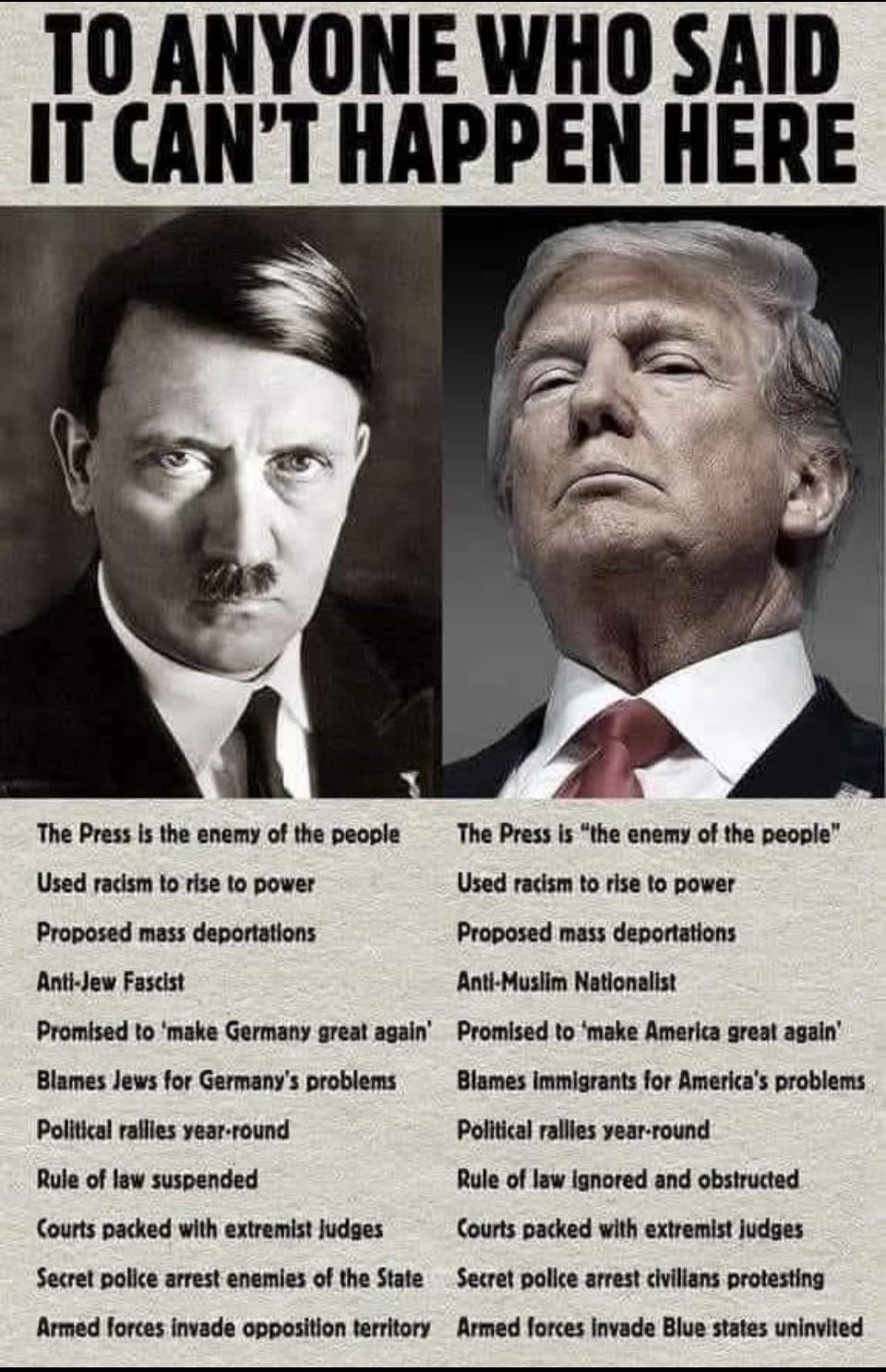
A comparison -- meaningful or not, helpful or not?

One can just feel a slow awakening among some people. Comparisons are bound to be made. I've already made this comparison and come to the same conclusion this one does. 

But is it too little, too late? Maybe not.


Peanut 1, possibly asserting our last, best hope: There is one big difference. Trump is older, by a lot, than Hitler was. None of his subordinates can replace him and retain the loyalties of his core voter base. It's the one reason I don't think that the US will follow the same pattern as Germany during the Nazi regime - the dear leader won't survive long enough.


Peanut 2: They only need Trump long enough for Musk, Thiel, and the like to get what they want for their dark enlightenment horseshit. Even without Trump, they'll prop up Vance long enough to get it done and then depose them all.


Peanut 3, asserting a very familiar feeling: I wish I could go back to every one of those [expletive deleted] who said I was overreacting during Trump's first term. Some of 'em are still saying it. Fuck.


Peanut 4, asserting a discomforting truth: Don't forget: The US hosted fucking Nazi rallies in New York. There were a lot of fascists here in the US for a long time. We didn't ever defeat the fascists in WWII. They just went underground.

Sunday, June 8, 2025

How autocratic legalism destroys democracies, the rule of law and civil liberties

A 2018 University of Chicago School of Law review paper by governance and dictatorship expert Kim Lane Scheppele entitled, Autocratic Legalism (AL), discusses how autocratic demagogues can legally kill a democracy and establish a deeply corrupt autocracy or dictatorship. Part of the abstract reads as follows:

Buried within the general phenomenon of democratic decline is a set of cases in which charismatic new leaders are elected by democratic publics and then use their electoral mandates to dismantle by law the constitutional systems they inherited. These leaders aim to consolidate power and to remain in office indefinitely, eventually eliminating the ability of democratic publics to exercise their basic democratic rights, to hold leaders accountable, and to change their leaders peacefully. Because these “legalistic autocrats” deploy the law to achieve their aims, impending autocracy may not be evident at the start. But we can learn to spot the legalistic autocrats before autocratic constitutionalism becomes fatal because they are often following a script using tactics that they borrow from each other. 

  • AL constitutes a pattern of democratic decline where charismatic demagogues elected through democratic processes systematically dismantle constitutional systems and norms by legal means, not force. This is a sophisticated form of authoritarianism that operates under the cover of legal legitimacy. That makes it particularly dangerous because the autocratic transformation may not be evident early on, and often some time later. Autocrats consolidate power while they maintain a facade of democratic governance to hide their true intentions. 
  • A key AL tactic centers on corrupting laws in one of three main ways. This involves (i) use or creation of convenient laws, (ii) abuse of unfavorable laws, and (iii) non-use (non-enforcement) of unfavorable laws.[1] In the first tactic, the dictator wannabe uses or creates convenient laws by getting lawmakers to pass statutory and constitutional changes that support autocratic goals. In the second tactic, convenient laws are abused by reinterpreting them in ways favorable to dictatorship and corruption. Third, non-use of law amounts to simply not enforcing to laws and legal norms that obstruct concentration of power with the dictator. djt and MAGA elites have engaged in all three tactics. 
  • The first major warning sign of rising AL is seen when a democratically elected leader launches a concerted and sustained attack on institutions whose job it is to check their actions or on rules that hold them accountable, even when doing so in the name of their democratic mandate. This attack manifests as the loosening of constitutional constraints on executive power through legal reform, representing the first sign of the autocratic transformation. The leaders' signature promise is to not play by the old rules. Instead they position themselves as agents of necessary change.  
  • Autocratic consolidation of power is accomplished by multiple systematic changes that appear innocuous or only modest individually, but collectively undermine and destroy the foundations of liberal democracy. Sometimes these changes receive electoral backing and reliance on constitutional or legal methods to accomplish autocratic goals. The leaders may use congressional supermajorities or direct appeals to "the people" to pass high-level statutory and constitutional changes that, in principle and isolation, may not seem inconsistent with liberal democracy, but in fact are seriously damaging to democracy, the rule of law, and/or civil liberties.
  • AL has an important international dimension. Autocratic leaders foster global authoritarian attacks on democracies and norms by learning from and supporting each other. Elite practitioners engage in systematic cross-border learning, strategic collaboration, and mutual legitimation tactics such as anti-democracy propaganda. An autocratic transnational ecosystem now exists to help AL leaders and elites to refine their tactics and adapt them to local conditions while presenting a unified front against allegedly tyrannical and completely corrupt liberal democracies and democratic norms.


Footnote:
1. Use/Creation of Convenient Laws: AL elites use legislative processes to codify laws that entrench power or suppress opposition. Georgia’s S.B. 202 (2021) imposed restrictive voting rules under the guise of "election integrity." These changes disproportionately targeted urban, minority-heavy districts that favored Democrats. Broader MAGA efforts passed 425+ restrictive voting bills nationwide after the 2020 election.

Abuse of Unfavorable Laws: Autocrats reinterpret or manipulate existing laws to evade accountability. The DOJ’s dismissal of charges against Michael Flynn (2020) exemplifies this tactic. Despite Flynn’s two guilty pleas to lying to the FBI. In February 2025 djt fired Hampton Dellinger, head of the Office of Special Counsel without case, despite the law (5 USC §1211(b)) that allows removal only for inefficiency, neglect of duty, or malfeasance in office.  

Non-Use/Non-Enforcement of Unfavorable Laws: On February 27, 2025, djt's FinCEN announced it would pause all penalties for non-compliance with Corporate Transparency Act (CTA) reporting requirements, despite statutory mandates for enforcement. FinCEN is the Financial Crimes Enforcement Network, a bureau of the U.S. Department of the Treasury established to combat financial crimes such as money laundering, terrorist financing, and fraud. The CTA was enacted to combat financial crimes by requiring companies to report beneficial ownership information. djt forced deliberate non-enforcement of that law. 

Also, on February 10, 2025 djt's Executive Order 14219 commanded the non-enforcement of the Foreign Corrupt Practices Act (15 USC § 78dd-1). That allows US companies to now violate that law (bribe foreign officials) for "routine business practices", effectively neutering the law by non-enforcement. Apparently, bribing foreign officials is now a routine business practice.