CONTEXT
Transpiration: the process by which plants give off water vapor through the stomata in their leaves

Stomata: any of the minute pores in the epidermis of the leaf or stem of a plant, forming a slit of variable width which allows movement of gases in and out of the intercellular spaces


Solar cell performance enhancement
Interesting Engineering writes about what seems to be a major advancement in solar panel technology. If this is for real, it is a big deal. IE writes:
Researchers have developed a leaf-inspired design that captures solar energy and generates freshwater, emulating real plant processesResearchers from Imperial College London have invented a new leaf-like design that collects and generates photovoltaic solar energy and produces freshwater by mimicking the processes found in real plants.Called PV-leaf [photovoltaic leaf], the innovation “uses low-cost materials and could inspire the next generation of renewable energy technologies.”
Studies have already found that PV-leaves can “generate over 10 percent more electricity compared to conventional solar panels, which lose up to 70 percent of the incoming solar energy to the environment.”
The invention also has the capacity to produce over 40 billion cubic meters of freshwater a year by 2050 if deployed with efficiency.The artificial leaf has been designed to remove the need for pumps, fans, control units and expensive porous materials. It can also provide thermal energy, adapt to a variety of solar conditions and tolerate ambient temperatures.
The photovoltaic leaf is capable of synergistically utilising the recovered heat to co-generate additional thermal energy and freshwater simultaneously within the same component, significantly elevating the overall solar utilisation efficiency from 13.2% to over 74.5%, along with over 1.1 L/h/m2 of clean water.
OK, 74.5% sounds too good to be true. So, more info. The press release from the Imperial College London comments:

Concept structure drawing:
Real leaf on the left
PV leaf on the right
OK, that sounds possible. The researcher's paper in Nature Communications says:
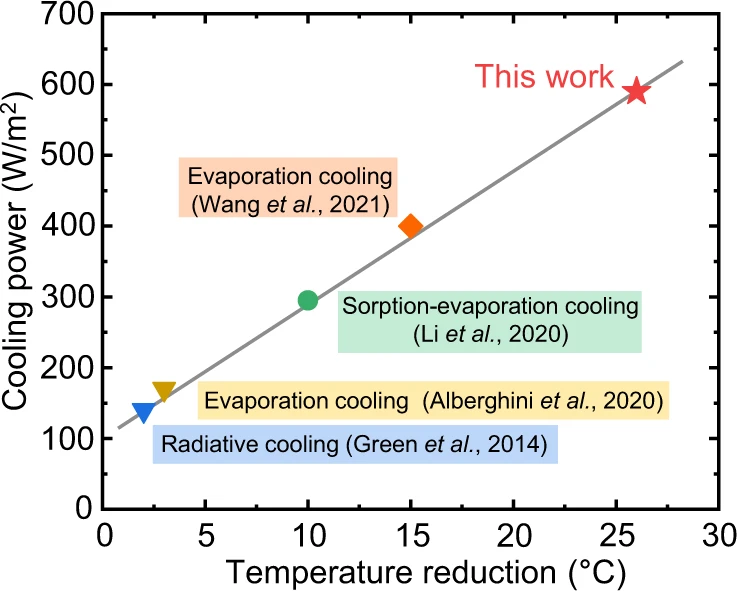
Most solar energy incident (>70%) upon commercial photovoltaic panels is dissipated as heat, increasing their operating temperature, and leading to significant deterioration in electrical performance. The solar utilization efficiency of commercial photovoltaic panels is typically below 25%. .... We demonstrate experimentally that bio-inspired transpiration can remove ~590 W/m2 of heat from a photovoltaic cell, reducing the cell temperature by ~26 °C under an irradiance of 1000 W/m2**, and resulting in a relatively 13.6% increase in electrical efficiency. Furthermore, the photovoltaic leaf is capable of synergistically utilizing the recovered heat to co-generate additional thermal energy and freshwater simultaneously within the same component, significantly elevating the overall solar utilization efficiency from 13.2% to over 74.5%, along with over 1.1 L/h/m2 of clean water.** At the latitude of Massachusetts, the solar radiation value at the Earth's surface is approximately 1000 W/m2 on a clear day at solar noon in the summer months.A biomimetic transpiration (BT) layer is attached to the back of a solar PV cell in order to remove the heat generated in the cell. Natural bamboo fiber bundles are employed to mimic the vascular bundles in transporting and distributing liquid water over the cell’s surface, while hydrogel cells with large specific surface area and excellent water absorption performance are used to mimic the sponge cells in providing effective evaporation.
The capital cost of the additional transpiration components (hydrogel, fiber bundle, supporting mesh and piping) of the PV-leaf relative to a conventional standalone PV panel is estimated to be ~1.1 $/square meter, based on available bulk prices, which is only ~2% of the price of a commercial PV panel (~55 $/square meter). The payback time of the additional components is thus less than half a year. Given current predictions for the global PV capacity to reach over 22 TW [terrawatts] by 2050, and assuming that 30% of the PV panels have access to water resources [primarily sea water?] as coolant, PV-leaf designs promise to generate an additional ~650 GW [1 TW = 1,000 GW] of power globally, which is close to the current global PV installed capacity.

Ooh, that's how they did this - they attach the fake leaf to the bottom
of existing solar cells to draw heat off by transpiration, which cools the solar
cell, and that increases electricity output from 13.2% to 14.5% (an impressive 9.8% increase)
Note in (c), the "root" in water - that's where the water
for transpiration and cooling of the solar cell comes from
(it can be sea water)
But here a major problem jumps right out. The salt.
Where does the salt in salt water go? It stays in the fake leaf hydrogel and accumulates each day as water passes from the root into the air as water vapor. The water vapor can be captured and used as freshwater. But at the end of each day, the hydrogel needs to be soaked in more salt water to release the accumulated salt from the previous day. Doing this near the sea could be feasible on a huge scale. Whether that's the case inland away from sea water isn't clear.
The paper explains that its claim of 74.5% total energy efficiency comes from a combination of the 9.8% increase in electricity, capture of heat and production of freshwater from salt water - see (c) in the figure below.